Everglades
RetributionThe Everglades is one of the principal landscapes of the Cupid murder investigation: a remote region where bodies are discovered in carefully chosen locations, evidence is difficult to find, and the distance from ordinary activity intensifies the investigators’ uncertainty. The narrative returns to the wetlands at different stages of the case, from a former military complex near Florida City to a fishing shack where Morgan Weber is found. The Everglades is not merely a backdrop. Its isolated sites shape the practical work of the investigation and make the killer’s selection and arrangement of locations part of the case.
Setting and Investigative Geography
The Cupid murders initially appear across Miami-Dade County in scattered, unpredictable locations. Among the places where victims’ bodies are found are an old sugar refinery in the Everglades, a foreclosed house in Liberty City, and an abandoned supermarket in Kendall. The range of sites makes a single geographic pattern difficult to discern. The bodies are not simply concealed: their discovery is part of the killer’s apparent design, and the settings become components of the crimes investigators must interpret.
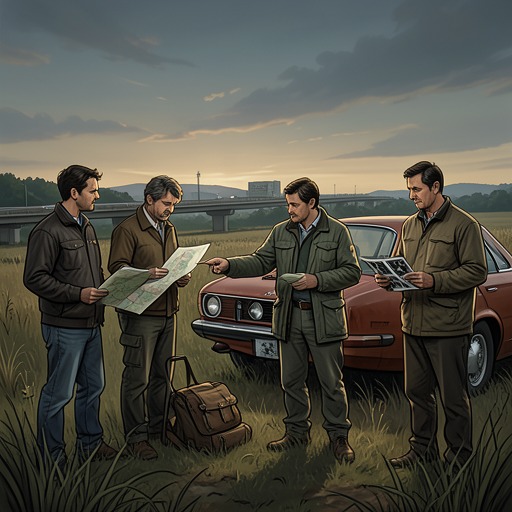
The region’s remoteness is particularly consequential. In the early investigation, a former military complex near Florida City sits well away from a main road and close to the Everglades. Chain-link fencing, warning signs, and a locked gate offer little practical security; the nearest gas station is more than five miles away. The distance from witnesses and routine traffic makes the site difficult to canvass for useful leads, while its isolation gives investigators little reason to expect that someone nearby saw what happened.
The Former Navy Complex
During SWAT training, officers with the Miami-Dade Police Department search an abandoned missile silo and warehouse belonging to the U.S. Navy, just west of Florida City. They notice a strong odor after opening the silo doors and investigate a makeshift enclosure inside. There they find Marilyn Siban, a nineteen-year-old who had disappeared about two months earlier. The discovery turns a training exercise into a major crime-scene investigation and makes the military complex another location on the expanding map of Cupid’s crimes.
The site provides investigators with a possible answer to where Marilyn was killed, but not an easy route to identifying her killer. The amount and distribution of blood at the scene lead the medical examiner to conclude that she was probably killed there. Yet the remoteness of the former complex, its position near the Everglades, and the lack of obvious witnesses leave the crime scene difficult to connect to a person. Investigators expect to spend five days processing the silo, warehouse, and surrounding area, but Dominick Falconetti doubts that the work will produce much physical evidence. Earlier crime scenes have yielded no prints, hair, semen, foreign DNA, or other trace material, and the searches around this site initially turn up no useful tracks, clothing, weapons, or cigarette butts.
Marilyn Siban and the Expanding Pattern
Marilyn’s case also shows how the Everglades setting intersects with the victims’ lives before discovery. She disappeared from Club Liquid on South Beach after going to a bar in the crowded nightclub. Her friends did not immediately report her missing because they believed she might have met someone and left with him; the report followed when she failed to appear at her waitressing job. The photograph used for identification had been taken for a used-car dealer in the Keys shortly before she vanished. The contrast between that ordinary record of her working life and the distant site where investigators later find her underscores how far the investigation must travel from the last known sighting to the final discovery.
As the cases accumulate, the Everglades is one part of a broader pattern rather than a location that explains the crimes by itself. Some victims appear to have been killed where they are found, while in other cases their bodies are transported and placed at a separate site. Investigators see deliberate choices in the locations, but cannot determine why particular sites are selected or what message the killer means to send. The geography supplies questions and investigative tasks, not a complete answer: even when a remote place yields a body, it may yield little that identifies who brought the victim there.
Morgan Weber and the Fishing Shack
Later, the Everglades becomes the setting for the discovery of Morgan Weber. A fisherman enters a shack in the wetlands and finds her remains suspended from the ceiling; the scene is secured by Miami-Dade officers and the Florida Marine Patrol. The discovery ends the hope that Morgan might still be alive. She is first tentatively identified through a driver’s license found beneath her, and the identification is later confirmed through dental records. The remains have been at the site long enough that investigators must rely on those records to establish who she is.
The fishing shack’s isolation again governs the response. C.J. Townsend accompanies Dominick and Manny Alvarez to the scene, then goes with them to the medical examiner’s office for the autopsy. She must also determine whether the shack stands on federal land in the Everglades or on property belonging to Miami-Dade County. The answer matters to the struggle over control of the investigation: after establishing that the site is county property, she uses a land survey and the possibility of trespassing and obstruction charges to make federal agents leave the crime scene. Thus the landscape is also a jurisdictional boundary, one that affects who may investigate and preserve the evidence.
The arrangement of Morgan’s body becomes an important connection between the remote site and evidence elsewhere. Investigators recognize the murder and staging as consistent with Cupid’s established pattern. More specifically, the way Morgan appears suspended in the shack recalls stuffed birds filmed by crime-scene technicians in William Rupert Bantling’s shed. The resemblance gives the location evidentiary significance: the staged scene may connect the latest killing to an object and practice associated with the suspect. In this way, the Everglades does not disclose the killer through geography alone; its carefully staged crime scene becomes meaningful when compared with evidence gathered beyond the wetlands.
Narrative Significance
Across the cases, the Everglades repeatedly brings together distance, discovery, and investigative uncertainty. Its remote sites allow the crimes to unfold outside the view of ordinary witnesses, while the bodies’ eventual discovery forces investigators into difficult searches and sometimes raises questions about jurisdiction. The region’s different settings—the old sugar refinery, the former military complex, and the fishing shack—do not form a simple route or a single explanation. Their significance accumulates through comparison: investigators look for recurring patterns in places that otherwise seem scattered and unrelated.
The narrative also places the Everglades between human systems rather than presenting it as an independent explanation for violence. Police agencies search it, medical examiners interpret what is found there, and prosecutors contest control when a scene may lie on federal land. The environment matters because its remoteness changes the conditions of detection, evidence gathering, and authority. As the investigation progresses, the Everglades remains both a place where victims are recovered and a challenge to the assumption that finding a crime scene means understanding how the crime happened or who committed it.