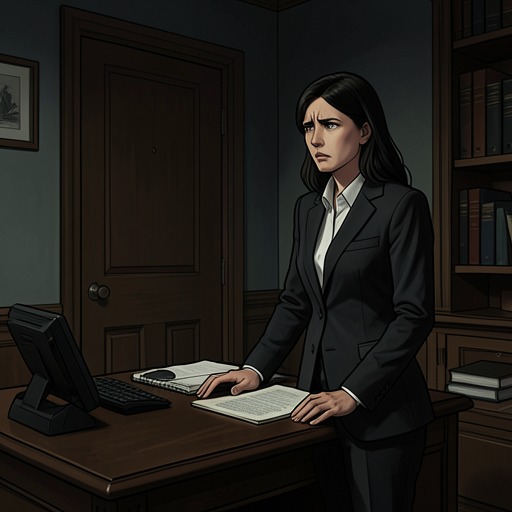
Miami-Dade County Courthouse
RetributionThe Miami-Dade County Courthouse is the principal courtroom setting for the prosecution of William Rupert Bantling, transforming a criminal case into a public spectacle and the place where C.J. Townsend recognizes Bantling as the man who assaulted her years earlier. Its courtrooms host the case’s first appearance, later hearings, and trial; its steps and corridors fill with reporters and cameras. The contrast between routine legal procedure and relentless publicity makes the courthouse both a working institution and a stage on which private trauma, prosecutorial responsibility, and public attention collide.
Setting and Public Attention
By the time Bantling is arrested in connection with the Cupid murders, reporters have gathered outside the criminal courthouse across the street from C.J.’s office. Television networks and newspapers send correspondents, and crews establish media positions with satellite feeds linking the courthouse to affiliates elsewhere. The arrest has become national and international news before the court has determined the case against him.
The building’s public approaches become part of the story’s press environment. C.J. anticipates the reporters outside her office and on the courthouse steps, so she takes the back stairs, enters through a side entrance, and reaches the courthouse by way of its underground garage. Her route is a small act of avoidance, not a way to escape the case’s exposure: once upstairs, she encounters cameramen and reporters waiting in the hallway outside Courtroom 4-1. The movement from concealed entrance to crowded corridor captures how little separation the courthouse can provide between official work and public spectacle.
The scale of the attention also changes how an otherwise routine hearing is conducted. Bantling is brought over from the jail at a special time for a hearing in a courtroom set aside for him, rather than appearing through the ordinary, rapid process. The hearing is expected to be seen by millions through live broadcasts and later news programs. A proceeding that would commonly consist of a judge reading charges and deciding probable cause therefore becomes a nationally watched event, with the courthouse serving as its broadcast setting.
Courtrooms and Legal Proceedings
Courtroom 4-1 is chosen by Judge Irving J. Katz for Bantling’s first appearance. Its imposing design heightens the formality of the occasion: walnut paneling, a high ceiling, a raised bench, and metal dome chandeliers frame a room filled with spectators and cameras. Uniformed officers and corrections officers guard the entrances, including the passage used to bring prisoners from the jail across the street. The room’s arrangement makes both the legal process and the defendant’s arrival visible to the assembled press.
The hearing initially follows the expected procedural course. The judge reads the arrest form and addresses the charge arising from Anna Prado’s death. But when Bantling rises and protests his innocence, C.J. sees a jagged scar on his arm and recognizes his voice. The recognition takes place in open court, in front of the judge, lawyers, officers, reporters, and cameras. The courthouse is thus not merely where the state begins its case: it is where C.J.’s professional role as prosecutor abruptly intersects with her previously undisclosed experience as a victim.
Later proceedings take place in other courtrooms. C.J. approaches Courtroom 4-8 for the Arthur hearing with visible composure masking her fear of facing Bantling again. The judge calls the case first because of the press presence, intending to clear the courtroom before taking up the rest of the calendar. The decision makes the courthouse’s ordinary scheduling practices bend around the case’s exceptional publicity, while bringing C.J. into the same room as the man she has identified as her attacker.
The courthouse also anchors the formal escalation of the prosecution. After the grand jury indicts Bantling for Anna Prado’s murder, news spreads quickly, and the courthouse steps become the site of an improvised press briefing. The indictment is a legal development, but its immediate public presentation is mediated by reporters and broadcast coverage. Later, during the trial, the courtroom becomes the setting for competing accounts of guilt and the burden of proof. Lourdes Rubio addresses the jury on behalf of Bantling, while C.J. presents the state’s case before a crowded room.
Public Spectacle and Private Disclosure
The courthouse crowd is not limited to the first appearance. At later hearings and trial proceedings, journalists, camera crews, prosecutors, investigators, and spectators share the space with the parties to the case. The trial courtroom is packed, and C.J. sees Bantling seated beside Lourdes Rubio as she approaches the prosecution table. The gathering makes the case’s public importance impossible to ignore, but it also subjects participants to observation at moments when they might otherwise have expected a more private encounter.
That tension becomes explicit when Bantling raises C.J.’s past during the trial. In court, she tells the judge that she was raped years earlier while she was a law student in New York, then states that Bantling is not the man who attacked her. The disclosure provokes an audible reaction across the courtroom and is immediately framed as live news. The scene exposes how a courthouse can make private history consequential to public proceedings: what C.J. says bears on the court’s assessment of the case, yet it is also consumed as spectacle by the room and the watching audience.
Narrative Significance
Across the proceedings, the courthouse links legal process to public performance without making them identical. Judges must address charges and motions; prosecutors and defense counsel must argue within procedural rules. At the same time, the press turns hearings, an indictment, and testimony into recurring news events. The building’s rooms and thresholds give that contrast a concrete form, from the guarded prisoner passage to the crowded courtroom and the reporters waiting outside.
For C.J., the courthouse is also the setting where professional duty repeatedly meets personal consequence. She arrives to prosecute Bantling, recognizes him in Courtroom 4-1, prepares to face him at a later hearing, and ultimately has her own history brought into the trial. The place does not resolve the conflict between those roles; it holds them in public view. In that way, the Miami-Dade County Courthouse is central not only to the case’s legal chronology but also to the novel’s portrayal of justice conducted under the pressure of exposure.