Carlo dell’Aqua
ShōgunCarlo dell’Aqua’s authority rests on a difficult union of religious office and commercial power. As Father-Visitor of Asia and personal representative of the General of the Jesuits, he is the Society’s most senior figure in the region. His decisions make plain that, in Japan, the security of the Church cannot be separated from trade, diplomacy, and the changing balance of power among Japanese lords.
Identity and authority
Dell’Aqua is introduced as a commanding presence: six feet three inches tall, broad-built, white-haired, and sixty-one years old. He wears an orange robe and an elaborate cross, and his Neapolitan background is audible in the fluent, musical Portuguese with which he addresses Father Alvito. His stature is more than physical. As the highest-ranking Jesuit in Asia, he can direct the Society’s response to political danger and threaten its most powerful secular ally with ecclesiastical discipline.
That authority operates within an institution whose influence depends on conditions in Japan. Portuguese traders carry Chinese silks from Macao, while Jesuit priests—among the few able to speak both Chinese and Japanese—serve as negotiators and interpreters. The trade has grown to touch the lives of samurai, making the priests and their religion difficult for Japanese rulers to exclude without risking the commercial relationship. Dell’Aqua’s office therefore places him at the center of a network in which spiritual standing, access to rulers, and the movement of valuable goods continually reinforce one another.
The Church, trade, and political leverage
Dell’Aqua does not pretend that the Church’s interests are insulated from commerce. When Ferriera asserts his authority as Captain-General of the Black Ship and Governor of Macao, claiming vice-regal powers and the right to eliminate John Blackthorne or Toranaga, Dell’Aqua orders him not to proceed. Ferriera calls the matter temporal rather than spiritual. Dell’Aqua answers that the Church’s position is so entangled with politics and the silk trade that an attack on either can endanger the Church itself; he threatens Ferriera with immediate excommunication if he defies the order.
The confrontation exposes the limits of both men’s claims. Ferriera can invoke the king’s authority and control of the Black Ship, but Dell’Aqua can put his standing in the Society and the safety of its mission at risk. His intervention is not a rejection of political calculation. It is an assertion that the Captain-General cannot make a unilateral decision whose consequences might undermine the Church’s place in Japan.
The urgency is concrete: Ferriera says the Macao venture has already committed a million ducats to silk and expects to carry at least a hundred thousand ounces of Chinese gold. Dell’Aqua responds pointedly that the Jesuits understand the venture’s importance. He recognizes that the success of the voyage and the security of the Society are bound together, even when those shared interests bring him into conflict with the man commanding the ship.
Blackthorne as threat and possible convert
Dell’Aqua treats Blackthorne as both a danger to Jesuit influence and a possible object of religious conversion. He identifies four available courses: leave the English pilot unprotected, protect him, help Toranaga remove him, or convert him. Each carries a different political consequence. If the Jesuits do nothing, Blackthorne may be killed and Toranaga may blame them. If they protect him, Dell’Aqua believes, Blackthorne may soon bring about his own death. Helping Toranaga eliminate him could remove a threat, but conversion offers what Dell’Aqua regards as the best outcome for both the Church and the pilot’s soul.
His interest in conversion is practical as well as doctrinal. He judges Blackthorne intelligent and knowledgeable about Catholicism, and reasons that the Englishman’s religious allegiance may be susceptible to the beliefs of his monarch. Dell’Aqua thus considers whether an enemy of the Society might be turned into a Christian ally rather than simply destroyed. The possibility does not displace his concern about the political damage Blackthorne could cause; it is one option in a strategy designed to contain that damage.
The discovery of Blackthorne’s rutters gives Dell’Aqua another means of shaping Toranaga’s judgment. He directs Alvito to deliver them and explain that they arrived through Rodrigues, remained unopened for two days, and had been forgotten amid the attention given to Blackthorne. The account traces their passage from Mura to Father Sebastio and then to the Jesuits. Dell’Aqua says the documents establish Blackthorne as a pirate, thief, and traitor, and expects their contents to help dispose of him. At the same time, the explanation is arranged to clear Mura and Father Sebastio of suspicion and to show Toranaga that the Jesuits have favored his interests over Yabu’s. The rutters are evidence, but their political force depends on who presents them and how their transfer is explained.
Negotiating with Toranaga
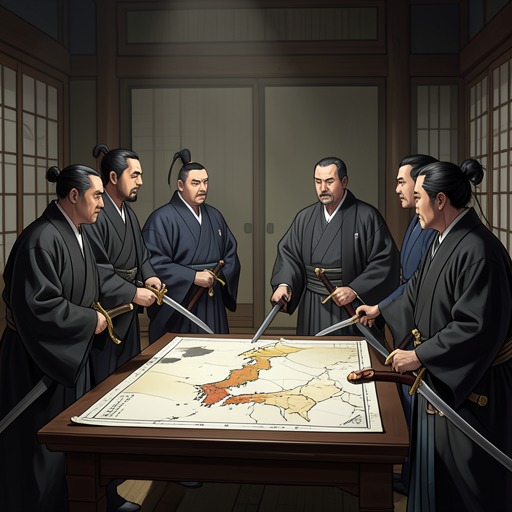
Dell’Aqua’s response to Toranaga combines disclosure, delay, and commercial inducement. He proposes that the Jesuits give Toranaga the maps he wants and explain the European spheres of influence as boundaries intended to separate Portuguese and Spanish interests. On other questions, he would offer further information after checking the facts in Macao, asking Toranaga for a reasonable delay. In the same communication, however, Alvito is to announce that the Black Ship will sail three weeks early with its largest cargo of silks and gold yet, and that at least thirty percent of the cargo will be sold through a broker chosen by Toranaga.
These terms convert trade into diplomatic leverage. Dell’Aqua expects the Captain-General to accept the early departure once Toranaga grants Ferriera immediate sailing clearance; he dismisses the broker’s identity as a minor matter so long as Ferriera retains his percentage. His plan preserves the voyage while giving Toranaga a substantial place in the transaction. It also shows that the Jesuit strategy is not simply to submit to whichever Japanese ruler holds power, but to bargain for the Society’s continued access and influence.
A later proposal makes that bargaining still more explicit. Dell’Aqua has arranged matters concerning a cathedral, while Alvito offers Ferriera a profitable transaction on Toranaga’s behalf: carrying ten thousand ducats of gold to Goa for investment in the Indian gold market through the Jesuits’ usual contacts, with half the profit going to Ferriera. The Jesuit leaders calculate that, by the Black Ship’s return six months later, Toranaga may either have regained the presidency of the Regents or be dead. The proposed investment is therefore structured around political uncertainty: it may reward Ferriera if Toranaga returns to power, while the Jesuits secure a potentially useful commercial arrangement in the meantime.
Character and narrative significance
Dell’Aqua’s defining method is to treat apparently separate domains as parts of one negotiation. Excommunication becomes a check on a Captain-General; the Black Ship’s schedule becomes an inducement for Toranaga; a set of sailing directions becomes both evidence against Blackthorne and a means of reassuring a Japanese lord; and the prospect of conversion turns a dangerous foreign pilot into a possible religious gain. His spiritual commitments are real within the choices presented, but they operate through political and commercial calculation rather than apart from it.
Through Dell’Aqua, the novel shows why the Jesuits matter to Japanese rulers and why their influence remains vulnerable. They possess linguistic and commercial connections that Japanese leaders need, yet their trade depends on permission, their mission is exposed to political conflict, and their representatives must bargain with people whose aims may diverge sharply from the Church’s. Dell’Aqua’s authority is formidable, but it is exercised in a world where a ship’s departure, a ruler’s favor, or a threat of excommunication can alter the safety of the entire enterprise.