Ferriera, captain of the Black Ship
ShōgunFerriera, captain of the Black Ship, is the commander of the year’s most consequential Portuguese trading venture and a forceful advocate of his own authority. His decisions are shaped by the ship’s enormous commercial stakes, his hostility toward Blackthorne, and his conviction that military power gives him the right to act even when churchmen object. He appears not merely as a guardian of Portuguese interests but as a figure in whom commerce, religious enmity, and personal ambition reinforce one another.
Identity and Position
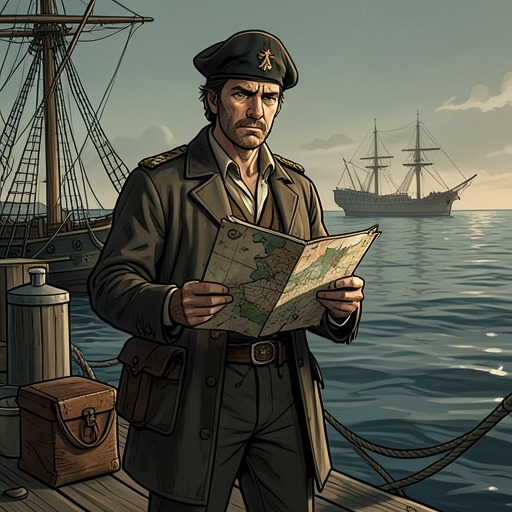
Ferriera is described as a Portuguese nobleman and Captain-General of the Black Ship for that year. In his middle thirties, he is lean and slight, but the scene presents him as formidable and self-possessed. His manner conveys the status he believes his office grants him: he speaks as a commander accustomed to making decisions, not as an agent awaiting permission from the priests who accompany the enterprise.
His position joins military command to commercial responsibility. As Captain-General, he claims vice-regal powers over the waters and asserts that he can choose to eliminate Blackthorne, Toranaga, or anyone else he regards as an enemy. That assertion is more than bluster about rank: it shows how readily he turns an institutional office into personal license. At the same time, the command depends on a trading venture whose schedule and success he regards as essential.
The Black Ship and Commercial Stakes
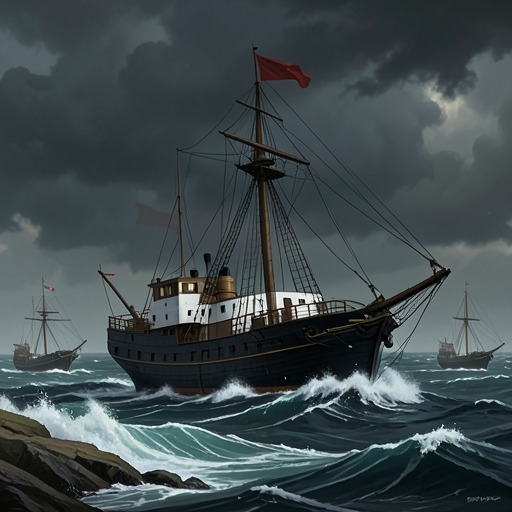
Ferriera insists that he must return to Macao immediately to prepare the Black Ship. The cargo already purchased at the February Canton Fair includes silks valued at a million ducats, and he expects the ship to carry at least a hundred thousand ounces of Chinese gold. He emphasizes that the venture has absorbed the available cash in Macao, Malacca, and Goa, as well as money borrowed by Macao’s merchants and civic leaders—and that his own funds are invested too.
These figures explain the urgency behind his repeated insistence that the ship sail on time. His intended route is from Macao to Nagasaki, then south with the November monsoon toward Goa and, eventually, home. He imagines the return voyage as the richest treasure ship in history, making delay or danger a threat not only to a timetable but to a vast concentration of capital. His vow to keep the voyage on course, even at terrible cost, exposes the extremity of his priorities: the success of the venture takes precedence over the safety of the places and people caught in its path.
Hostility Toward Blackthorne
Ferriera’s opposition to Blackthorne is both political and religious. He regards the Englishman as an enemy of his king and describes him as a pirate and heretic. He is particularly angry that Rodrigues did not cause an accident during the storm, and he interprets Rodrigues’s gratitude to Blackthorne for saving his life as evidence that the Englishman has gained his confidence by deceit. He also suspects that a separate attempt against Blackthorne was ordered by a Japanese leader; although he does not know who arranged it, he is angered that it failed.
Ferriera therefore sees Blackthorne’s removal as a task he can arrange, rather than as a question to be settled by the church or by Japanese authorities. Alessandro dell’Aqua tells him that neither Blackthorne nor Toranaga must be interfered with. Ferriera’s response elsewhere makes clear how sharply this instruction conflicts with his own view of command: he insists that the decision to eliminate an enemy belongs to him. The clash reveals a struggle over who may direct Portuguese action, not simply a personal quarrel between two men.
Threats and Contested Command
When Toranaga’s vessel is within range, Ferriera announces that he intends to blow it out of the water. He presents the choice as a military decision, arguing that the Portuguese are caught up in a Japanese conflict and that his ship is in danger. He asks the chief gunner whether the target is in range, turning his threat into an operational question rather than leaving it at the level of rhetoric.
The priests oppose an attack, but Ferriera rejects their restraint. He orders the crew to prepare to repel an attack and says that if the approaching vessel comes within fifty yards without invitation, it is to be fired upon regardless of what the priests say. The episode gives concrete form to the earlier dispute with Alessandro dell’Aqua: Ferriera treats immediate command and perceived danger as grounds to override ecclesiastical objections. The evidence establishes his order and the confrontation over it, not the completion or result of the threatened firing.
Bargaining and Ambition
Ferriera’s conduct is not governed by military urgency alone. When asked to help in the Church’s name, he agrees to help get a man out of a trap, but makes his assistance conditional on receiving the Captain-Generalship of the following year’s Black Ship, whether or not the current voyage succeeds. He presents the demand with outward gravity, while the arrangement itself turns a religious appeal into an opportunity to secure his future position.
He then adds a final condition: he wants the heretic. In light of his earlier fixation on Blackthorne, this demand connects his bargaining to his campaign against the English pilot. The episode sharpens the contradictions that define him. He is willing to cooperate when the price serves his ambition, but he does not relinquish his hostility or his conviction that Blackthorne should be removed. Ferriera’s narrative role lies in making those interests collide in public: the Black Ship’s commercial timetable, military authority, the priests’ limits on violence, and the fate of a rival all become parts of the same contest.