Johann Vinck
ShōgunJohann Vinck is the Erasmus’s oldest sailor, a veteran chief gunner and boatswain’s mate whose blunt humor and practical courage bind him to John Blackthorne across years at sea. His story moves from shared danger and hard-won reunion to a final, irreparable rupture: when the ship is lost and the prospect of going home seems to vanish, the old sailor turns his anger on the pilot he once trusted, then dies on the shore. Blackthorne’s burial of Vinck gives that loss a human scale amid the wreckage of a voyage that has consumed nearly everyone around them.
Identity and Background
At forty-three, Vinck is the oldest man aboard. He is hairless and toothless, with a complexion compared to aged oak, yet remains physically strong. His age is part of the crew’s rough banter: Blackthorne, at thirty-six, tells him that most men his age are already dead, and Vinck replies by crediting his brandy, sexual exploits, and saintly life. The exchange captures his comic self-presentation without making him merely a joke; he has survived enough to know how easily a sailor’s boasts can meet the sea’s answer.
Vinck and Blackthorne share a history predating the voyage to Japan. Six years earlier, they sailed together on the ill-fated search for the Northeast Passage, and each knows the other’s character and competence. That accumulated familiarity gives Vinck a standing among the men different from that of a new shipmate: he can tease the pilot without ceremony, challenge him directly, and later rally the crew around him. His loyalty is grounded in a working relationship tested on earlier voyages, not in easy agreement.
Seaman and Survivor
Vinck’s place aboard the Erasmus is practical as well as social. As chief gunner and boatswain’s mate, he belongs to the ship’s experienced working leadership, while Blackthorne’s authority as pilot rests on his command of navigation and the vessel’s course. The voyage unfolds in a world where charts can be dangerously vague and longitude cannot be fixed; a pilot’s knowledge is essential, but the ship’s survival also depends on the expertise of men who can maintain its guns, rigging, and hull. Vinck represents that laboring seamanship: alert to the condition of the vessel, accustomed to hardship, and ready to act when danger becomes immediate.
That readiness is clearest during the crew’s struggle against armed samurai at the ladder out of the pit. Vinck has been in a cataleptic state, but when a samurai’s downward strike threatens to cut Blackthorne’s wrist, Vinck throws himself into the fight. He holds the sword arm at bay, strikes at the attacker, and climbs toward the weapon, continuing even after a kick catches him in the face. The confined ladder leaves the sailors at a severe disadvantage against swords, and the crew’s rush to help does not turn the encounter into a victory. Vinck’s intervention nevertheless changes the immediate stakes: he takes the danger onto himself to protect Blackthorne, acting with a ferocity that makes his earlier helplessness seem only a pause.
His reactions to life ashore reveal another side of the same practical man. He judges Japan partly by what a sailor can eat and drink, complaining that the crew needs meat, bread, beer, and brandy, while also telling Blackthorne that the place has offered him pleasures he did not expect. The contrast between his enjoyment and his grievances is characteristic: Vinck adapts readily to immediate experience, but measures comfort in bodily terms and does not conceal his appetite. His crude humor can make him sound careless; his conduct in the pit shows that, at the moment of danger, he is anything but detached from his companions.
The Ship, the Crew, and Blackthorne
When Blackthorne eventually finds his men again, Vinck helps turn the reunion into a welcome rather than an interrogation. The sailors crowd around their returned pilot, astonished that he is alive and convinced at first that he might be a samurai. Vinck takes command of the commotion, insisting that the men give Blackthorne room, a chair, and a drink. His intervention restores a familiar shipboard order inside a rough room ashore: Blackthorne is again treated as their pilot, and Vinck is again one of the voices able to organize the crew.
The reunion also reveals how much work has been done in Blackthorne’s absence. Vinck explains that a Japanese samurai who spoke Portuguese had been assigned to the sailors, enabling them to communicate. When asked about the ship, Vinck said it needed to be careened, scraped, and repaired; Japanese workers then cleaned the bilges and undertook the repairs. He reports the result with a shipwright’s attention to detail: the rigging is in good order, the cannon have been returned aboard, and the sailors have powder and shot. The Japanese have copied the original sails in tough silk and made a spare set. Vinck is impressed, though he notes that the vessel has not yet been tested at sea and that a gale will be the true trial. His account shows both his guarded confidence in the repair and his continuing measure of events by whether the ship can sail.
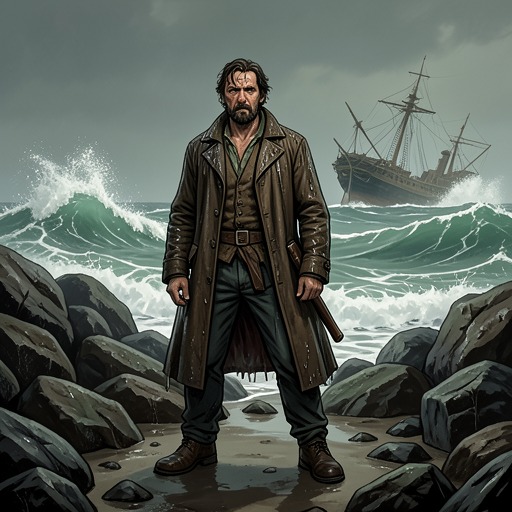
The ship is more than a workplace for Vinck; it embodies the crew’s remaining means of movement and the possibility of return. This is why his later anger is so consequential. When Blackthorne stands before the wreck, Vinck insists that the Japanese tried to beach the vessel, while Blackthorne says the tide carried it there. The disagreement becomes an argument over responsibility as well as over what happened. To Vinck, the wreck makes Blackthorne’s earlier decisions newly visible as choices with a terrible cost; to Blackthorne, the sea has taken the ship beyond anyone’s control. Their familiar exchange has become a confrontation neither man can repair.
Death and Narrative Significance
After the Erasmus is destroyed, Vinck accuses Blackthorne of bringing the men to Japan and making him responsible for the deaths along the way. Blackthorne accepts the accusation instead of defending himself. Vinck presses the practical question that now has no answer: how will they get home, and how long must they wait in a country he expects to be consumed by war? His fear shifts from complaint to panic. He imagines the sailors being beheaded, draws a pistol from his ragged shirt, and waves it at Blackthorne while laughing uncontrollably. Blackthorne does not try to disarm him; he waits, hoping for the bullet rather than resisting. Vinck runs down the beach, collapses, and dies with the pistol still leveled at Blackthorne.
The death is not presented as a battle or a deliberate execution. It follows the wreck and the collapse of Vinck’s confidence in a return voyage, ending in a burst of terror and disordered laughter. Blackthorne closes Vinck’s eyes, carries him back, and buries him above the waterline on a rise overlooking the wreck. He makes a cross from two pieces of driftwood and says a service. The familiar words come easily because he has said them so often: on this voyage alone, he has performed services for more than a hundred of his own crew.
Vinck’s grave gathers the losses of the expedition into one stark image: a sailor buried above the surf, a makeshift cross, and the charred skeleton of the ship below. Blackthorne recalls that the expedition began with five ships and 496 men, and that only seven remain. The changing count places Vinck’s death among a broader attrition, but his final confrontation makes it intimate. He was one of the men who knew Blackthorne from an earlier failed search, one who fought to protect him in the pit, and the voice that helped the crew welcome him home. His death marks not only the loss of a veteran sailor but the point at which shared loyalty can no longer overcome the wrecked ship, accumulated deaths, and uncertain future.