Sebastio
ShōgunSebastio is a young Jesuit missionary in Japan whose encounter with John Blackthorne turns a shipwreck into a clash over religion, trade, and who has the right to speak for the stranded foreigners. Sent to Anjiro after news of the ship reaches his mission, he recognizes the vessel as Dutch and Blackthorne as English, but his response is shaped by a hostility that compromises his role as interpreter before Yabu.
Identity and Position
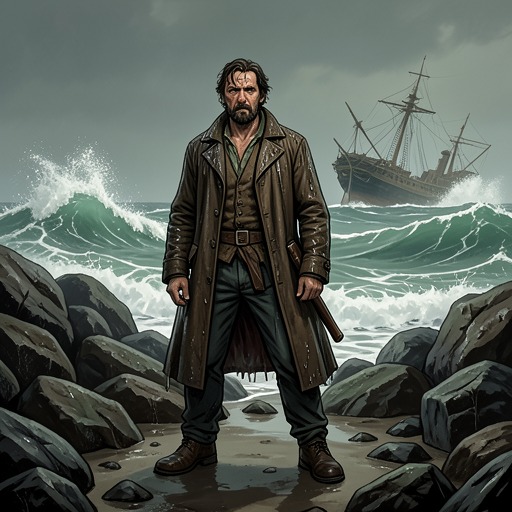
Sebastio is a Portuguese priest, still unordained and barely two years into his time in Japan. He is in his middle twenties, thickset and dark, with a long beard. When he approaches Blackthorne, his travel-stained orange robe, muddy European boots, rosary, and crucifix mark both his religious office and his European identity. He is accompanied by ten Japanese men, none armed; the group’s shock at the foreign ship and its crew underscores how extraordinary their arrival appears to the people of Anjiro.
His position is at once influential and precarious. In the confrontation before Yabu, he is the only available interpreter, and therefore controls what the English pilot can understand of the proceedings. Yet Sebastio is also a young missionary without the experience or authority he believes the emergency requires. He has sent an urgent carrier-pigeon message to his superior in Osaka, wishing he could consult him before acting.
Arrival and Confrontation with Blackthorne
Sebastio comes to Anjiro after a messenger from Mura reports the ship. He hopes the news is false: he believes no heretic vessel has entered the Pacific apart from those associated with Francis Drake, and considers the routes to Asia secret and guarded. The ship is indeed Dutch, and its pilot English. Sebastio’s immediate response is to label Blackthorne a heretic and pirate, while Blackthorne insists that the crew are peaceful merchants and that he is the ship’s pilot.
The dispute becomes an official interrogation when Yabu asks who Blackthorne is, where he came from, how he reached Japan, and what piracy he has committed. Blackthorne rejects Sebastio’s authority and demands to address Yabu directly. He insults the priest and deliberately bows to the daimyo, attempting to discredit the man who controls the translation. Sebastio flushes; for the first time, he finds that his training has not made him impervious to insult. He recognizes that Blackthorne has unsettled him in front of Yabu, and his composure gives way to uncertainty.
Prejudice and Narrative Significance
Sebastio’s judgment is driven by his loathing of Protestantism. He regards the heresies associated with Luther, Calvin, Henry VIII, and Elizabeth I as satanic, and that animus overwhelms his assessment of the ship and its crew. His conviction that Blackthorne is a pirate is not presented as a neutral finding: it precedes the interrogation and colors the way he interprets the evidence. The young priest’s religious certainty thus becomes a practical weakness in a situation where he is responsible for conveying another person’s words accurately.
The encounter also exposes the limits of Sebastio’s power. As interpreter, he occupies the crucial space between Blackthorne and Yabu, but Blackthorne’s direct challenge makes that mediation visible and contests it before the daimyo. Yabu’s instruction that Sebastio translate the insult restores the priest to his assigned function without erasing the loss of composure. In this first meeting, Sebastio represents the Portuguese Jesuit presence in Japan, while his fear, inexperience, and prejudice make clear that religious authority does not guarantee either command of the encounter or control over how its participants are understood.