Toda Buntaro
ShōgunToda Buntaro is a senior warrior in Toranaga’s service, an accomplished archer, and the husband of Toda Mariko. Feared for his sudden rages and valued as a commander, he is also defined by a marriage in which loyalty and tenderness have been overtaken by injury, resentment, and the demands of duty. His conduct toward Mariko makes him both a source of danger and a figure of painful contradiction: he insists that he cannot lose her, yet repeatedly treats her as someone whose life and choices belong to him.
Identity and Background
Buntaro’s military standing is visible in the weapons he carries and the authority he exercises. When he visits Lady Fujiko, he arrives with a large bow and a quiver, having ridden through the gate with his men before dismissing most of them. Lady Fujiko and her maid welcome him warmly in manner while privately hating him; his reputation for uncontrollable anger is such that he may lash out without warning or pick a quarrel with almost anyone. His household’s servants and women are frequent victims of these rages. The contrast between formal welcome and concealed fear establishes the difference between the public discipline expected around a warrior and the private violence that his rank can shelter.
His family history places him within Toranaga’s military establishment. Buntaro’s father is Lord Hiro-matsu, and Buntaro is described as having a son of his own. Mariko’s recollection of a conversation from sixteen years earlier supplies a separate, important part of her history: her brother had confided that their revered father intended to avenge himself on his liege, Dictator Goroda, by assassinating him. That memory belongs to Mariko’s family past, not to Buntaro’s, but it illuminates the inherited political danger surrounding her life and the history of the assassination that later shapes her marriage.
Marriage to Mariko
Buntaro remembers the beginning of the marriage as a blessing. He says he wanted Mariko from the first moment he saw her, and recalls that other daimyos desired her as well. After the assassination, he sent her away, ostensibly to protect her, while pretending that he was disgusted with her. Years later, when The Taikō ordered her return, Buntaro expected her to feel grateful. He acknowledges that he took her as a husband might without considering what she wanted from him, including the poems and flowers she valued. In his account, she remained faithful but had become emotionally cold, repeatedly asking for death or asking him to kill her.
His confession is not a simple declaration of love. Buntaro says Mariko has made him detest other women, but he also calls her tainted and resents what he believes she has done to their son. He cannot bring himself to kill her or to let her kill herself, yet cannot rid himself of her. The contradiction is central to his bond with Mariko: attachment does not restrain his urge to control her, and the language of protection coexists with possessiveness and violence.
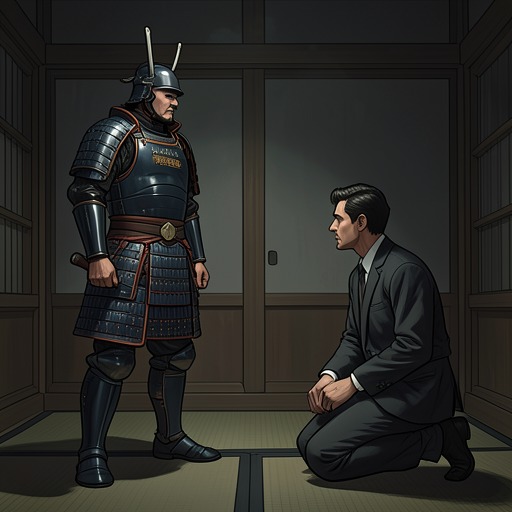
That violence becomes terrifyingly physical when Buntaro sits with his bow and shoots a succession of arrows past Mariko’s face. One touches a strand of her hair before passing through the paper wall; the next arrows also come within inches of striking her. Mariko remains kneeling, calm and motionless. The scene makes her composure visible without mistaking it for safety: Buntaro’s skill turns a domestic confrontation into a demonstration of how completely he can endanger her while retaining control of the encounter.
After Toranaga hears Buntaro’s distressed account of the marriage, he dismisses him and orders him to stay entirely away from Mariko while he considers what should be done. Toranaga sends his own doctor to examine her; the report finds bruising but no internal injury. The medical examination records the physical consequences of the household conflict, while Toranaga’s intervention temporarily places limits on Buntaro’s access to his wife.
Military Service and Political Position
Buntaro’s value to Toranaga is not confined to his reputation as a fighter. Toranaga assigns him command of the Attack Regiment, which is to embark on galleys for Yedo within five days, with Kasigi Omi as second-in-command. In the same set of orders, Toranaga directs Yabu to mobilize Izu and send six thousand men to the frontier passes, anticipating that Ikawa Jikkyu may move south and cut the lines of communication. Buntaro’s appointment places him at the head of an active military operation as the larger conflict threatens to widen.
He also proposes a defensive force for a threatened position: five hundred archers, no musketeers, and horsemen, in addition to troops sent by his father. His proposal reflects the confidence of a commander who expects to make the place secure through a force suited to the task. At Yokosé, he demonstrates the same practical attention to security. Having intercepted Zataki the previous evening, he welcomes him with formal courtesy and arranges for him to camp north of the village until the meeting place is ready. He identifies armed positions on the surrounding heights, secures the eastern retreat, places sentries at the bridge, and leaves a hundred men as an honor guard at Zataki’s camp. The hospitality is therefore also a controlled military arrangement: the guest is received ceremonially, but the approaches and possible movements are watched.
Toranaga later orders Buntaro to hand his duties over to Naga, explicitly creating an opportunity for him to make peace with Mariko. The order shows how closely the marriage has become entangled with military service: a change in command is required to make room for a private attempt at reconciliation. Buntaro’s usefulness to Toranaga gives him authority, but it also makes his domestic conduct a matter his lord must manage.
Reconciliation, Jealousy, and Threats
Buntaro’s tea ceremony with Mariko offers a brief alternative to the violence between them. In a quiet house, he opens a small T’ang tea caddy, measures the green powder with a bamboo spoon, heats water in an old iron kettle, and prepares the tea with precise, tranquil movements. Mariko tells him that he has performed the ceremony perfectly, then weeps. Her tear wounds him, but the delicacy of the ritual does not resolve what lies between them. The scene lets care and grief occupy the same space without turning a moment of grace into lasting reconciliation.
Buntaro’s attention soon shifts to the knife and a sprig of wild thyme. He says that if Toranaga loses, either before or after Buntaro’s own death, he or one of his men will kill Anjin-san. His jealousy of Mariko’s connection to Anjin-san is thus expressed not as a private grievance alone but as a threat backed by household retainers and military authority. Elsewhere, he asks Toranaga for permission to take Anjin-san’s head. Toranaga assigns Mariko to prepare for a journey to Osaka and orders Buntaro to accompany him as commander of his escort; after Buntaro has acted as Toranaga’s second, Toranaga permits him or one of his men to do the same to Anjin-san, with or without Anjin-san’s approval. The permission makes the threat part of a hierarchy of service, rather than an independent act of vengeance.
Buntaro’s resentment also erupts in an accusation that Mariko has shamed him before their lord and failed in her duty. He calls her afraid and cowardly, and uses a slur about Anjin-san’s foreign diet to attack him. The insults reveal how Buntaro interprets marital conflict through public honor and obedience: Mariko’s refusal is, to him, not simply a personal choice but an affront to his standing as husband and retainer.
Duty, Suspicion, and Narrative Role
Buntaro’s conception of loyalty reaches its bleakest form when he considers Toranaga’s possible defeat. He believes he will accompany his lord on his final journey and share the fate of his entire family. He cannot forgive Ishido, but his commitment to Toranaga also leads him to plan for the deaths of Mariko and their son before his own suicide. He postpones that imagined act until his duty is done and Toranaga has entered the Void safely and honorably. In this private calculation, service and family love have become inseparable from killing: he imagines preserving honor by deciding the deaths of those closest to him.
The political landscape around Buntaro further complicates his position. A coded report relayed through Kasigi Mizuno says that Buntaro came secretly to Mishima by way of Takato and spent three days there. During the visit he saw Zataki twice and Zataki’s mother three times. The report provides no explanation for those meetings, so their purpose remains unstated; their secrecy nevertheless makes Buntaro part of a web of movements that other characters track and interpret. The same message reports that he later challenged and killed a samurai without apparent purpose while brooding and cursing Anjin-san’s name. His private jealousy and public violence continue to surface even as military and political decisions press around him.
Buntaro is therefore more than a violent husband or a capable archer. His precise tea-making and his readiness to command troops belong to the same disciplined warrior, just as his professed wish to protect Mariko belongs to the same man who shoots arrows beside her face and contemplates killing her. The tension between service and possession gives his character its force: he treats obedience to a lord as the organizing principle of life, yet cannot make that principle produce mercy within his own household. His later presence in reports from Mishima, and the subsequent inquiry into whether he is well, leave his personal fate unresolved while keeping his strained marriage and loyalties active within the unfolding conflict.