Toda Hiro-matsu, Toranaga’s trusted general
ShōgunToda Hiro-matsu, Toranaga’s trusted general, embodies the personal loyalty on which Toranaga’s military power rests. A veteran commander with authority over two provinces, he carries his readiness to protect his lord into every encounter: it shapes the way he enters Anjiro, confronts Yabu, and weighs the dangers of the sea. Yet his devotion is not mere force. His blunt reliability and his measured recognition of Blackthorne’s seamanship make him a practical judge of both men and risks.
Identity and Service
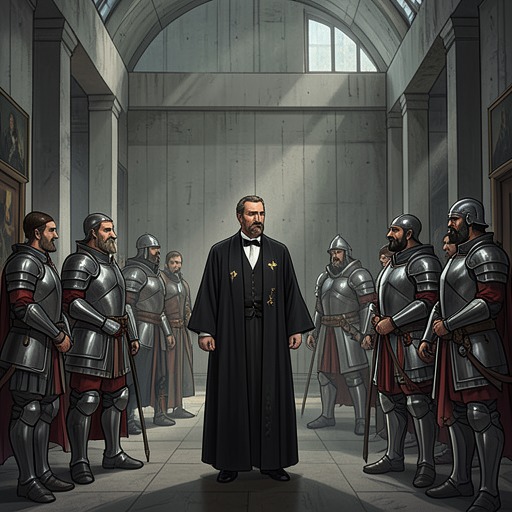
Hiro-matsu is sixty-seven, unusually tall for a Japanese man and powerfully built, with heavy jowls that mark a body still strong after a long military life. He lands alone from a galley bearing Toranaga’s crest, dressed in brown silk military clothing marked with five small crests. His armor is equally functional: a burnished breastplate and steel arm protectors, a short sword at his belt, and the longer killing sword loose in his hand, ready to be drawn.
That readiness is a lifelong custom. Hiro-matsu has carried a weapon in this manner since he was fifteen, prepared to kill at once to protect his liege lord. Not even the Taikō could make him change. The detail gives his loyalty a physical form: it is not a declaration reserved for ceremonies but a habit built into how he moves and arms himself.
After the Taikō’s death, Hiro-matsu became Toranaga’s vassal. Toranaga granted him Sagami and Kozuké, two of his eight provinces, with an annual income of five hundred thousand koku, while allowing him to retain his customary manner of carrying his sword. Hiro-matsu is also described as Toranaga’s most trusted general and adviser, commander-in-chief of all his armies. His authority therefore combines personal confidence, military command, and substantial territorial power.
The Anjiro Confrontation
Hiro-matsu’s arrival in Anjiro turns Yabu’s interest in the foreign ship into a political crisis. Yabu immediately suspects that someone has betrayed him, either in Yedo or among his household and the people of Anjiro. The general’s presence, and the Toranaga crest on the galley, tell Yabu that his unauthorized actions are known and that he has been caught in disobedience.
Hiro-matsu’s reception of Yabu makes the imbalance clear without a drawn blade. He returns Yabu’s bow, but bows less deeply than etiquette requires and does not wait for Yabu to bow again. Yabu understands the slight as a sign that he is in grave danger. Hiro-matsu is known as the Iron Fist, and only Toranaga or a few counselors would ordinarily have the privilege of displaying Toranaga’s flag. His arrival is not a routine visit: it signals that Toranaga has committed an exceptionally important representative to the matter.
Hiro-matsu then declares that Toranaga has confiscated the ship and everything aboard it. Yabu knows that Anjiro lies in his own fief and that neither Toranaga nor Hiro-matsu has the local authority to issue such an order there. His hand tightens on his sword. Hiro-matsu remains calm, having carried out Toranaga’s instructions and entered a situation in which retreat could mean being killed. The scene sets local jurisdiction and personal military power against one another: Yabu possesses the territory, but Hiro-matsu arrives with Toranaga’s command and the willingness to enforce it.
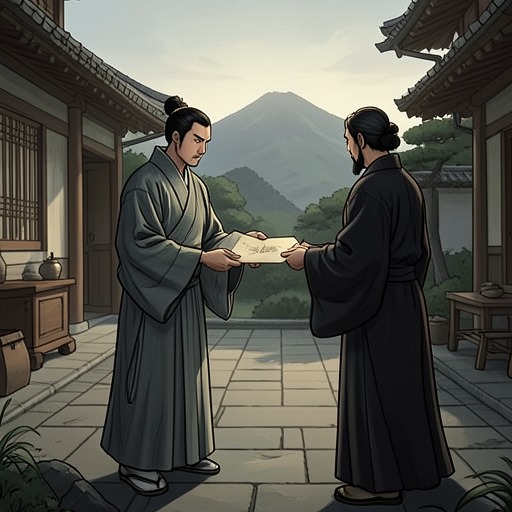
Rather than leave Yabu a face-saving way to resist, Hiro-matsu invites him to travel to Osaka and present the seized goods to Toranaga personally. He lets Yabu protest, as Toranaga has instructed, then insists in Toranaga’s name and frames the journey as a reward for Yabu’s generosity. Yabu recognizes the trap beneath the courtesy: he suspects that accepting may cost him his head and lands, but sees no safe alternative. Hiro-matsu’s formal hospitality thus completes the coercion that the confiscation began. Yabu agrees to go, and the immediate confrontation ends with his submission disguised as willing gratitude.
Judgment at Sea
Hiro-matsu’s relationship with Blackthorne develops through a different kind of test. During the dangerous voyage in the galley, Blackthorne insists on going ashore to recover Rodrigues’s body, despite Hiro-matsu’s refusal and the danger of the sea. Hiro-matsu understands the pilot’s reason but also knows that Toranaga has ordered him to bring the foreigner back safely. Blackthorne’s resolve makes the order harder to carry out: he intends to go, while Hiro-matsu is responsible for preventing him from coming to harm.
The conflict draws on Hiro-matsu’s earlier view of foreigners. During the storm, he had seen Blackthorne standing steadily on the pitching deck, apparently at home amid the danger. Hiro-matsu had concluded that foreigners such as him would be easier to control on land than at sea, where their maritime skill gave them the advantage. The voyage complicates that judgment. He recognizes that Blackthorne, rather than Rodrigues, had held the course and brought the ship to harbor; without that decision, Hiro-matsu believes the vessel would have been lost and he would have failed Toranaga. He privately considers that Blackthorne deserves thanks, even as the pilot’s impatience and defiance irritate him.
This recognition does not erase their differences or make Hiro-matsu careless about his duty. He remains caught between understanding Blackthorne’s purpose and obeying the order to protect him. Instead, the episode shows that Hiro-matsu can revise his assessment when experience warrants it. The foreigner is not simply a threat to be contained: his knowledge is also essential to Toranaga’s survival and to the success of the voyage.
Loyalty, Leverage, and Political Weight
Hiro-matsu’s loyalty makes him an asset to Toranaga, but it also gives his relationships political value to others. In a later discussion aboard ship, Yabu considers whether Toda Mariko could serve as a hostage. He suggests that her presence might offer a way to control Hiro-matsu, Buntaro, their clan, and even Toranaga. The scheme depends on the very bonds that make Hiro-matsu dependable: a trusted general can be pressured through people and obligations close to him.
Toranaga’s own treatment of a woman who begs to die instead of obeying his orders invokes Hiro-matsu’s place in that network. He tells her that he has listened to her because Lord Hiro-matsu is his oldest friend, while refusing her request and commanding her to obey. The exchange presents Hiro-matsu not only as a commander but as someone whose longstanding friendship with Toranaga can affect how the lord treats another person. It does not soften Toranaga’s authority; rather, it shows friendship operating within, and sometimes influencing, a system governed by command.
Across these episodes, Hiro-matsu’s military bearing, political trustworthiness, and personal attachments reinforce one another. He can compel Yabu in Toranaga’s name, yet his importance also makes him a potential target of leverage. At sea, he follows the same governing principle in another form: Toranaga’s order defines his responsibility, but fulfilling it requires him to judge danger and acknowledge Blackthorne’s skill. The result is a portrait of loyalty as active service—unyielding in purpose, but dependent on clear-eyed judgment.