Vasco Rodrigues
ShōgunVasco Rodrigues is a Portuguese pilot and sailor whose encounters with John Blackthorne expose the uneasy line between professional solidarity and national rivalry. He welcomes Blackthorne as a fellow navigator, attempts to kill him when he fears the danger he represents, and is then rescued by the very man he tried to drown. Their relationship ends neither in uncomplicated reconciliation nor renewed hatred: Rodrigues acknowledges his debt, apologizes without asking to be forgiven, and warns that their friendship will not protect Blackthorne if they meet as armed pilots at sea.
Identity and Introduction
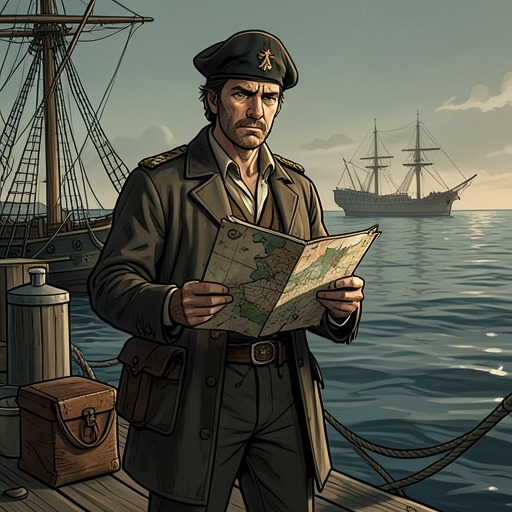
Rodrigues first appears aboard the galley carrying Blackthorne away. Blackthorne is resisting boarding, calling the vessel a slave ship, when a Portuguese voice from its deck rebukes the sailors harassing him and asks whether he is the Dutch pilot. Rodrigues then comes down the gangway: a seaman about Blackthorne’s age, dressed carelessly, armed with a rapier and pistols, and wearing a jeweled crucifix. His smile and boisterous manner make him an immediate contrast to the frightened, captive pilot he has come to collect.
The introduction turns on professional recognition. Rodrigues tests Blackthorne by asking for the latitude of The Lizard; Blackthorne supplies the figure and warns of nearby reefs. Rodrigues responds with a warm handshake and an invitation aboard, treating navigational competence as a bond that crosses national and religious divisions. He declares pilots a fraternity and presses Blackthorne for the practical details of his voyage: how he passed Malacca and the Indian Ocean patrols, and whose rutter he had taken. His welcome is genuine, but his questions also show the strategic attention a working pilot gives to routes and navigation.
A Shared Passage and a Reversal at Sea
During the voyage, Rodrigues and Blackthorne occupy the same perilous maritime world while remaining on opposite sides of a larger political and religious divide. After Blackthorne has rested, he offers to take Rodrigues’s watch and promises to wake him if the wind changes. Rodrigues measures him before accepting the offer. The exchange establishes a limited trust grounded in the immediate demands of seamanship: a watch must be kept, and a pilot’s judgment can affect everyone aboard.
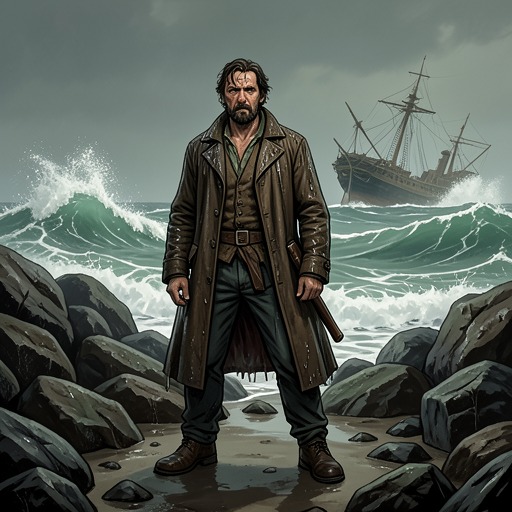
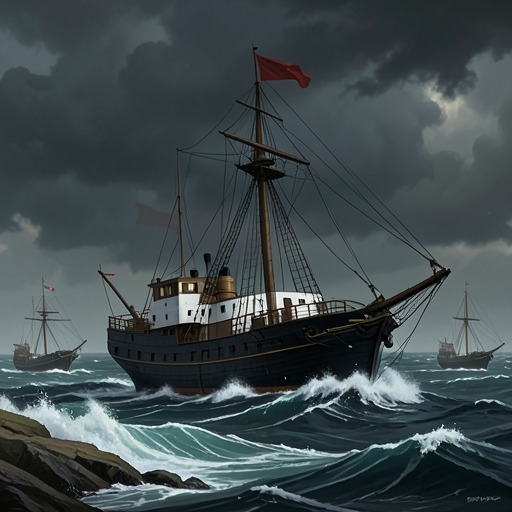
That trust is broken during the storm. As the vessel approaches safety, Rodrigues deliberately swerves into the wind while Blackthorne is amidships and without a lifeline, intending to send him overboard. Blackthorne survives, and the danger soon turns upon Rodrigues. When the great wave strikes, Rodrigues is washed into the churning sea after his own lifeline snaps. The ship reaches harbor without him, while Blackthorne sees him struggling in the water near the rocks and knows the vessel itself is lost.
Blackthorne rescues him. On the journey from the bay to Osaka, Rodrigues regains consciousness in pain, his leg set and his dislocated shoulder strapped. He learns from Blackthorne that the Japanese rescuers would not bleed him, despite Blackthorne’s efforts to persuade them. Rodrigues says the Jesuits in Osaka can perform the treatment. His first response to learning that Blackthorne saved him is not gratitude but the bitter recognition that he now owes his life to the man he tried to kill. The reversal makes their connection more than professional: Rodrigues’s survival is bound to Blackthorne’s decision to help him despite knowing the danger between them.
Debt, Confession, and Political Fear
When Rodrigues later asks after Blackthorne, he wants to know what has happened since they parted. Father Alvito explains that Blackthorne has saved Toranaga’s life for the third time, including during the earthquake in Izu. Rodrigues recognizes the political danger in Blackthorne’s proximity to Toranaga. He fears that if Toranaga’s men become ronin, Blackthorne could train them; with samurai or other fighters under his command, he could take a capable crew to sea aboard the Erasmus. The pilot’s concern is not simply personal resentment. Blackthorne’s maritime skill, combined with Japanese military strength, could threaten the Portuguese position.
Rodrigues confesses the attempted murder to Father Alvito. He says that his instinct was to kill Blackthorne from their first time together on the galley, and that during the storm he acted on it by swerving without warning. He had interpreted Blackthorne’s survival as providential, and later understood his own drowning and rescue as punishment for the attempt. What deepens his shame is that Blackthorne rescued him while aware of what Rodrigues had done. Rodrigues had sworn to make amends, yet now believes the danger Blackthorne poses may require him to kill him. The conflict is stark: personal obligation pulls him toward repayment, while fear of what Blackthorne could do at sea pulls him toward renewed violence.
The Terms of Their Friendship
When Rodrigues and Blackthorne meet again, Blackthorne asks directly whether the turn into the wind was meant to put him overboard. Rodrigues answers yes without evasion. He apologizes and says he is glad to confess his shame to Blackthorne’s face, but does not ask for forgiveness or understanding. Blackthorne’s question gives Rodrigues the opportunity to acknowledge the act openly; Rodrigues accepts the truth rather than defending it as a necessary maneuver.
Their exchange does not erase the political conflict. Rodrigues admits that, for his people and country, Blackthorne’s death would be preferable, even as he recognizes the sadness and foolishness of that fact. Blackthorne, for his part, says that it is the Portuguese Black Ship he wants, not Rodrigues dead. Rodrigues then defines the limit of their friendship: outside a meeting at sea, he remains in Blackthorne’s debt; if they meet at sea in armed ships, Blackthorne must look to his life. The warning is both a threat and a form of honesty. Neither man pretends that private regard can dissolve the stakes of their rival maritime powers.
Rodrigues leaves with Yoshinaka and the samurai following him, and his arms are collected at the gateway. His final departure preserves the unresolved quality of the relationship: he has confessed, apologized, and named his debt, but he has not abandoned the conflict that may make them enemies again.
Narrative Role and Significance
Rodrigues gives the book’s maritime rivalry a human face. His welcome of Blackthorne is rooted in a pilot’s respect for another pilot, while his attempted murder reflects the political consequences he sees in Blackthorne’s knowledge and possible command of a Japanese crew. The rescue reverses their positions without making either man’s loyalties simple: Rodrigues becomes indebted to his intended victim, and Blackthorne can save him without ceasing to covet the Black Ship.
The later confession brings that contradiction into the open. Rodrigues is capable of both deliberate violence and genuine shame, and his apology does not pretend that either his national interests or his fear has disappeared. His bond with Blackthorne therefore rests on a hard, clearly stated distinction between personal debt and armed conflict. Their friendship matters precisely because it survives without promising safety.