the late Taikō
ShōgunThe late Taikō is the peasant-born soldier whose rise from samurai to general and supreme ruler briefly brings Japan an unprecedented decade without war. His achievements outlive him as laws, military precedents, political bargains, and a contested succession; his death, however, exposes how much the peace depended on his personal authority. The novel presents him as both an architect of order and a force whose ambitions and unresolved legacy leave the realm poised for renewed conflict.
Identity and Rise to Power
The late Taikō’s social ascent defines the scale of his achievement. He began as a peasant soldier, became a samurai, then a general, and ultimately the absolute Lord Protector of Japan. The retrospective account that places these stages together calls him the greatest general and describes his position as that of a giant among lesser men. His authority was not merely military: he subdued the land and compelled the daimyos to acknowledge his supremacy, making his personal command the foundation of the political order.
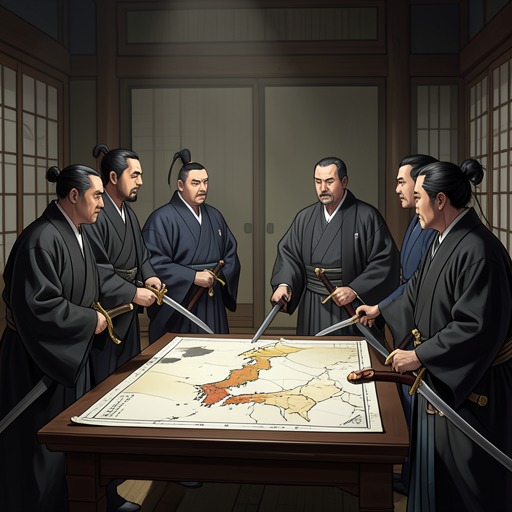
That order altered the map of power as well as the conduct of its rulers. The late Taikō rearranged fiefs according to his judgment, promoting some daimyos and dispossessing others. In one major bargain, he offered Toranaga the Kwanto, a fief encompassing eight provinces, while requiring him to surrender his hereditary lands in Imagawa, Owari, and Ise. Those provinces were still held by the Hojo, so the grant entailed a conquest rather than an immediate transfer of secure territory. Toranaga accepted; within a year, his forces defeated the Hojo, taking more than five thousand heads. The exchange bound a territorial reward to military service, and the memory of the bargain later gives Toranaga a precedent for negotiating with Yabu.
Rule, Peace, and the Regency
For the ten years before his death, the late Taikō’s rule produced what the narrative calls a warlessness known as peace. That peace is remembered not as an ordinary condition but as an astonishing break in a history of conflict. Mura’s reflection makes its fragility clear: with the ruler who made the peace dead, war threatens to spread from province to province and, ultimately, from village to village. The rich paddies and abundant sea may sustain Mura’s village, but they cannot protect it from the choices of the powerful.
The late Taikō tried to secure the transition beyond his own lifetime by appointing a Council of Regents to rule while his seven-year-old son remained a minor. The arrangement distributes authority, but the novel stresses its weakness: among five eminent daimyo regents, Toranaga and Ishido possess the real power. The late Taikō had also required the regents to meet in Osaka Castle for at least ten days, twice each year, with no more than five hundred retainers inside. Other daimyos, accompanied by their families, were likewise required to visit the castle twice a year to pay their respects to the Heir. These rules make attendance an instrument of control. Toranaga’s presence in Osaka is therefore not a freely chosen courtesy: refusing the fixed meeting could be treated as treason, while going places him within Ishido’s reach. The system meant to preserve the late Taikō’s settlement instead makes the rival regents’ contest more dangerous.
Military Innovation and the Warrior Code
The late Taikō’s rule also belongs to a transformation in warfare. According to the historical account in the novel, the Portuguese introduced muskets and gunpowder when they first reached Japan in 1542; within eighteen months, Japanese makers were producing firearms. Their quality was inferior to European examples, and guns initially remained novelties, used chiefly for hunting, where bows were considered more accurate. Their limited use was also cultural. Japanese warfare was described as ritualized individual combat, in which hand-to-hand fighting and the sword carried honor, while firearms were condemned as cowardly and contrary to Bushido.
That inherited code required samurai to fight, live, and die with honor, to maintain an unsullied name, and to show unquestioning loyalty to their feudal lord—even to seek death in that lord’s service. The late Taikō’s era thus contains a tension between military change and a martial ideal that could resist it. Yabu sees the musket not as a novelty but as the basis for a new strategy: five hundred selected samurai, trained to operate as a unit and armed with muskets, could spearhead twelve thousand conventional troops, supported by twenty cannon handled by specially trained men. Yabu’s plan is his own, but the possibility he recognizes grows out of the late Taikō’s legacy of unification and the approaching breakdown of peace. The weapons and methods that could decide the next war challenge the older prestige of individual combat.
Religious Policy and Its Contradictions
The late Taikō’s treatment of Christianity is presented through the recollections of Rodrigues, who speaks while injured and only partly lucid. His account is openly hostile: he condemns the ruler as an enemy of the Church and interprets the persecution in religious terms. The details he recounts nevertheless describe a policy that changed over time. He says the late Taikō issued expulsion edicts against Christian priests, ordered them gathered at Nagasaki for shipment to Macao, and then abruptly left them alone. Most priests remained in Kyushu, where they were welcome, and the ruler did not consistently enforce the edicts or close many churches. Rodrigues also says that some Christian daimyos were banished and lost their lands, suggesting that religious policy and political advantage could overlap.
The reprieve did not last without exception. Three years before the late Taikō’s death, according to Rodrigues, twenty-six priests were crucified at Nagasaki. Rodrigues calls the act inexplicable and reads the ruler’s subsequent inaction as another reversal, but that interpretation belongs to the speaker rather than a neutral account of motive. The pattern itself is consequential: the edicts, their partial suspension, and the execution of the twenty-six leave the Church uncertain of its standing. After the late Taikō’s death, Father Alvito still hopes that the ruler might accept Christianity at the end of his life, a hope that is disappointed. Even the report of his final hours therefore connects personal belief to the larger question of whether Christian influence can survive the political order he leaves behind.
Death, Heir, and Enduring Significance
The late Taikō has been ill for months, and his death is expected. In his final hours, he opens his eyes, smiles at Ochiba and Yodoko, and recites a death poem comparing life to dew that appears and vanishes within a dream. He then asks those around him to guard his son. Yodoko, who has been his faithful wife and counselor for forty-four of her fifty-nine years, closes his eyes and gives his body dignity before leaving Ochiba with the dead ruler. The final request is at once intimate and political: the child’s safety is the charge that remains when the father can no longer enforce it.
His death leaves the seven-year-old heir, the Taikō’s Heir, unable to inherit supreme power unaided. Mura imagines the boy caught between the great lords, as vulnerable as the villagers whose lives depend on which side Yabu chooses. The political settlement cannot reproduce the late Taikō’s personal command, and the coming struggle threatens both his dynasty and the decade of peace he established. In this way, his legacy is deliberately double. The late Taikō has unified the realm, redistributed its lands, and created procedures meant to hold power through a minority; yet those procedures expose the rivalries they cannot resolve. His death poem gives that political failure the image of evanescence: a ruler who seemed larger than his age disappears, and the order that seemed enduring becomes another thing at risk of vanishing.