CISG Contact Impact Hypothesis
StrangersThe CISG Contact Impact Hypothesis holds that humanity’s first encounter with an intelligent extraterrestrial civilization could unsettle human societies even without an attack: the encounter itself might erode confidence in religion, government, and cultural traditions. Developed by the Contact Impact Study Group, the hypothesis becomes the intellectual basis for concealing contact and controlling its disclosure. Its force in the novel comes from the dispute it creates between those who regard secrecy as protection against civilizational collapse and those who see that secrecy as a dangerous misreading of humanity—and of the encounter itself.
Origin and Central Claim
The Contact Impact Study Group was a government research committee formed to assess the positive and negative effects on human society of face-to-face contact with an intelligent species from beyond Earth. Its members included biologists, physicists, cultural anthropologists, medical doctors, sociologists, and psychologists; Leland Falkirk was its sole military representative. The group began its work about nine years before the events under investigation, and the committee’s classified report had been completed seven years earlier. Its subject was not simply whether extraterrestrials might be hostile, but what the reality of contact could do to human beliefs and institutions.
The hypothesis drew on historical encounters between societies of unequal power. As Father Stefan Wycazik explains it to Parker Faine, the CISG feared that contact with a more advanced civilization could resemble the effects of a powerful culture upon a less powerful one: the latter might lose faith in its religion and political systems, suffer a collapse of cultural confidence, and experience damaged social values and family structures. The account invokes Indigenous peoples’ encounters with Western civilization as a warning about cultural disruption, loss of self-esteem, and associated social harm. The hypothesis therefore treats contact as a potentially destabilizing relationship between civilizations, not merely as an exchange of scientific information.
Its predictions are severe. According to the explanation passed from an anonymous source through Michael Gerrano to Father Wycazik, the CISG anticipated weakened religious faith, declining trust in governments and other secular belief systems, a widespread sense of inferiority, and increased suicide. The committee’s concern is that the psychological and cultural consequences could persist even if the visitors did not intend harm. On this account, the danger lies partly in the contrast between civilizations: learning that humanity is not alone, and may be vastly less advanced, could change the way people understand their own place and institutions.
Secrecy as Policy
The report’s conclusions shaped an approach to disclosure. According to the information Father Wycazik receives, the CISG believed that contact should be concealed if possible, and that unavoidable disclosure should be spread over ten or even twenty years. Gradual revelation would, in theory, give human societies time to absorb knowledge that might otherwise disorient them. This recommendation converts a forecast about social consequences into a policy of managed information: the public is not treated as ready to judge the encounter, and those holding the secret acquire power over when and how it becomes known.
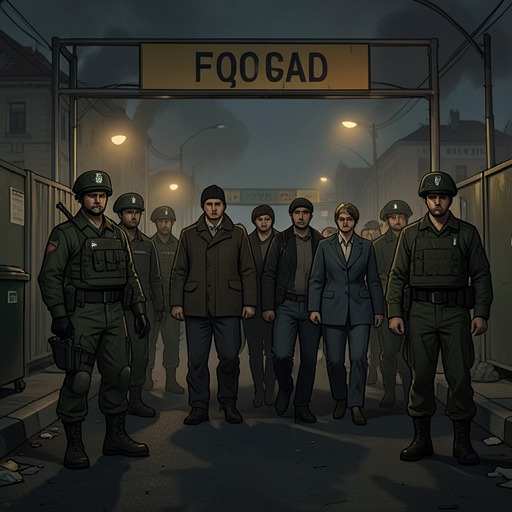
The novel connects that governing logic to the military response surrounding the events in Nevada. The incident was publicly framed as a toxic spill, with the interstate closed and a quarantine imposed. Army units established roadblocks along a ten-mile stretch of I-80 before notifying local and state authorities, whose representatives complained that they were excluded from crisis management. Ginger Weiss argues that the use of a Domestic Emergency Response Organization team suggests that officials expected the patrols to encounter something highly classified, not merely a chemical spill. These circumstances do not by themselves establish that the CISG ordered the operation. They do show how secrecy and exceptional security measures accompany the state’s effort to contain knowledge of the event.
The connection is sharpened by the timing of the report’s renewed restriction. A source investigating the CISG discovers that many former committee scientists are on unusual leave or furlough, and that new security restrictions were applied to the files on July 8, two days after the Nevada incident. The date makes the committee’s work appear newly relevant to the crisis. Meanwhile, the witnesses’ recovered nightmares of being restrained on motel beds and attended by men in decontamination suits suggest that the official account and their experience do not fit neatly together. The hypothesis thus belongs to a wider contest over evidence: the government’s language of contamination and containment obscures the possibility that the crisis involved first contact.
Dispute Over the Hypothesis
The CISG’s conclusions are not accepted unanimously, even by people who know the report exists. Miles Bennell tells Falkirk that some of the people working around him disagree with the committee: they consider its conclusions fundamentally mistaken and its viewpoint too elitist. Their objection challenges the assumption that experts can reliably decide what knowledge the public can bear. It also exposes the difference between predicting social upheaval and demonstrating that disclosure would cause it.
Falkirk, by contrast, treats the CISG as correct and makes its warning part of his argument for containment. In his view, disclosure would invite politicians and others to interfere with the response; that interference could compromise an effort he frames as a war to protect humanity from obliteration. Foster Polnichev disputes the need to kill witnesses to keep the story contained. He regards Emmy Halbourg not as a monster but as a child whose extraordinary power may be the only unusual thing about her. Falkirk interprets that possibility as a deception by an enemy: if people are persuaded that accommodation is a blessing, he fears, they may surrender without resisting. The hypothesis therefore helps explain Falkirk’s fear, but it does not settle whether his escalating measures are proportionate or justified.
Father Stefan Wycazik offers the clearest challenge to the CISG’s underlying analogy. He understands why the committee worried about cultural damage, drawing on his Jesuit education and the history of religious contact with other cultures. But he argues that humanity is not a primitive society encountering a more advanced human civilization. In his view, the situation is contact between one advanced culture and an even more advanced one, and the older analogy cannot establish that human institutions will collapse. His own religious response is affirmative: the existence of life elsewhere in the universe strengthens, rather than destroys, his sense of a creation that cherishes life. Parker shares his rejection of the prediction that first contact must destroy humanity.
Contact and the Hypothesis’s Limits
The witnesses’ recollections of the luminous ship provide an experiential counterweight to the CISG’s forecast. Sandy Sarver describes standing beside strangers who no longer felt like strangers, gathered quietly on the highway shoulder as they looked toward the craft. For her, the sight changed the scale of a childhood fear: the father who had abused her seemed small against the immense universe revealed by the encounter. Jorja Monatella likewise senses that the existence of a superior intelligence places human struggles for domination in a new perspective, making a broader human kinship imaginable. These responses do not prove that contact will leave every person or institution unharmed, but they make the encounter more than the destabilizing shock anticipated by the committee.
The novel’s ending extends that counterargument into a long view of human development. Miles Bennell imagines humanity using the visitors’ knowledge and technology over centuries, then eventually sending a crew in suspended animation to return the call tens of thousands of years later. The CISG imagines contact chiefly as a threat to established confidence and social order; Bennell’s vision makes it a beginning that humanity might mature toward answering. The difference is not simply optimism against caution. It is a disagreement about whether human beings should be protected from transformative knowledge or trusted to build a response to it.
Narrative Significance
The CISG Contact Impact Hypothesis gives the novel’s conspiracy a serious argument rather than a purely procedural excuse: secrecy is presented by its defenders as an attempt to prevent social and potentially species-wide catastrophe. At the same time, the policy built around that forecast produces its own harms. By classifying the report, restricting access, militarizing the response, and treating disclosure as a threat, authorities make the fear of public disorder a justification for withholding the facts needed to assess that fear.
The hypothesis remains contested even after the ship’s existence changes the witnesses’ sense of the future. The encounter supplies evidence of wonder, solidarity, and renewed possibility, but it does not erase the question of how societies will respond over time. In that unresolved tension, the CISG’s warning functions both as a plausible caution about cultural disruption and as a test of who gets to define humanity’s capacity to face change.