Extraterrestrial Infection and Possession Hypothesis
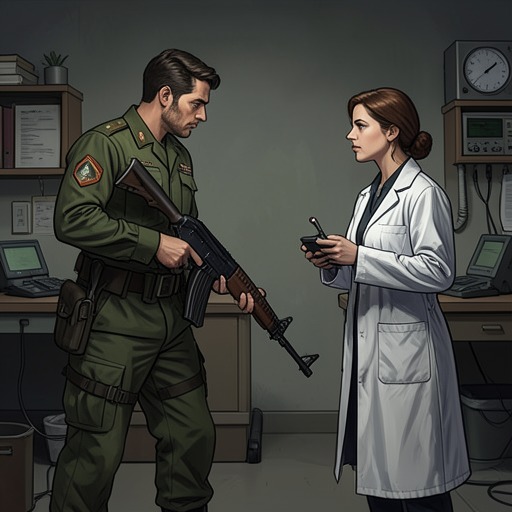
StrangersThe Extraterrestrial Infection and Possession Hypothesis is the fear that people changed by contact with an alien presence may no longer be wholly human: an external intelligence might inhabit them, control them, or use them to spread. It becomes a central interpretive crisis after the Nevada encounter, where new powers can be read either as a wondrous human transformation or as evidence of a hidden parasite. The hypothesis is never simply a scientific question. Under Leland Falkirk, uncertainty becomes a security emergency, and the possibility of infection is used to justify surveillance, confinement, and even the threatened killing of witnesses.
Origins in the Nevada Cover Story
The hypothesis takes shape against the military’s account of a toxic emergency on Interstate 80. On Friday, July 6, Faye Block’s motel register confirms that guests were present before the road closure; the Blocks remember being told that a truck carrying dangerous chemicals to Shenkfield had caused a spill. The motel was shut until Tuesday, and the guests were ordered to evacuate. Shenkfield was described as an isolated testing ground for chemical and biological weapons, making the alleged danger sound credible. Yet the familiar explanation also gave authorities a reason to restrict movement and control what witnesses could see.
Dom Corvaisis and Ginger Weiss later find that the Army had closed a ten-mile stretch of Interstate 80 and established roadblocks before informing the Elko County sheriff or Nevada State Police. Local officers complained that the Army excluded them from the quarantine and from planning for the possibility that the supposed nerve gas might spread. The press reports and the Army’s conduct do not themselves prove that the spill was fabricated, but they expose a striking imbalance between the stated emergency and the secrecy surrounding it. The investigation therefore makes the cover story part of the problem: the more the official account is questioned, the easier it becomes to imagine that the authorities are concealing something more consequential than a chemical accident.
Ginger argues that the use of a Domestic Emergency Response Force company is especially revealing. If the incident had been an ordinary toxic spill, she reasons, there would have been little reason to assign the quarantine line to personnel selected for exceptional security clearance. Their presence suggests that the people guarding the zone might have seen something classified. This remains an inference, not proof of alien infection, but it connects the government’s secrecy to the fear that the event involved an unknown form of contact.
Competing Interpretations of the New Powers
The argument becomes explicit when Falkirk asks Miles Bennell how he could determine whether Brendan Cronin and Corvaisis had changed. Bennell says researchers have devised medical and psychological tests and maintains that infection is not a danger: the men may be entirely human and still possess new abilities. He says the researchers had initially feared infection or possession but had concluded more than a year earlier that they were wrong. His confidence rests on the possibility that extraordinary powers can coexist with human identity, rather than proving that the person has been replaced.
Falkirk refuses that distinction. If the changed people can defeat lie detectors or truth drugs, he argues, ordinary tests may not reveal what they are. His suspicion extends beyond the Nevada witnesses to Bennell himself, who has spent eighteen months working in the cavern, conducting laboratory tests. Bennell distinguishes this later research from the first hours of contact, which he regards as the only plausible period for infection. Falkirk asks how he can be sure. The exchange shows how the hypothesis becomes self-sealing: evidence of powers raises suspicion, while expertise and reassurance can themselves be reinterpreted as signs that a suspected person has learned to deceive.
Foster Polnichev offers a different reading of the healings and telekinesis. If the newly empowered people were infected agents seeking to spread an alien presence unnoticed, he reasons, they would not draw attention by performing miraculous cures. He considers it more likely that the power is all that is present in people such as Emmy Halbourg and Winton Tolk, and that the changes may be the greatest event in human history rather than an invasion. Falkirk treats the same uncertainty as a reason for distrust. He speculates that an infected person might become a parasite’s slave, or might remain unaware of a benign, mutually supportive relationship with it. In either case, he concludes, the person is no longer strictly human and cannot be trusted.
Fear as a Basis for State Action
Falkirk’s position turns an unverified hypothesis into an existential threat. He tells Polnichev that the objective is no longer merely to suppress news: he believes humanity itself could be annihilated if the authorities fail to contain an infection. Public disclosure, in his view, would invite politicians and others to obstruct violent measures. The scale of the feared danger thus becomes an argument for secrecy and preemptive control, even though the nature of the supposed infection remains unknown.
That logic has practical consequences. When Tolk saves a stabbed child from near death, his power becomes a public story and a possible route by which reporters might trace the connection to Cronin and Emmy. Polnichev reports that Tolk is in seclusion while journalists gather outside his house. Falkirk demands that the entire Tolk family be taken into custody, although Polnichev points out that agents entering the house in front of reporters could expose the cover-up. The hypothesis therefore operates at once as a theory about alien biology and as a rationale for deciding who may be isolated, watched, or silenced.
The earlier quarantine reinforces that pattern. Army control of the roadblocks and exclusion of civilian authorities had already made the supposed toxic emergency an instrument of exceptional power. Later, the DERO deployment and the possibility that soldiers might have witnessed something classified deepen the witnesses’ suspicion that the chemical explanation was a screen. The narrative does not make every suspicion equally reliable; instead, it shows how a concealed event and a coercive response feed one another. Official secrecy gives the infection hypothesis room to grow, while the hypothesis gives officials a language for extending secrecy.
Evidence, Limits, and Human Agency
Cal Sharkle’s belief that aliens had landed and were taking over his neighbors initially appears to support the most frightening version of the hypothesis. He describes being strapped to a bed and injected by apparent figures in pressurized suits. But Brendan, recalling Sharkle’s account during the journey to Vista Valley Road, separates the events Sharkle has confused: he witnessed a starship’s descent, while government personnel in decontamination suits later detained and mistreated him. The memory block imposed after that treatment left Sharkle unable to distinguish the alien landing from what human agents had done to him. His story demonstrates that fear of possession can arise from real abuses, then distort the interpretation of those abuses.
Brendan’s failed attempt to revive Father Stefan Wycazik further complicates any easy equation between strange power and limitless alien control. Brendan discovers that healing requires participation from the person being healed: he supplies the life-giving power, but the patient must provide what he understands as the loom on which that power can work. Wycazik had been dead before Brendan reached him, so the threads of healing could not repair his body. Brendan can heal the wounded and cure the sick, but cannot raise the dead. This does not establish the origin of his ability or settle whether contact involved infection; it does establish a limit, and it places the power within a relation between healer and patient rather than presenting it as simple, absolute control.
The hypothesis remains unresolved because the same phenomena sustain opposed readings. To Falkirk, abilities that cannot be explained may conceal an alien will; to Bennell, they can belong to human beings without displacing their humanity; to Polnichev, their visible use for healing argues against an unnoticed campaign of infection. The novel’s tension lies less in confirming a parasite than in showing what the fear of one permits. Faced with uncertainty, the authorities can treat the newly changed as people to be understood—or as threats whose humanity need not be trusted.