Moon trigger motif
StrangersThe Moon trigger motif is the phrase and image of the moon as they intrude on the speech, dreams, and actions of people whose experiences converge around the Tranquility Motel. First appearing as an unexplained murmur in Dominick Corvaisis’s sleep, the motif recurs in typed words, anonymous notes, night terrors, a sudden fear of the visible moon, and the obsessive behavior of Zebediah Lomack. Its significance is not initially explained: the force of the phrase comes from its repetition across people who do not understand what it means, and from the way it seems to point toward a past they cannot recall.
First Appearances and the Anonymous Messages
As Dominick drifts to sleep after taking Dalmane with whiskey, he hears himself murmur the moon’s name twice. The words startle and interest him even as the drugs pull him under, but he cannot explain what he means. The moment is more than a curious slip: it marks the return of a phrase that appears without an accessible memory or conscious intention to account for it.
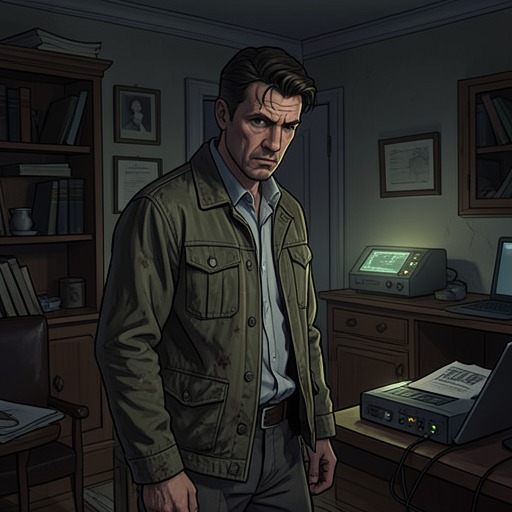
Days later, Dominick finds the same words typed repeatedly on the work diskette in his IBM Displaywriter. He had believed he slept through the night without moving, and the screen gives him evidence that he had instead wandered to the machine in a trance. On previous occasions, he had typed a different message, “I'm scared,” but now the phrase is repeated hundreds of times. The repetition unsettles him, especially because it recalls the words he had murmured while falling asleep the previous Sunday. His medication appears to be helping, and he has told neither Dr. Cobletz nor Parker Faine about this new episode. He does not know what the phrase signifies, but fears that reporting it could jeopardize the treatment he needs.
The motif becomes more disturbing when two anonymous communications seem to answer thoughts Dominick has kept private. A note in a plain white envelope tells the sleepwalker to search the past for the source of his problem and says the secret is buried there. Later, another envelope contains only the words naming the moon. Dominick believes no one knows that he has spoken the words in his sleep or typed them while sleepwalking; he has disclosed neither episode to Parker nor to Dr. Cobletz. The envelope bears a New York postmark and a December 18 date, but its sender remains unknown. The words feel like private evidence returned to him from outside himself: their source is unexplained, and their appearance intensifies rather than resolves his fear.
A Phrase That Crosses Between People
The moon’s name also appears beyond Dominick’s episodes. On a night walk, Jack Twist sees the moon swelling near the horizon and says its name aloud. A sudden, irrational terror grips him: he feels compelled to run and hide, as though the moonlight could dissolve him. The fear passes within a minute, leaving him perplexed by his reaction to an object otherwise familiar from romantic poetry and love songs. The scene gives the motif a waking, visual form: the moon is no longer only a phrase spoken in sleep, but an ordinary sight that can provoke bodily dread without an understood cause.
Other sleepers repeat the words without offering an explanation. Faye Block hears Ernie Block say the phrase over and over in an urgent, almost panicked voice. In Las Vegas, Jorja listens as Marcie’s troubled sleep shifts from talk about doctors and needles to an urgent mention of the moon, accompanied by violent kicks and sudden stillness. Brendan Cronin, asleep in Chicago, speaks the same words in rhythm with the winter wind. In Boston, Ginger Weiss’s housekeeper reports that Ginger has shouted the phrase repeatedly and sounded frightened, though Ginger remembers none of it. These episodes differ in circumstance, but the refrain persists across them: speech arrives during sleep or a disturbed state, while the speaker lacks a clear account of what prompted it.
Dominick’s night terrors make the bodily cost especially visible. He wakes shouting the moon’s name while struggling on the floor beside his bed, where he has tethered himself to prevent sleepwalking. He has untied one knot and partly loosened another, then abrasively pulled against the rope until his wrist hurts. He cannot recall the dream, but knows it was terrifying and unlike his earlier nightmare of being forced face-down into a sink. After he improves his tether with surgical gauze and a quarter-inch climbing rope rated to withstand 2,600 pounds, the phrase still breaks through: in Portland, he wakes three times wrestling with the line and shouting it. The restraint changes; the refrain does not.
Zebediah Lomack and the Moon Obsession
Zebediah Lomack’s experience turns the motif from a repeated verbal intrusion into a consuming fixation. A professional gambler whose life had revolved around staying in the game, he begins stargazing during the summer before the events he later recalls. He buys a Tasco 10VR refracting telescope and books about astronomy. At first the interest is casual. Over the following months, however, his attention shifts from the stars to the moon: he cancels casino trips to study it, spends nights at the telescope, and amasses books about lunar subjects. By September, more than 1,500 volumes fill his small house, while moon images cover its walls and ceilings.
The fixation reorganizes his home and life. A three-by-five-foot color photograph of the moon, reproduced in fifty copies, covers the living room’s walls and ceiling; he tapes the posters over the windows, making the room a private planetarium. He stops playing cards and lives on his savings. Looking at the many moons brings both wonder and terror, feelings he cannot explain. The moon motif thus has a material counterpart: it is no longer confined to a voice or a screen but multiplies across the rooms around him, making escape from its image nearly impossible.
On Christmas night, Zeb notices names written across some of the posters. In his own handwriting, though he cannot remember writing them, are Dominick, Ginger, Faye, and Ernie. He knows no one named Dominick, Ginger, or Faye and cannot identify the Ernie he has written. Yet he feels that these people matter profoundly and that remembering them is tied to his sanity and survival. The names make the moon images a kind of involuntary record. Zeb senses that a buried memory is returning, but his fear grows as he approaches it; he turns away from the posters, frightened of remembering.
His effort to rid himself of the collection also fails. While carrying books toward a pit he intends to refill, Zeb realizes that he has drifted into his moon-dream and is carrying them back toward the house instead. When the reflected light on the snow draws his gaze upward, he names the moon and concludes that he is a dead man. Later, in the kitchen, he attempts suicide with a shotgun. At the point of crisis, the returning memory breaks open: he remembers the summer before last, the named people, a young priest, others, Interstate 80, and the Tranquility Motel, as well as the moon. He dies when the gun discharges. His recovered memories connect the moon fixation to the motel group’s shared past, but the episode does not explain what originally happened or why the moon became its recurring sign.
Repetition, Memory, and Unresolved Meaning
The motif’s narrative force lies in the gap between recurrence and understanding. Dominick hears and types the phrase without knowing its meaning; Jack is frightened by the visible moon without understanding why; and the sleeping speakers repeat the words without being able to explain them. Zeb’s case comes closest to an answer because the names on his posters and his final recovery of memory place the Tranquility Motel and its people inside the same pattern. Even there, the return of memory is abrupt and fatal rather than a full explanation.
The refrain also travels across forms of evidence. It can be heard in murmured sleep talk, found repeated on a work diskette, received as an anonymous message, spoken while looking at the moon, and embodied in Zeb’s walls of lunar images. Each appearance converts something private into a sign that can be witnessed: a screen records Dominick’s unconscious repetition, Faye and other observers hear sleepers speak, and Zeb’s posters reveal names he cannot consciously retrieve. The accumulating instances make the phrase feel shared, although the characters do not yet possess a shared account of its origin.
The Moon trigger motif therefore functions as a warning signal and a fractured link to suppressed experience, not as a decoded symbol with a settled meaning. It binds otherwise separate episodes through repetition, while preserving the characters’ uncertainty about what the moon signifies and what their lost past contains. Its most consequential revelation is that the apparent private symptom belongs to a wider pattern involving Dominick, Ginger, Faye, Ernie, and others connected to the Tranquility Motel. The phrase arrives before understanding; its repetitions make forgetting increasingly difficult to sustain.