Fugue
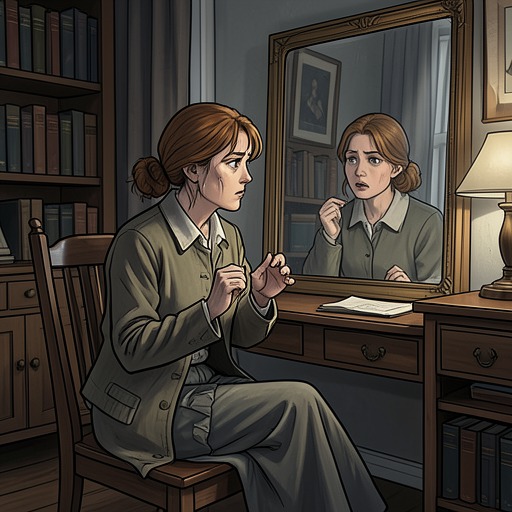
StrangersFugue is the term Ginger Weiss turns to when episodes of inexplicable terror disrupt her awareness and leave gaps in her memory. In each episode, an ordinary object becomes the focus of danger, the surrounding world seems to dissolve, and she flees without understanding why. When awareness returns, she cannot fully account for her actions.## Definition and Ginger’s First Interpretation After an episode in a delicatessen, Ginger consults a well-thumbed copy of Taber’s Cyclopedic Medical Dictionary in her home office. The entry describes fugue as serious personality dissociation, an impulsive departure from home or one’s surroundings, and a state that may leave a person unable to remember what happened during it. Ginger already knows what the word means; she cannot explain why she has sought it out, except that seeing the definition in print might make it less powerful. She nevertheless decides not to pursue further reference books and cannot believe that her brief attack signals a serious medical problem.
That response captures a tension that persists through the episodes: Ginger can recognize a medical term and later reconstruct some of the circumstances, but recognition does not give her control while an attack is happening. The label organizes the apparent sequence—fear, flight, lost time, and a return to awareness—without explaining why particular objects provoke it or making the danger feel less real in the moment.## Episodes of Fear and Flight The first detailed episode begins when Ginger accepts a grocery bag from an ordinary-looking man and notices his black leather gloves. The gloves are expensive and neatly stitched, but nothing about them objectively accounts for the sudden terror they provoke. As she stares at them, the delicatessen and its contents seem to fade into a pale haze. The gloves, by contrast, become more vivid and threatening. The man’s voice seems distant, while the sounds of customers, dishes, and the cash register swell into an unbearable roar.
Ginger’s fear turns into an imperative to escape. She does not know what danger she faces, but feels she must run or die. Clutching the groceries to her breast, she shoulders past the man, gets outside, and runs along Charles Street. Her awareness of the world falls away as she flees through a grayness in which she cannot properly see or hear. Minutes later, she comes to herself on Mount Vernon Street, gripping the iron balusters beside the steps of a red-brick town house. Sweating and gasping, with aching hands and a burning throat, she cannot remember how she reached the railing—or what frightened her.
A later episode occurs at night in George Hannaby’s professional offices. Ginger has entered the file room to retrieve Viola Fletcher’s records; in George’s darkened office, a hand-held ophthalmoscope on the green desk blotter suddenly arrests her attention. It is a routine instrument, but its sight fills her with a terrible sense of danger. She breaks into a cold sweat, and her heart pounds so loudly it seems to come from outside her body. The familiar command to run returns as mist descends.
When awareness returns, Ginger is on a concrete landing in an emergency stairwell, squeezed into a corner between flights of stairs. A bare bulb burns overhead; the surrounding stairwells recede into shadow. She cannot remember leaving the office corridor or taking the stairs. She is relieved that nobody appears to have witnessed her flight, but that relief does not resolve the episode: the ordinary workplace has become an empty, isolating space, and the actions that brought her there remain unavailable to her.
The pattern recurs after Ginger has worked through an operation, while she is washing her hands at a scrub sink. Looking down at water and soap circling the stainless-steel drain, she feels the same irrational terror with even less warning. The drain seems to throb and widen; the rest of the room, including George Hannaby, Agatha Tandy, the hallway, and the surgery doors, fades from view. Ginger tries to hold on to the fact that it is only an ordinary sink, but the sense of mortal danger overwhelms that reasoning. She runs and loses conscious awareness of her actions. The next thing she registers is snow falling past her face beneath a gray patch of winter sky; her hair and eyebrows are white with flakes, and she realizes that her cheeks are wet with tears.## Recurring Structure and Meaning Across the episodes, the trigger changes but the sequence is strikingly consistent. A commonplace object—the gloves, the ophthalmoscope, the drain—takes on an intensified, threatening presence while its surroundings lose solidity. Sensation is distorted as well: the delicatessen’s noises grow thunderous, the man’s voice recedes, and the office and hospital settings dissolve into mist. The transformations belong to Ginger’s experience; the narrative supplies no external evidence that the objects themselves are dangerous.
Flight follows this collapse of ordinary perception. In the delicatessen, Ginger gets as far as a street railing before awareness returns; at George Hannaby’s office, she finds herself in the stairwell; after the operation, she runs from the sink and next becomes aware of snow and tears. These outcomes are not interchangeable details: they show the episodes carrying her out of the immediate setting while withholding the passage between action and recovery. Her later bewilderment is part of the experience, not simply a failure to understand its cause.
The concept also links fear to threatened control over perception and memory. Ginger can identify the gloves as ordinary, the ophthalmoscope as standard medical equipment, and the sink as only a sink, yet those judgments cannot stop the objects from becoming centers of danger. The repeated contrast between what she knows and what she feels gives the episodes their force: reason remains present, but does not govern what she sees or does. Fugue names the rupture that follows—the sudden departure, the lost interval, and the uncertain return—without settling the underlying mystery.