Government Cover-Up and Information Disclosure Debate
StrangersGovernment Cover-Up and Information Disclosure Debate is the widening conflict over whether the events surrounding July 6 should remain secret or be brought into public view. What begins as a military-managed quarantine becomes a struggle over memory, evidence, institutional authority, and the possibility that extraordinary new abilities may be a benefit rather than a threat. Colonel Leland Falkirk treats secrecy as a defense of humanity; other officials and researchers increasingly regard concealment as both morally costly and impossible to sustain.
The cover story and its evidence
The debate grows out of an operation presented to residents of Elko County, Nevada, as a toxic emergency. The motel witnesses remember being told that a truck carrying dangerous chemicals to Shenkfield had caused an interstate spill, that roadblocks sealed the danger zone, and that the Tranquility Motel had to close until the crisis was under control. The account also explained why guests were evacuated and why Ned and Sandy Sarver could go to their trailer near Beowawe, outside the quarantine area. The explanation gave the official response a practical, comprehensible shape: dangerous cargo, a restricted area, and temporary emergency measures.
The surviving newspaper record makes that account harder to accept. Dom Corvaisis and Ginger Weiss find that United States Army units closed a ten-mile stretch of I-80 and established roadblocks before informing the Elko County Sheriff or Nevada State Police. Local authorities complained that the Army excluded them from the quarantine and contingency planning, including preparations for the possibility that changing conditions might spread nerve gas. The military’s control of the zone thus appears not merely restrictive but unusually comprehensive, displacing civilian oversight while keeping the situation’s essential details within military channels.
Ginger argues that the speed of the response suggests advance warning: forces could not have arrived and staffed the roadblocks so quickly if they had first learned of an accidental spill at the moment it occurred. She further reasons that the DERO team’s presence makes sense if the people guarding the zone might see something classified, rather than if they were dealing only with an overturned truck and a leaking container. These are deductions, not proof of the concealed event, but they redirect the investigation. Dom and Ginger discover that stories elsewhere in the Sentinel may connect the highway closure to Thunder Hill, and Dom tells the motel group that Shenkfield may have been a misdirection rather than the true source of the crisis. The investigation therefore replaces an apparently settled public explanation with a chain of clues and competing interpretations.
Secrecy as policy and practice
The concealment is not limited to controlling access to the highway. The motel witnesses’ vivid nightmares of being strapped to beds and attended by men in decontamination suits suggest that their memories of the incident were suppressed. As those memory blocks begin to deteriorate, the government’s attempt to contain information also becomes an attempt to control what the witnesses can remember and report. When the Salcoe family’s conditioning weakens, the FBI and CIA subject them to another program of memory repression and alteration in Monterey. Their cooperation demonstrates that the cover-up is distributed across agencies, while the growing number of people involved makes it harder to manage as a single, reliable operation.
That institutional spread matters to the argument. The CIA’s brainwashing specialists had promised that the witnesses’ memories could be repressed, but the experience had proved too powerful for the conditioning to hold. The people responsible for maintaining silence now propose further sessions even as the failures multiply. In a separate effort to identify a suspected leaker, Falkirk orders interrogations after the polygraph is repaired and treats the circulation of photographs as evidence of possible disloyalty or contamination. The machinery of secrecy responds to uncertainty with more surveillance and control, but each coercive measure risks producing additional evidence that the official account cannot be trusted.
The witnesses themselves become targets of this struggle. In a discussion with General Bob Alvarado, Dr. Miles Bennell questions why the witnesses should be removed from the motel for another memory-scrubbing session when Falkirk has not called in the memory specialists. Alvarado says Falkirk has instead proposed bringing the witnesses to Thunder Hill for study, especially Brendan Cronin and Dom, and claims he may accept Bennell’s judgment about whether their abilities indicate an inhuman presence. Bennell finds the apparent change in Falkirk’s position difficult to trust. The proposed examination is therefore not a resolution of the conflict: it leaves open whether the witnesses are being invited into a genuine inquiry or being placed under renewed government control.
The dispute over danger and disclosure
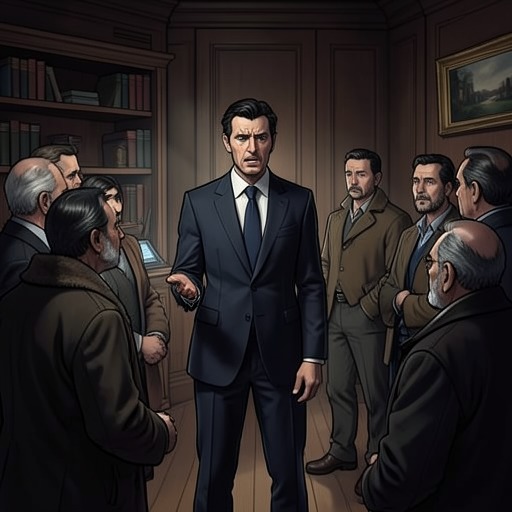
The central disagreement is about what the July 6 events mean, and how much certainty is required before the government acts. Bennell challenges Falkirk to explain why staff would undermine security despite knowing about the classified CISG report and its warning of terrible consequences if the discoveries became public. Lieutenant Horner’s answer identifies a substantive division rather than simple disloyalty: some people believe the CISG was wrong, too elitist, and unjustifiably catastrophic in its assessment of disclosure. The debate is therefore not only between secrecy and recklessness. It is also about whether an earlier assessment of danger should govern present decisions when new evidence and powers have emerged.
Bennell makes that difference explicit when he urges Falkirk to speak with Cronin and Dom, disclose the truth to them, and seek their cooperation. He argues that their healing and other phenomena should be studied rather than answered with elimination or another memory wipe. He also accepts that disclosure may make the cover-up unsustainable, adding that if the public must be told, it should be told. Falkirk, by contrast, interprets the same developments through the possibility of infection and species-wide destruction. For him, the question is no longer merely whether news can be kept from the public; he fears that public opposition could obstruct a necessary fight against an enemy capable of obliterating humanity.
Foster Polnichev offers the sharpest counterargument. The miraculous cures associated with Cronin and Winton Tolk, as well as the telekinetic abilities of Dom and Emmy Halbourg, appear to him to point toward beneficial consequences. He regards the need to kill the Halbourgs, the Tolks, and the Nevada witnesses merely to preserve secrecy as evidence that containment has become too costly. Falkirk refuses that interpretation: he believes the apparent gifts may be the means by which an enemy persuades people to accept surrender. The same events thus support radically opposed conclusions, and each side sees the other’s reading as a danger in itself.
A divided government and an unauthorized plan
The disagreement reaches a formal crisis during a conference call intended to secure support for Falkirk’s proposed roundup of the motel witnesses and his authority to destroy them, along with the Thunder Hill staff, if he obtains proof that they are no longer human. Instead, FBI Director Emil Foxworth reports that Parker Faine, Dom’s friend, has broken into the Salcoe operation and escaped. The Salcoes are moved to a safe house for further memory modification, but the escape strengthens the view that the operation is leaking and that the cover-up is difficult to contain.
Polnichev, Foxworth, and National Security Adviser James Herton agree that disclosure may be unavoidable. General Maxwell D. Riddenhour, Chairman of the Joint Chiefs, also declines to authorize Falkirk’s immediate measures. He calls for input from scientists and other specialists, and says stronger action could follow if evidence of an imminent threat appears; for the present, he wants a cautious course that leaves open the possibility of undoing the cover-up. Falkirk hears hesitation where he believes decisive action is required. His angry response turns the call into a confrontation, and Riddenhour secures only a temporary agreement: no action against the witnesses and no additional steps to strengthen the cover-up, while neither side is authorized to dismantle it immediately.
Falkirk nevertheless decides to proceed against those orders. He plans to close I-80 under the pretense of another toxic spill, isolate the Tranquility Motel, transport the witnesses to Thunder Hill, and detonate two five-megaton backpack nuclear weapons inside the mountain. He believes this would destroy the principal source of contamination, though he also recognizes that other possible sources, including the Tolk and Halbourg families and witnesses elsewhere, would remain. The plan turns secrecy from an attempt to manage information into a proposed mass killing, undertaken without the authorization Riddenhour has withheld. Its extremity exposes the moral danger in Falkirk’s claim that protecting humanity requires silencing the people whose experiences might clarify the threat.
Leaks, countermeasures, and the stakes of knowing
Resistance to the cover-up also develops from within the institutions enforcing it. Alvarado tells Bennell that he arranged for Jack Twist to return by directing attention to the motel, hoping to make continued suppression impossible. He handled postcards with gloves to avoid leaving fingerprints and intended to contact other witnesses anonymously, but other notes and Polaroids had already begun a new crisis. Bennell admits that he sent photographs to Dom and the Blocks. He chose Dom because he was a writer whose imagination and publicity might help make the story heard; he sent material to the Blocks because they were local and close to the center of events. The two men’s separate efforts reveal that information is being released strategically, not simply leaking by accident.
Their actions also demonstrate the uncertainty that shapes the debate. The anonymous notes, photographs, old newspaper reports, and witnesses’ returning nightmares are fragments, not a complete public account. Each fragment can expose a weakness in the official story while leaving room for competing explanations. Yet the decision to suppress those fragments has consequences of its own: renewed memory modification, exclusion of civilian authorities, surveillance, and Falkirk’s plan to use nuclear weapons. The conflict is therefore not simply over whether disclosure would cause panic or whether secrecy can be maintained. It concerns the authority to interpret extraordinary events and the human cost of withholding that interpretation from the people who experienced them. As the evidence of healing and telekinetic power accumulates, the government’s internal disagreement makes a unified, durable cover-up less plausible, while Falkirk’s response shows how the language of national and species survival can be used to justify measures that threaten the very people it claims to protect.