The Fallen Moon
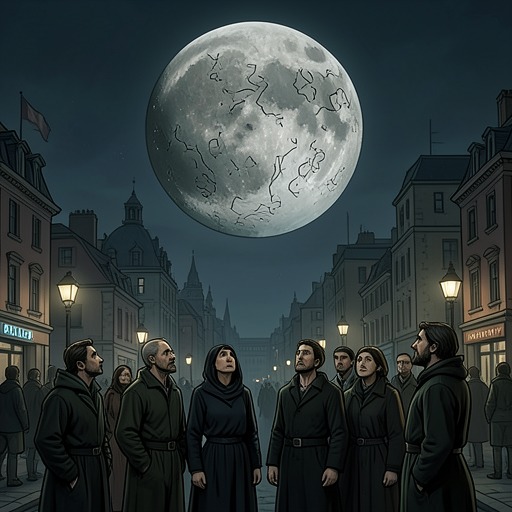
StrangersThe Fallen Moon is the image through which the witnesses first experience the spacecraft’s arrival at the Tranquility Grille: a brilliant moon seems to bear down on them, changes from frost-white to blood-red, and is recognized as something other than the moon. The image matters not only as a frightening misperception but as the memory’s recurring hinge. When the survivors begin to remember the forbidden night, the falling moon joins scattered sensations to the fact of the ship, while Marcie’s repeated word becomes a small, tentative route back toward recognition.
The Moon Before Recognition
The image returns through Sandy Sarver’s recollection after Parker Faine’s revelation that something had come down from the sky. Until then, the night had been blocked from the witnesses’ memories. Sandy’s response is immediate: large portions of the forbidden night break loose, and she describes the fourth jet passing so low over the motel that it seemed almost to take off the roof. People had left the diner and gathered from the motel, but the shaking continued. The ground vibrated like an earthquake; the air vibrated too. The physical commotion comes before the explanation, so the memory initially offers sensation rather than understanding.
Sandy recalls Dom Corvaisis turning away from the jets, looking back across the diner roof, and shouting, “The moon! The moon!” The others look up. It is brighter than usual, unnervingly bright, and for a moment seems to be falling on them. Her telling carries both delight and trepidation; the truck falls silent as the others listen. Ernie Block answers softly that he remembers, and Brendan Cronin says that he remembers too. Their brief responses show the image doing more than describing Sandy’s private recollection: it begins to reopen a shared night.
From Frost-White to Blood-Red
The remembered sky is not quiet or serene. People scream and begin to run as the shaking and roaring grow louder. Sandy recalls a sound like kettledrums and shotgun blasts mixed with an immense wind, though there is no wind, with a strange whistling, warbling, flutelike sound beneath the thunder. The moon suddenly grows brighter. Beams descend from it and cast a frosty glow across the parking lot; then the light changes, and the moon turns blood-red. In that turn, the witnesses understand that what they took for the moon is something else.
Jorja Monatella’s recovering memory follows the same change of color: the form turns from frost-white to scarlet. The recollection unsettles her, but it also brings understanding, and the barriers implanted by the mind-control specialists begin to crumble. The image of the moon is especially charged because Jorja had often looked at Marcie Monatella’s album of moons without being led back to what she had seen. Now the connection arrives all at once. Her trembling combines fear of the unknown with exultation: the recovered image is frightening, but it also makes the past legible.
The Apparition Becomes a Ship
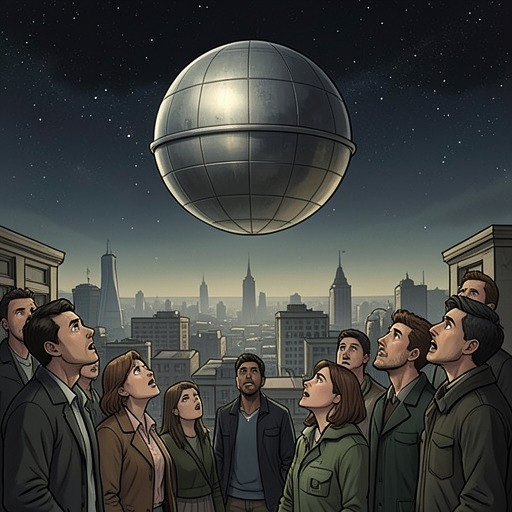
Sandy remembers the object passing over the diner slowly, no faster than a blimp, despite appearing impossibly heavy. Its slow movement and weight contradict the familiar image of a lightweight balloon; its beauty and strangeness make the witnesses certain that it is not something made on their world. Jorja’s recollection places her in the Tranquility Grille parking lot with Marcie in her arms, watching the craft glide through the warm July night. It might have looked serene, but the thunderous noise and vibrations beneath it made that serenity impossible to separate from fear.
The memory’s recognition is not produced by a spectacular design. Jorja recalls that the craft did not resemble the flying saucers and rockets of movies and television, nor did it display the expected exotic lights, protrusions, or blazing exhausts. Its existence, rather than a familiar science-fiction appearance, is what makes it extraordinary. The falling moon is thus an image created by the witnesses’ first encounter with something their experience cannot immediately name: the celestial form gives the event a recognizable shape, but the color change and the ship’s movement break that first interpretation open.
Marcie’s Word and the Physical Evidence
After the memories begin returning, Marcie murmurs “Moon, moon” against Jorja’s neck. Jorja wants to reassure her that remembering will reveal something wonderful rather than frightening, but she cannot promise a happy ending while the group remains in Leland Falkirk’s custody and she does not know what he intends to do with them. The image therefore remains double-edged: it offers a path toward understanding, but the danger surrounding the witnesses has not passed.
Later, beside the spacecraft resting on trestles, Jorja carries Marcie over to Jack Twist. Having already experienced the collapse of her memory block, Jorja is still overwhelmed by the sight of the ship. She touches its mottled, scorched, abraded hull and feels fear, wonder, and delight together. Marcie reaches out too. When she says, “The moon. The moon,” Jorja can answer with what the earlier memory could not yet supply: it was not the moon falling, but this ship, glowing white like the moon, then red, then amber. Marcie traces the vessel’s flank and says, “Moon fell down.” The words preserve the original misrecognition even as Jorja gently revises it.
Recognition Without Erasure
Marcie’s response does not simply replace the moon with a correct label. The ship is at once the thing she saw descend and the moon-shaped image through which the encounter has endured in memory. Jorja explains that it is a spaceship, comparing it to the kind seen in movies. Marcie looks directly at her and asks, “Like Captain Kirk and Mr. Spock?” Jorja agrees, and Jack adds another familiar point of reference, Luke Skywalker. The exchange gives an overwhelming reality a form Marcie can approach without pretending that the original fear has vanished.
Across these returns, the image moves from apparition to testimony and then to touch. First it is a bright, apparently falling moon; next it is the remembered color sequence that exposes what the witnesses actually saw; finally it is the physical hull beneath Marcie’s hand. The recollection restores knowledge, but it does not make the encounter harmless or erase the uncertainty of the witnesses’ captivity. The Fallen Moon holds those consequences together: the terror of seeing the unknown descend, the delayed return of a memory suppressed, and the possibility that naming what happened can begin to turn fear into wonder.