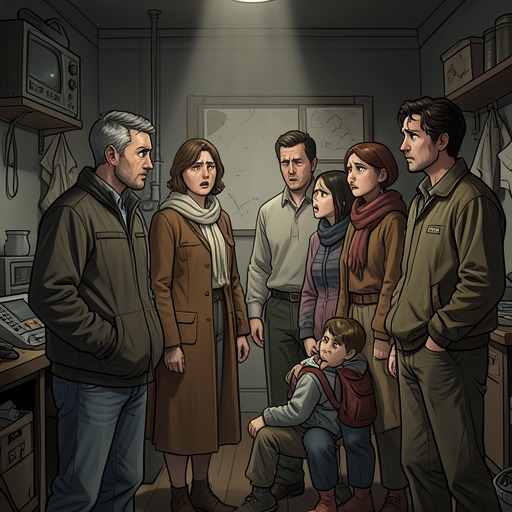
Fear of the dark
StrangersFear of the dark transforms an ordinary part of Ernie Block’s life into a threat he cannot reason away or safely disclose. At fifty-two, Ernie experiences the fear as both an assault on his independence and a danger to his marriage: he hides it from Faye, fears that it signals premature senility, and finally has to accept her help. Its force is most sharply rendered in a nighttime flight across the interstate, where the darkness seems to reach for him, and in an unexplained urge to escape from his own home.
Onset and Concealment
Ernie has known danger before. During his service with Marine Intelligence in Vietnam, he drove through enemy fire, survived more than twenty near-misses, suffered several painful mortar wounds, and escaped in a Jeep running on four flat tires. He had believed that experience had shown him the full measure of fear. The fear that develops now is different: it is not attached to incoming shells or a visible enemy, but to darkness itself, and its irrationality makes it harder for him to understand.
For two and a half weeks after Thanksgiving, Ernie conceals the problem from Faye. While she is away visiting Wisconsin, he allows himself to sleep with a night light; after she returns, he continues to need a lamp, though he does not tell her why. He uses Murine to clear his bloodshot eyes each morning, a small practical measure that helps maintain the appearance that nothing is wrong. Even a short, well-lit walk from the motel office to the Tranquility Grille can leave him feeling fragile and vulnerable, yet he keeps the fear to himself.
His silence is bound up with his sense of duty. Ernie has spent his life doing what was required of him, and he is determined not to fail his wife. The Block family’s expectation that men do not let their women down makes disclosure feel like another possible failure. In this frame, the fear threatens more than his comfort: it endangers the role of capable provider that he believes Faye depends on.
The Interstate Episode
The fear becomes unmistakable on the drive back from Elko to the Tranquility Motel. Ernie has gone to collect lighting fixtures, but a flat tire and the delay of getting it repaired leave him nearly two hours behind schedule. With evening approaching, he races west in the Dodge van, passing traffic because he cannot imagine completing the drive in full darkness. He even pictures the consequences of being caught out after nightfall: in the morning, someone might find him by the roadside, mentally broken by hours of staring into the black landscape.
The motel’s blue and green neon sign appears ahead as a beacon against twilight. About three-quarters of a mile from home, however, Ernie notices a piece of ground south of the road. He feels that it is crucial to understanding the strange changes in him, although he cannot identify what makes it different from the surrounding landscape. The pull of the place briefly overrides his fear. Once he gets out to examine it, the sense of importance evaporates; he can no longer see why the land seemed special.
Then nightfall reasserts itself. Ernie realizes how little light remains and bolts across the interstate without checking for traffic. A horn sounds as he runs, falls into the shallow divider gully, scrambles up the other side, and hurries back toward the van. He experiences the darkness as something with grasping force, rising from depressions in the ground and reaching beneath the truck to seize him. He yanks open the door, climbs into the cab, and locks himself inside.
The headlights offer temporary reassurance, but Ernie is shaking too violently to pull into traffic. He drives along the shoulder to the exit, follows the sodium-lit ramp, and then has to leave that pool of light for the county road. The motel is only two hundred yards away. He reaches it, parks by the office, switches off the headlights, and cuts the engine: the journey ends at home, but the fear has followed him there.
The Bathroom and the Urge to Flee
Three days after the interstate episode, Ernie cannot sleep. As darkness settles, his nerves tighten until he fears he will begin screaming and be unable to stop. He slips out of bed without waking Faye and sits in the lit bathroom, savoring its brightness while trying not to arouse her suspicions. The light is a refuge, but only a temporary one; eventually he has to return to the bedroom.
After flushing the toilet to disguise his movements, Ernie washes his hands and notices the frosted window above the bathtub. It is about three feet wide and two feet high and opens outward. Looking at the opaque pane brings a shiver, followed by a sudden, urgent sequence of thoughts about climbing through it, crossing the utility-room roof, reaching the arroyo behind the motel, and escaping into the hills to find help. Ernie does not remember walking from the sink to the bathtub. The impulse is not a deliberate plan grounded in any threat he can identify; he is bewildered by the desire to escape from his own home, where he knows he has nothing to fear.
When Faye discovers him at the window, Ernie reports seeing a figure in motorcycle gear, with a helmet and gloves. He looks across the utility-room roof but finds nowhere deep enough to hide a person, leaving open the possibility that the intruder never existed. What is not uncertain is the darkness beyond the motel: as Ernie becomes aware of the black hills and distant mountains, weakness and vulnerability overwhelm him. He drops back into the bathtub and turns away from the window. At Faye’s direction, he shuts it with such force that he nearly breaks the pane, then struggles to secure the latch while avoiding another look at the night.
Diagnosis and Significance
In the aftermath, Faye listens to Ernie in the kitchen with the blinds closed and all the lights on. He has interpreted his symptoms as possible premature senility or Alzheimer’s disease, imagining that he may become mentally incapacitated and a burden to her. Faye takes his fear seriously but rejects that explanation. Drawing on what she has read and her experience with her father, she tells him that the pattern does not sound like Alzheimer’s; it sounds like a phobia, an irrational fear that can be overcome.
Ernie’s fear is made especially disturbing by the contrast between his earlier endurance and his present helplessness. A man who survived combat and insists on protecting his wife cannot master the approach of night by willpower alone. The scenes give darkness an apparent physical agency—something that presses down, clutches, and reaches for him—while keeping the source of the threat uncertain. The result is not simply a fear of being unable to see: familiar spaces, including the motel and his own bathroom, become difficult to inhabit once their light fails. Faye’s diagnosis offers a name and the possibility of help, but the evidence here does not yet establish how the fear began or how it will be overcome.