Red Moon Imagery
StrangersRed Moon Imagery turns a child’s repeated drawings into a visible trace of memory that Marcie cannot yet recover or explain. The moons recur in her drawings and chanting, then become the object of a sudden cry of terror; when Leland Falkirk encounters the same red images in her album, his carefully maintained composure breaks into violence. The motif makes an otherwise inaccessible past present in the story, while leaving its precise contents unresolved.
Repetition and the Search for Memory
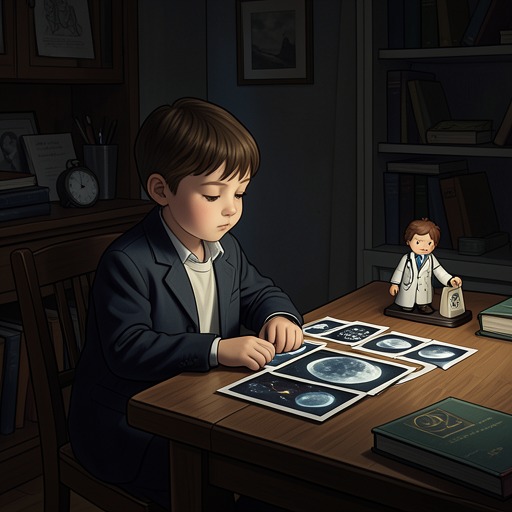
At the kitchen table, Marcie colors moons again and again, murmuring one word in monotonous, mesmeric, rhythmic chains. The scene makes the image more than a subject of a drawing: it is an activity and a sound loop, a pattern she cannot seem to leave. The repetition gives the motif a force that exceeds deliberate explanation. Marcie does not tell anyone what the moons mean; the reader sees the fixation before understanding its cause.
By the following night, Ginger sees that Marcie has worsened. The girl sits with her head bent, her face half-hidden by thick black hair, staring at her tiny hands as they lie limp in her lap. Her speech contracts to the recurring word: “Moon, moon, the moon, moon”. Ginger recognizes that Marcie is pursuing memories of July 6, still teasingly close to awareness but inaccessible. The account ties the moon fixation to this search without disclosing what Marcie is trying to remember. The drawings and chant therefore register an approach to memory, not a recovered account of the past.
Jorja insists that Marcie will come out of her state, and Ginger offers reassurance even though she knows how empty her words sound. Their different responses mark the strain of witnessing a memory struggle that cannot yet be translated into explanation. The moon image supplies a repeated sign where Marcie’s own account is unavailable; it makes the persistence of the search perceptible without pretending that the search has succeeded.
The Album and Falkirk’s Composure
Later, in the Blocks’ kitchen, Leland Falkirk opens an album lying on the table and finds photographs and drawings of the moon, all colored red. A dozen DERO troops search outside in the raging wind, and vehicles are being driven around behind the motel. Against this urgent pursuit, Falkirk turns the album’s pages and encounters the child’s collection: scarlet moons, repeated across the images.
Falkirk performs calm as a form of command. He gives Lieutenant Horner instructions to send men after the escaped witnesses and to meet him with a county map, reasoning that they will try to reach a county or state road. Alone, he continues through the album: a page, then another; more red moons. The narration repeatedly emphasizes how calmly he turns the pages, making his self-control increasingly conspicuous. He prides himself on being unfazed, but the sequence sets that claim beside the accumulating images rather than confirming it.
After seeing more red moons, Falkirk throws the album across the room. Its pages strike the cupboards and refrigerator; a score of scarlet moons flutter free. He then smashes a smiling bear-shaped cookie jar, scattering chocolate-chip cookies over the album and its fallen images, and sweeps or throws other kitchen objects to the floor. The violence is specific and domestic: the red drawings lie among broken crockery, crumbs, and scattered household things. The text does not explain what Falkirk recognizes in them, but the abrupt transition from controlled page-turning to destruction makes the album a pressure point in the scene.
The rupture does not end his performance of authority. Falkirk breathes deeply, leaves the kitchen, and goes downstairs to study the county map with Horner, once again described as calm. The return to planning contrasts with the wreckage upstairs. Red Moon Imagery thus places private disturbance beside the machinery of pursuit: the officer can resume issuing orders, but the episode has exposed the instability beneath his insistence on control.
Terror, Contact, and the Unopened Memory
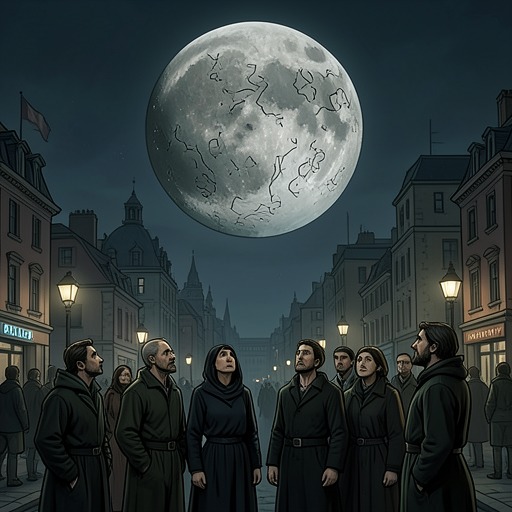
As the group travels through the snowy night, Marcie cries, “The moon!” and screams for her mother to look. She tries to wrench herself free of Jorja, who cannot hold on to her. The scene turns the earlier quiet repetition into bodily alarm: the word that had accompanied her drawings now comes out as a cry, and her attention to the moon is bound to an immediate, inexpressible danger. The text does not establish what she sees, so the force of the moment rests on her terror rather than on a confirmed apparition.
Marcie gradually stops struggling and screaming, returning to a soft chant of “Moon, the moon, moon”. Then she says, “Don’t let it get me, don’t let it, don’t let it.” Ernie Block pats and strokes her hair and tells her she is safe. Brendan Cronin identifies the shift as a moment of memory: “She remembered something,” he says, adding that “A crack opened for just a moment.” The brief opening is significant precisely because it does not become a full explanation. When Jorja asks what Marcie saw, the girl has already slipped back into a deep, unresponsive state.
Even in that withdrawal, Marcie tightens her arms around Ernie and holds on as the Cherokee rocks through the snowy night. The gesture offers a small, physical counterpoint to the threatening moon and the memory she cannot yet narrate: she remains adrift, but she can seek safety in another person’s embrace. Across the drawings, the album, and the roadside outburst, the red moon motif joins repetition, concealed memory, and fear without resolving them into a single disclosed cause. Its recurring presence marks the past as active in the present, while the momentary crack in Marcie’s awareness suggests that what has been inaccessible may return only in fragments.