Disguised as Prisoner Escorts, Crossing the Bridge and Escaping the Camp
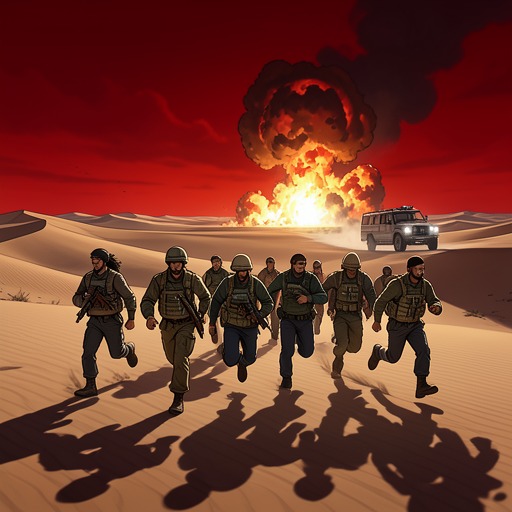
StrikeDisguised as prisoner escorts, Tucker Pierce, Tori Sleeper, and Kent Berringer cross the Bridge with Chief Brock and Master Sergeant Sanchez, using a transfer order to pass through the future dome and return to the Retro camp. The crossing succeeds without detection, but the escape is exposed almost immediately on the past side: a former camp commander recognizes Tucker, forcing the group to abandon stealth and flee under fire. The action turns a carefully staged deception into a desperate vehicle escape across the open Mojave Desert.
Context and the Cost of Escape
The camp’s security has already shown both its brutality and its vulnerabilities. Earlier, a disturbance draws attention across the grounds: prisoners gather with locked arms and chant for water as smoke and fires rise nearby. The explosions appear intended to make noise rather than destroy buildings. While guards are distracted, orange-clad prisoners board a bus in silence. The demonstration is revealed as a diversion for a prison break, with the crowd effectively sacrificing its own chance to escape so that a smaller group can get away. That episode establishes the stakes of escape in the camp: distraction can create an opening, but it depends on coordination and on people accepting danger for one another.
Recognition is another persistent threat. During an earlier inspection, Scottie steps out of line and calls attention to the man Feit is about to inspect. Later, as Tucker’s group is being taken through a seemingly hopeless situation, a soldier lifts a hand to his heart. The gesture surprises Tucker and suggests that not every uniformed guard is simply an enemy, though it offers no guarantee of help. Against this background, a transfer disguise offers a more controlled route out: rather than relying on a riot or a hidden ally, the group must make its passage look routine to the security system and the personnel watching it.
The Transfer Disguise
Before the group reaches the dome, Brock explains the arrangement: they will park a hundred meters away, approach on foot in an escort formation, and pass a checkpoint where their badges will be scanned. Their orders have been entered into the system. Brock is to speak for the group as the officer in charge, while the others are to remain silent unless directly questioned. The cover story is simple—a prisoner is being transferred to the forward camp—and its apparent legitimacy depends on everyone preserving the same disciplined appearance.
The drive through the filthy streets is quiet. Brock assigns the positions: Tori Sleeper and he will lead, with Kent Berringer and Sanchez behind, around Tucker as the prisoner. At the dome’s perimeter, a low metal fence channels personnel toward the security check. Tucker keeps his hands visible, folded in front of him, while feeling the two pulsers concealed in his sleeves and mentally rehearsing how to bring them into play. The weapons provide a contingency, but the immediate plan is to avoid provoking the guards at all.
Brock presents his black pad and announces the prisoner transfer. The guard checks his own device, apparently verifying the orders Colonel Pike has placed in the system. The group passes through. The successful checkpoint crossing is a narrow victory: the cover works because the forged appearance of routine is backed by instructions already present in the system, not because the guards have been overpowered or deceived by an improvised explanation.
Crossing the Bridge
Inside the future dome, the giant doors stand open. The group sees a hovering Retro fighter by the Bridge and soldiers guarding the structure. The scene makes the larger danger tangible: Retro aircraft are poised to pass into the past, and the dome will have to be closed by the Sounders before a blast can be contained. The escort party’s passage occurs amid preparations for a wider struggle, not in a secure or empty facility.
Brock steps into the light first; Tori follows, then Tucker, without hesitation. The crossing feels like stepping through a doorway, with no sensation of movement despite the centuries and different stream of existence on the other side. The past dome looks much as it did the previous day, apart from a black plane that has floated out through the huge doors. Kent comes through behind Tucker and remarks on how much better the place smells. The momentary observation marks the contrast between the two settings, but the group has little time to absorb it: Tucker is back in the camp where he, Tori, and Kent are known prisoners. They have escaped once already and are now attempting a second escape.
A separate, future-side movement places the crossing within the operation’s broader scale. Five kilometers away and three hundred years ahead, Colonel Pike leads Airman Eric Lewis, Airman First Class Olivia Kinsey, and the civilian nuclear engineer Liger along a street toward the Bridge City dome. They pass a queue of black aircraft waiting to travel into the past. Their calm, purposeful progress contrasts with the immediate risk faced by the group crossing back into the camp, while the planes embody the invasion the operation is trying to confront.
Exposure and Flight
Brock and Tori lead the group out of the dome into the Mojave’s bright light. The camp has been cleared of visible wreckage from the previous day’s SYLO attack: even a burned barracks has become an empty patch of sand. The attack appears not to have changed the camp’s operation, and the group still has to reach a vehicle waiting thirty yards away. For a few steps, Tucker allows himself to think they may make it.
Then a woman calls Tucker by the prisoner number he hoped never to hear again. She is the commander of blue unit, leading prisoners across the open ground in front of the dome. She recognizes him, sees that two other prisoners are also present in Air Force uniforms, and reaches for a communicator. Brock announces that the show is over and fires his pulser, knocking her to the ground. The disguise has bought them passage through the checkpoint and the Bridge, but it cannot survive recognition by someone who knows Tucker from the camp.
Sanchez immediately calls for the group to run to the Humvee. He and Brock get in front; Tori, Kent, and Tucker climb into the back, and Sanchez starts the gas engine and accelerates. Tucker draws the two pulsers from his sleeves as Retro soldiers appear from multiple directions and fire at the vehicle. Sanchez swerves at speed to make the Humvee a difficult target. Energy shots strike its heavy body and rattle the passengers, but the vehicle keeps moving. Prisoners scatter as the soldiers try to get a clear shot.
Outcome and Significance
The escape becomes decisive when Sanchez drives beyond the last barracks and out of the camp. There are no surrounding fences; after the Humvee passes the line of huge antiaircraft guns protecting the dome, open desert stretches ahead. Kent’s shout of triumph is checked by Tucker’s warning that the group is not yet safe, since it could still be followed. The immediate break from the camp succeeds, but the flight has not yet become security.
The sequence links individual discipline to collective resistance. Pike’s pre-entered transfer orders, Brock’s command of the cover story, the group’s assigned positions, and Sanchez’s driving each serve a different part of the escape. At the same time, the earlier diversion and the unexplained soldier’s hand-over-heart gesture show a camp where resistance may depend on sacrifice or quiet allegiance as well as force. The failed attempt at stealth makes the limits of planning plain: the disguise can pass a checkpoint, but a face and a number remembered from captivity can undo it. Once recognized, the group survives by acting together and turning the planned escort into an armed flight.