Tucker’s Attempt to Reach the Dome
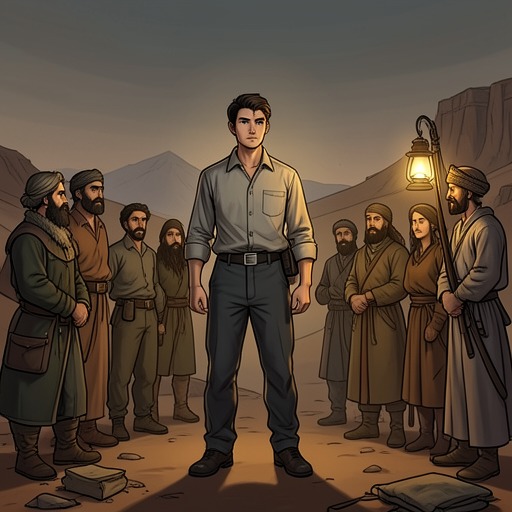
StrikeTucker’s Attempt to Reach the Dome is a decision made amid a prison-camp uprising and an ongoing air attack: rather than flee into the desert, Tucker turns toward the dome, believing it may hold the truth he needs. He sets out alone, but Tori Sleeper and Kent Berringer come after him and insist that the three will face the danger together. The attempt turns a moment of apparent defeat into a deliberate move toward the story’s central mystery.
Camp in Turmoil
The choice takes shape inside a camp whose geography makes the dome impossible to ignore. At its center, the giant steel structure rises like the hub of a wheel, with roads and buildings radiating outward. A short runway leads to its massive door; because the black fighters take off and land vertically, they need little runway. A concrete tarmac around the dome holds idle aircraft. From the infirmary roof, Tucker can see how the camp occupies the surrounding desert, though not the hundreds of antiaircraft cannons that have defended the dome against SYLO attacks or the wrecked fighters scattered beyond it.
Elsewhere in the camp, smoke and fire mark what first appears to be a prison riot. Several blasts have produced black clouds and fires, but the buildings remain standing. Tucker reads the limited damage as a sign that the explosions are intended to make noise rather than destroy structures. A growing crowd of prisoners locks arms at the edge of a clearing and chants for water. The scene’s meaning changes when orange-clad prisoners quietly board a bus: the demonstration is a diversion, drawing Retro guards away so that a smaller group can escape. Those in the courtyard are accepting the risk of holding the guards’ attention for the escapees.
The escape attempt does not remove Tucker’s immediate danger. Feit and Major Bova move down a line of prisoners toward him and his companions. Scottie, the woman from the barracks, steps out of line and calls attention to the person Feit is about to inspect. Her shout abruptly makes concealment seem impossible. Later, as Tucker and his companions are being taken along, a nearby soldier puts a hand over his heart. Tucker stops in surprise. The gesture is not explained, but it interrupts the sense that every person around them is simply part of the force closing in.
Choosing the Dome
The decisive opening comes from the air attack. Tucker sees two scorch marks on the dome from missile impacts, but the structure otherwise appears untouched. The attacks have failed to damage it, and the latest strike reinforces the impression that the assault is not going to open a path by destroying the target. Tucker decides instead to use the disorder around him to reach it himself.
Tori warns that staying is suicidal. Tucker argues that flight offers no safety: the group is in the middle of nowhere, has nothing with which to survive in the desert, and would be rounded up once the attack ended. Kent adds that going after Tucker’s mother would amount to giving themselves up. Tucker answers with a third option: the dome. As another missile strikes its outer skin and leaves it unharmed, he identifies the absence of the Retro guards as an opportunity. Kent and Tori are stunned by his proposal to run toward the very target under attack.
Tori suggests a different course: leave the camp, disappear into the desert, and try to reach SYLO. Tucker agrees that this is what his friends should do, but says he cannot go with them. He tells them he loves them, then runs toward the dome before he can reconsider. His departure is both a practical choice and a separation: he accepts the possibility of facing the danger alone in order to pursue the truth, while leaving behind the two people who have been beside him.
The Approach and Reunion
The air battle continues as Tucker runs. One missile misses the dome and hits a barracks that is already burning; the building has been evacuated, and a second United States Navy fighter breaks off without firing. The attack’s danger is therefore immediate, but it also keeps the camp in the confusion Tucker hoped to exploit. He questions whether finding out what is inside the dome is worth abandoning his friends, and whether the truth could help save his mother. He nevertheless continues, convinced that he has committed himself and cannot turn back.
Tucker takes cover along the outside wall of a large cement building beside the dome. It looks more like a command center than a barracks. Keeping away from its windows, he reaches the far end and cautiously looks around the corner: the dome is only fifty yards away. This is the same spot where Retro guards had stopped the group earlier that morning. Now those guards are gone, apparently sheltered in underground bunkers, and the dome is unprotected. The distance makes Tucker’s goal suddenly concrete, but it does not make the crossing safe; the air battle is still audible and ongoing.
Then Tori and Kent arrive behind him. Tucker protests, but Tori says they are not splitting up again. Kent recognizes the absurdity of running toward a target everyone else is fleeing, yet he stays with them. Tori makes their shared decision explicit: they will go together. Tucker knows her determination and gives up his attempt to argue. The reunion reverses the isolation created by his departure: the friends who seemed to be leaving him instead choose to share the risk.
Significance and Narrative Frame
The attempt is defined by a reversal of direction. In the camp, prisoners use noise and spectacle to draw authority away from an escape route; Tucker sees the air assault and absent guards as cover for movement toward the dome. Where the bus diversion helps a handful of prisoners flee, Tucker’s plan carries him toward the structure at the heart of the camp. The same turmoil that makes escape seem urgent also gives him the opening to pursue a different objective.
The episode also distinguishes between getting away and learning what the dome conceals. Tucker does not believe the desert can protect his friends, and he does not accept that retreat toward SYLO is the only alternative. His decision is not presented as a completed arrival or a successful entry: the evidence follows him to the dome’s immediate perimeter and shows Tori and Kent joining him there. In the book’s wider retrospective account, the narrator notes that some later events had to be pieced together from what others reported. It then shifts to a separate group, three hundred years in the future and five kilometers farther ahead, approaching the dome in Bridge City. That later approach is distinct from Tucker’s, but the juxtaposition places his movement toward the camp’s dome within a larger conflict whose struggle also converges on a dome across time.