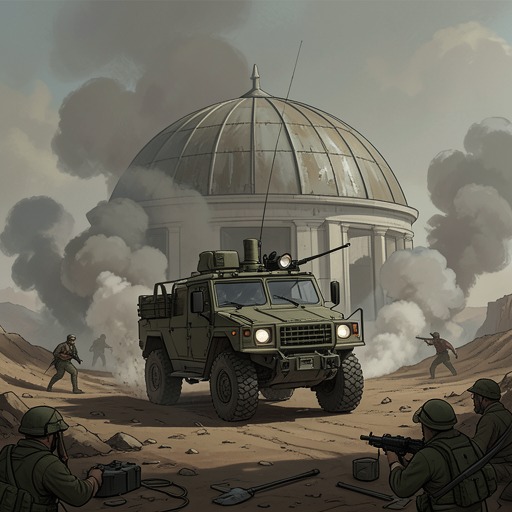
SYLO and the Sounders Attack the Retro Prison Camp
StrikeSYLO and the Sounders Attack the Retro Prison Camp is a coordinated assault that shifts the battle for the camp and its dome. Sounder-controlled drones first dismantle the Retro antiaircraft defenses; SYLO helicopters and ground forces then press the advantage, relieving Sounders under attack at the dome. The operation turns on coordination across forces and fronts, but its meaning is complicated by the characters’ awareness that fighting for survival can also normalize killing.
The Signal and the Opening Move
The attack begins in the desert with Tucker, Tori Sleeper, Kent Berringer, and Captain Granger waiting for word. Tori clutches a communicator whose screen is blank. The quiet is broken by faint musical notes, followed by black drones appearing far away above the Retro camp. One becomes two. Their arrival prompts Captain Granger’s alarm, but the drones pass over the waiting group without firing. For a moment, the apparent threat remains uncertain; then Tori delivers the message that resolves it: “We own the sky.” Kent confirms that he has received the same signal and that the drones are in.
Tori’s words are both a report and a declaration of changed control. The drones arc away in opposite directions, and Captain Granger orders the attack to begin: “This is it! Fire it up! Strike! Strike! Strike!” SYLO soldiers rise, vehicles start, and the stillness gives way to the movement of an advancing force. Tucker, Tori, and Kent remain momentarily stunned as the operation they had been waiting for becomes real. Captain Granger, watching the drones, qualifies the declaration: “We do not own the sky. Not yet. But we will.” The distinction between present control and the objective still to be won gives the signal its force: the assault has begun, but the camp and dome are not yet secured.
The Drones Break the Defenses
The drones do not attack the waiting group. Instead, they fire at the ground around the camp, targeting the antiaircraft guns that had helped the Retros repel attacks from the air. From a distance, Tucker’s party sees explosions spreading around the camp as the weapons are destroyed. Tori recognizes the maneuver as Captain Kenny Sokol clearing the way. Captain Granger orders every available force brought in, and seconds later helicopters fly toward the camp in formation. He tells the group, “Now we own the sky,” while making clear that taking the dome remains the next objective.
The attack exploits the Retro defenders’ uncertainty. They have been attacked before, but this time their own aircraft appear to have turned against them. The artillery gunners hesitate, realizing too late that they should be firing at those aircraft. That lost time gives the drones an opening to concentrate their fire on the large guns. The Retros’ delay is not merely confusion in the air: it disrupts their ability to coordinate a defense of the dome while the attack develops around them.
The prisoners, meanwhile, are herded into the barracks and locked inside. The guards’ decision reflects a change in tactics after prisoners escaped into the desert during an earlier air raid. It also removes guards from the immediate defense of the dome. The camp’s commanders have to respond to threats on several fronts, and the effort to contain the prisoners leaves fewer defenders available when the Sounders come under pressure.
The Fight for the Dome
At the dome, a small Sounder force and Captain Kenny Sokol’s commandos meet the Retro soldiers moving to retake it. The Sounders inside the camp have prepared for the attack: they place armored vehicles across the giant open entrance as a barricade and position armed defenders inside on either side of the opening. The first Retro advance meets the Sounders’ heavier firepower. The Retros carry smaller weapons and retreat toward nearby buildings for cover.
The initial advantage does not remove the imbalance in numbers. For several minutes the sides are locked in a standoff, with dozens of Retros facing only a handful of Sounders. Retro commanders order their soldiers forward despite the casualties, and the advancing force grows as the guards who had been rounding up prisoners join the fight. Some attackers reach the entrance, but the defenders stop them before they can enter. The Sounders hold the position, yet the size of the force pressing against them makes the outcome uncertain.
The wider attack is also dangerous for the approaching SYLO convoy. Tucker’s group draws close enough to see damaged antiaircraft weapons near the barracks, while others are still aimed toward the sky or levelled at the vehicles. An explosion hits beside their truck and throws it sideways. The arrival of six SYLO attack helicopters changes the immediate danger: they swoop low and fire missiles into the large guns, setting one ablaze and driving the gunners away. The drones are no longer acting alone; the helicopter strike helps clear the route for the ground force.
SYLO Arrives and the Battle Turns
As the Sounders’ defense at the dome begins to falter, Captain Granger asks Tori to send a message. He tells her to tell the others to look to the sky. Several SYLO helicopters appear above the dome, interrupting the Retro advance. Armed SYLO commandos descend by zip lines from the aircraft and move toward the entrance. Some are hit while descending, but the others land, return fire, and force Retro soldiers to take cover. Their weapons may be far less technologically advanced than the Retros’, but the account emphasizes their effectiveness in disciplined groups: the commandos move between buildings and use covering fire to protect one another.
The sudden reinforcement forces the Retros to shift from advancing on the dome to defending themselves against attackers arriving from several directions. A SYLO soldier who enters the dome is initially challenged by a Sounder commando; another recognizes that the young allies have helped bring SYLO into the fight and reassures the defenders, “The kids did it. They’re fighting for us.” The line marks the operation’s change from separate resistance and intervention to a visible joint effort. The account calls SYLO’s arrival the cavalry, but the battle remains a contested assault rather than a completed victory: the forces have broken the immediate pressure on the dome and gained room to act, while the broader fight is still underway.
Victory and the Cost of Fighting
The operation takes place against a campaign to colonize the past by replacing its population with people from the twenty-fourth century. Captain Kenny Sokol describes the undertaking as planned over years by the military and the United States government; he says that many oppose it, but that the Sounders are a small minority and public opinion supports the invasion. That context makes the alliance at the camp more than a tactical arrangement: SYLO’s force is helping the Sounders resist a state-backed project, while the Sounders’ control of the drones gives the assault its opening advantage.
The characters’ earlier argument about killing complicates any simple equation of military success with moral innocence. Tori points out that they condemn the Retros’ disregard for human life while accepting deaths when those deaths serve their own aims. She recalls the people killed when the group sabotaged a Retro fleet and admits that she thinks about having shot people herself. When she asks whether Tucker would press a button to end the invasion and save the survivors if doing so erased the entire population of 2324, his immediate willingness exposes the reach of the choice confronting them. The assault on the camp advances their effort to protect their own time, but it cannot settle the question of what means that effort permits.
Later, Tucker reflects that the group has been fighting for its survival and for the planet, while also recognizing that revenge had helped drive him and that winning would leave the survivors responsible for rebuilding. His statement that “the killing has to stop somewhere” links the campaign’s military urgency to a harder question about what kind of world victory is meant to preserve. In that light, the attack’s defining reversal is not simply that the sky changes hands: it is that a successful alliance against invasion still has to reckon with the habits of violence it has adopted in resisting it.