Kent and Tucker’s Prison Camp Fight
StrikeKent and Tucker’s Prison Camp Fight is the turning point in a camp spectacle designed by Major Bova: Tucker discovers that Kent Berringer has survived, then risks himself to stop another prisoner from killing him. The rescue saves Kent from the immediate attack, but it does not end the camp’s violence; Bova executes the other prisoner moments later.
The camp’s rules and Bova’s spectacle
The fight unfolds after Tucker has been reduced to a number in the Retro camp. A woman identifies him as Zero Three One One, and the camp’s machine insists that he has no mother or friends, only an assigned identity and future. It warns him not to speak with Air Force personnel or other workers except about their tasks, threatening severe consequences for disobedience. Against this system of enforced anonymity, the struggle that follows begins with Tucker recognizing someone from his former life.
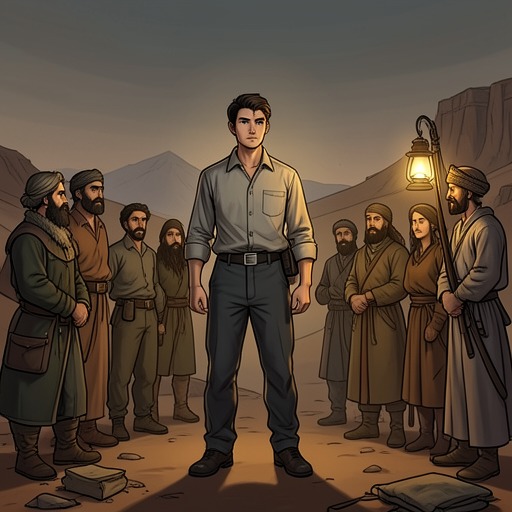
Major Bova presents himself to the prisoners as their host, introducing himself by name even as he declares that names are not used in the camp. His courteous manner sits uneasily beside his authority over the workers. To punish two young men who had tried to escape, guards drag them from jeeps and place them before the assembled prisoners. Bova describes the attempted escape as a mistake he might forgive, then makes the punishment a forced contest: one prisoner will be spared, and the other will die. He has the overhead floodlights extinguished, leaving the jeep headlights to illuminate the men on the ground. The staging turns a threat of execution into a public performance.
Tucker initially does not know who the prisoners are. When he finally sees their faces, he recognizes one of them as Kent Berringer. Kent’s survival means more than the return of a friend: Tucker takes it as evidence that his mother and Tori may also have survived the crash and separation. That recognition transforms the scene from an imposed spectacle into an immediate personal emergency.
Tucker’s intervention
The contest becomes lethal when the shorter prisoner reaches one of the jeeps and pulls out a heavy piece of metal, like a crowbar or pipe. The guards have no time to react before he runs after Kent, who is still turned away and unaware of the attack. The escape attempt has thus become a trap: the man whom Bova has made a participant in the spectacle is now attacking Kent from behind.
Tucker breaks from the crowd as the attacker pins Kent down and presses the metal bar against his throat. He throws his shoulder into the man’s back, disrupting the chokehold long enough for Kent to be released. The interruption is an immediate physical risk, not a calculated challenge to Bova: Tucker moves because Kent is seconds from being strangled. Once the attacker recovers, the fight shifts from Kent’s struggle for breath to a close, chaotic grapple between him and Tucker.
Both men reach for the dropped pipe. Tucker gets to it first and strikes the attacker on the side of the head, leaving him motionless in the sand. He waits to see whether the man will resume the fight, then keeps hold of the pipe as he approaches Kent, uncertain whether the pressure on his throat has killed him. Tucker’s rescue is therefore not complete at the instant the attacker falls; the weapon remains in his hand while he checks on the friend he has just found.
Bova’s verdict
The attacker’s brief advantage does not earn him the promised reprieve. Major Bova acknowledges the attempt as treachery, but treats its failure as decisive: the man has proved himself “not deserving.” The judgment exposes the contest’s cruelty as more than a staged choice between two prisoners. Bova reserves the right to redefine what counts as deserving after the violence has played out, so the promise of mercy offers no dependable path to safety.
Bova presses his weapon into the prisoner’s gut and fires. The man cries out and falls dead; shocked gasps move through the crowd. Tucker’s intervention has saved Kent from the attack, but it cannot save the attacker from Bova’s punishment. The fight thus ends with two sharply different outcomes: a friend survives because Tucker acts, while the camp commander turns the failed escape and public contest into an execution.
The fight within the colonization system
The violence around Kent and Tucker belongs to a wider program of coercion, not merely Major Bova’s improvised punishment. Elsewhere, colonization recruits are instructed to maintain water-filtration plants and, if possible, press surviving natives into service; the stated goal is to operate without their support. An officer who knows Bova describes him as unusually cruel toward native workers and says that greater humanity might have allowed the colonization camp to be completed sooner. The larger mission, planned for years by the military and government, is to replace the twenty-first-century population with people from the twenty-fourth century. Read against that revelation, Bova’s numbered workers and staged execution show how the invasion’s administrative purpose is enforced through individual acts of intimidation: the contest offers prisoners no reliable mercy, only a spectacle in which their lives remain subject to the commander’s decision.