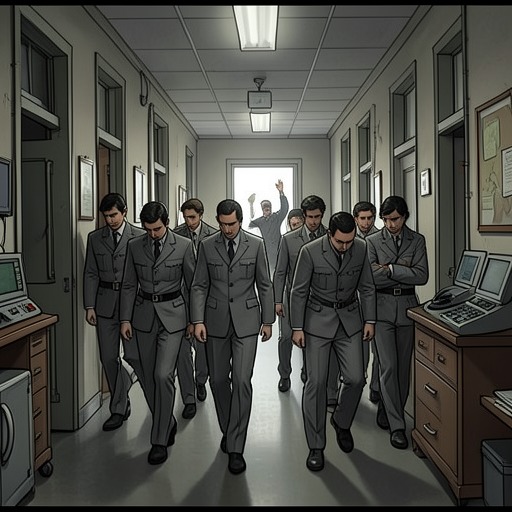
Eight Six Seven Five’s Execution
StrikeEight Six Seven Five’s Execution is the killing of a prisoner by Major Bova after the man admits trying to bring water to his unit. What begins as a public disciplinary hearing briefly appears to end in leniency: Bova lets the prisoner drink from a Jerry Jug and return to his unit. He then reverses that reprieve, takes a black baton-weapon from a guard, and kills the kneeling man for not saying please. The sequence makes the execution more than a punishment for taking water: Bova turns the language of courtesy into a rule that can be invoked at will, with a life at stake.
The charge and the prisoner’s account
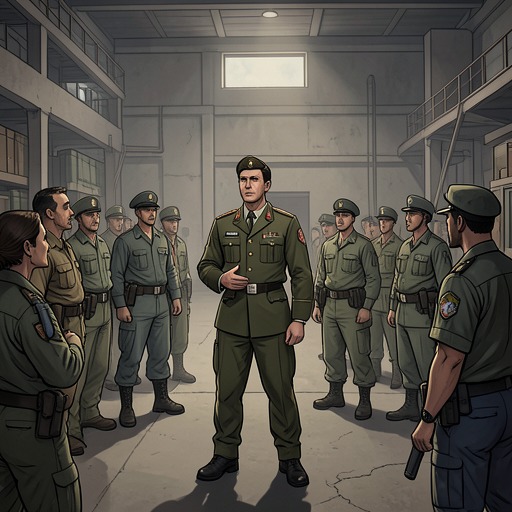
Bova introduces the matter by identifying the prisoner as Eight Six Seven Five and telling the assembled workers that he has been a “very naughty boy.” The number, rather than a personal name, is how the prisoner is designated in the camp. Bova’s phrasing turns a serious accusation into a show, inviting the group to watch while presenting the incident as a small piece of business.
When Bova asks what the man did, the prisoner struggles to answer. He eventually explains that he tried to bring water to his unit. Bova repeats the substance of this admission and emphasizes that it was extra water, then asks whether the people gathered at the edge of the hole are the prisoner’s unit. The question shifts attention from the act of carrying water to the supposed offense of giving it to those people.
Bova then asks Eight Six Seven Five whether he knew it was wrong to steal water and bring it to his unit. The prisoner, still kneeling, straightens up to answer. He says it was a mistake, denies stealing, and explains that he thought he was carrying the normal ration. His account does not alter the charge. Bova calls it a mistake too, but his smile makes the remark sound like a joke for the watching group rather than an acknowledgment that the prisoner may have misunderstood.
A reprieve staged as a reward
Bova presents obedience as the condition for reward. He allows the prisoners a few swigs of warm water, although the narrator observes that this hardly seems like much of a reward. The narrator also receives no drink, noting that he had not been working. Against the larger deprivation, the small allotment is both a limited concession and a demonstration that access to water is controlled by those in charge.
Bova returns to the kneeling prisoner and tells him that the matter was only a silly misunderstanding. He says there should be no repeat, invites him to drink, and tells him to rejoin his unit. The order appears to close the hearing: Bova turns and walks toward his jeep, and the show seems to be over. Eight Six Seven Five lunges for the Jerry Jug and takes a deep drink. For a moment, the prisoner is allowed to act as though the stated reprieve is real.
That apparent resolution gives the reversal its force. Bova stops before boarding the jeep, turns, and strides back toward the prisoner. The other prisoners freeze. Bova takes a black baton-weapon from a guard’s belt without breaking stride and approaches the man, who is still kneeling with the jug raised as he tries to get its last drops. The sequence links the killing to the prisoner’s effort to drink after Bova had expressly permitted him to do so.
The execution and its aftermath
Standing over the prisoner, Bova apologizes with what seems to the narrator like genuine sympathy, then says that he did not say please. He raises the weapon and aims it at the prisoner’s chest. The courtesy rule, which Bova had just used to discipline the group verbally, becomes the stated basis for lethal violence. The man is thrown backward with a pained yelp; the Jerry Jug clatters onto the sand. He does not move again.
The people around him do not intervene. The unit supervisor lowers her head in what appears to be genuine anguish, while the rest of the prisoners remain frozen. The narrator thinks he hears a small whimper, quickly suppressed. Their stillness is part of the scene’s consequence: the execution kills one prisoner, but also demonstrates to the witnesses what resistance or even visible reaction may cost.
Significance
The episode makes Bova’s authority legible through a deliberately unstable sequence of permission and punishment. He first frames the prisoner as guilty, then accepts an explanation, offers water, and tells him to return to his unit. Only after the prisoner acts on that permission does Bova impose a new, immediate standard: he had not said please. The shift from apparent mercy to execution shows that the prisoner cannot rely on the announced terms of his release.
Water gives the scene its material stakes. Eight Six Seven Five says he was trying to bring it to his unit; the concession offered to the workers is only a few swigs of warm water; and the final act before the killing is the prisoner’s attempt to drink from the jug. Bova’s insistence on etiquette does not displace that scarcity so much as add another layer of control to it. By making a word of politeness the decisive offense, he turns an ordinary social rule into an arbitrary test of obedience. The dead prisoner, the fallen jug, the supervisor’s bowed head, and the silent witnesses leave the camp’s power structure on display without any need for a further order.