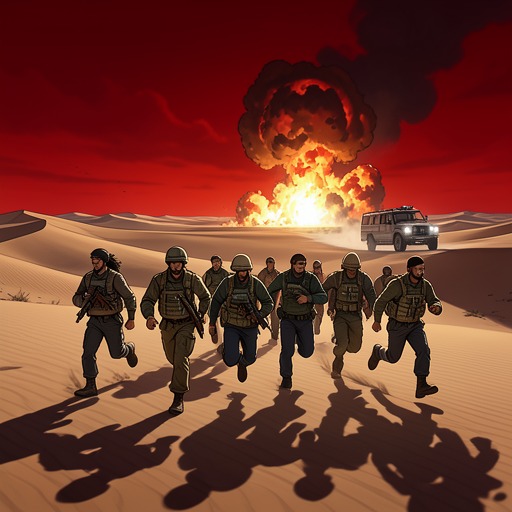
Jimmy Foote Calls for Helicopter Rescue
StrikeJimmy Foote Calls for Helicopter Rescue is the turning point that replaces an impossible trek across the desert with a direct route back to SYLO. When Tucker’s group, shaken but alive after escaping, sees Foote arrive in a battered blue pickup, his presence offers more than a ride: he has already summoned help, and the approaching helicopter gives them a narrow window to act against the Retro camp and secure the dome.
The Desert and the Urgency
The group’s immediate problem is distance. The dune buggy is still near Area 51, roughly sixty miles away across open desert. As Brock calculates, the heat is rising and the journey would take hours they do not have. Tucker helps Tori to her feet, and the group prepares to walk rather than lose time searching for another option. Their predicament is practical and urgent: they need to reach Los Angeles quickly, but they have neither nearby transport nor hours to spare.
The scale of that urgency becomes clearer when help arrives. The group is trying to get back to SYLO, where they must persuade its command to storm the Retro camp and secure the dome. The flight to Catalina Island will take less than an hour, leaving roughly seven hours for that appeal. The rescue therefore does not resolve the larger military crisis; it gives the group a chance to reach the people who might act before the opportunity closes.
Foote’s Arrival
A dust cloud appears ahead, at first resembling a windblown storm. It is a speeding blue pickup, driven by an elderly Native American man in a cowboy hat. The truck is ancient, with faded paint and rusted side panels, but to the exhausted group it is welcome transportation. Foote recognizes them and greets them with a smile, remarking that he had not expected to see them again and that they appeared to have been busy.
Foote is not a stranger who happens upon the escapees. He had supplied dune buggies for their assault on Area 51, and the Paiute tribe had been helping the survivors of Las Vegas plan the attack. They served as observers in the desert, watching the fleet of Retro drones. After the recent assault, Foote and others searched the wreckage of the base, pulled out several survivors, and got them help; some others had not survived. When the base no longer needed watching, the tribe turned its attention to the test site. They occasionally picked up people who had escaped into the desert, but had mostly kept watch there until the latest explosion prompted Foote to investigate in person.
Tori runs to the pickup and embraces him. Her relief is immediate, but Foote first checks what the group’s uniforms mean, asking whether they have joined the other side. Tori explains that the uniforms are how they escaped. The exchange clarifies the risk of their appearance: clothing that helped them get out could make them look aligned with the enemy. Foote accepts her explanation and turns the encounter toward the practical need to get moving.
The Call for Help
Tucker asks Foote for a lift back to the dune buggy, but Tori presses the more urgent objective: reaching Los Angeles as quickly as possible. Foote answers that this will not be a problem. As soon as he saw the group, he put out a call using a walkie-talkie. With phones unavailable, the radio is the means by which his people relay messages across distance. His help is already in motion before the group has finished asking for it.
The sound of an engine grows into a distinct thumping. Foote confirms the hopeful guess: it is a helicopter. The approaching aircraft first appears as a black speck, then hovers overhead close enough for the group to see the rising-sun logo painted on its underside. A symbol they have encountered repeatedly in conflict is, for once, a welcome sight. SYLO has arrived. Foote’s call has converted a chance roadside reunion into a coordinated rescue.
The Flight to Catalina
The helicopter carries the group to Catalina Island in less than an hour. From the air, the island’s military presence is unmistakable: Navy warships surround the whole land mass, while the shore and a large tent city are backed by barracks, antiaircraft guns, and what appear to be hundreds of attack helicopters. The scale of the operation is far greater than the makeshift camp outside Arbortown. For the arriving escapees, this is not merely a safe destination but a concentrated source of military power that may be needed for the next move.
The time gained by Foote’s call is measured against the deadline ahead. Roughly seven hours remain to convince SYLO command to attack the Retro camp and secure the dome. The rescue changes the group’s position from stranded travelers facing a sixty-mile desert crossing to people able to bring their knowledge and request directly to SYLO. Foote does not decide the command’s response, but his timely call makes that decision reachable. In a story of surveillance, military force, and contested routes, the modest walkie-talkie and the unexpected helicopter briefly turn distance from an obstacle into a passage.