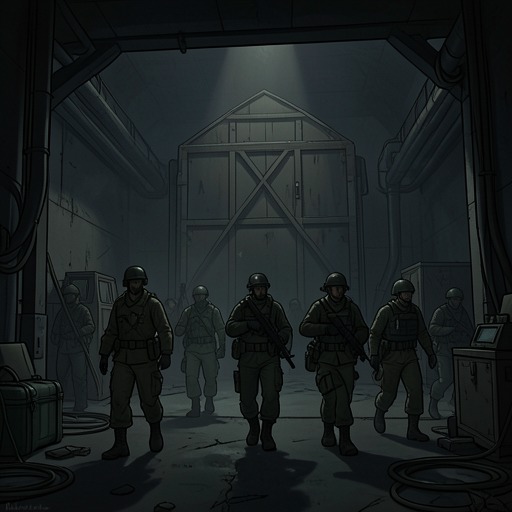
Sounders Move the Nuclear Device into the Future Dome
StrikeSounders Move the Nuclear Device into the Future Dome is a covert operation staged as an official military transfer in 2324. Colonel Pike’s team removes a nuclear device from a guarded depot and carries it toward the Time Bridge Dome Facility, while another Sounder force moves into position. The public sees a parade celebrating the next phase of the invasion; the operation’s real significance lies in how that spectacle conceals an armed resistance effort—and how an alarm turns the appearance of control into open crisis.
The target and the deception
The operation begins five kilometers from the Bridge City dome, three hundred years in the future. Colonel Pike leads a small group of Air Force personnel: Airman Eric Lewis, Airman First Class Olivia Kinsey, and Liger, a forty-year-old civilian nuclear engineer dressed in gray fatigues rather than camouflage. They walk along a wide street lined with giant black aircraft waiting to travel into the past. The planes make the stakes visible even as the team tries not to draw attention to itself: the invasion is not an abstract plan, but a force assembling around them.
Pike gains access to the nuclear depot by presenting a tablet and orders for an inspection. The documents are authentic in appearance, but Pike herself created them; she alone knows their origin. Her answer to the guard’s question—that the visit is scheduled, though he would not have known about it—turns a routine checkpoint into the first test of the disguise. The guard reads the orders and visibly loses confidence, but the team passes through the double doors using Pike’s identification card.
Inside, the depot’s scale and safeguards contrast with the bombs’ plain appearance. It is a huge warehouse protected by a dome five feet thick, and ten white cylinders stand in two rows of five. Each is six feet tall and three feet in diameter, without a nose cone or fins: these devices were not built to be dropped from aircraft. They match the specifications of the device exploded in the 1952 test that created the original Bridge. The stockpile is intended to make further Bridges from the past into the future. In moving one of these weapons, Pike’s team is handling not just a bomb but a means of reproducing the invasion route.
Removing the bomb
The team selects device 44-044. Pike gives the order to load it onto a pallet, and a technician named Swenor hurries to comply. Minutes later, a floating platform with a purpose-built cradle is positioned beside the cylinder. The bomb is lowered onto it while remaining upright; the loaded platform then hovers three feet above the floor. The careful, specialized handling makes the removal look like ordinary depot procedure, even as the device’s intended use gives the operation a much larger consequence.
Swenor responds to the transfer with enthusiasm, and Pike takes the pallet’s control device from him. She tells him that Airmen Lewis and the others will complete the move, thanks him for his help, and sends him back to his duties. Swenor leaves proud, imagining a place for himself in the history books. Liger, by contrast, tells Pike that this is the first honest thing she has said. Their exchange exposes the split between the mission’s actual purpose and the official story Pike has used to secure cooperation. The technician believes he has helped make history; he does not know what the team is doing with the weapon.
Lewis expertly operates the hovering platform while Olivia guides it from the front. Liger runs ahead to open the tall, heavy doors, allowing the device to pass out of the depot. The guards watch in awe. Pike orders them back to their posts, and they resume guarding the building without stopping the transfer. The bomb’s passage is therefore protected as much by the appearance of authority as by the team’s physical control of it.
A parade mistaken for victory
With two hundred yards still to travel to the dome, the hovering device cannot pass unnoticed. People in the street recognize it and applaud, believing its arrival means that the next phase of the invasion and colonization is beginning. Their interpretation is not random: they have heard the plans, and a nuclear device being sent toward the Bridge appears to confirm them. But they mistake the visible purpose of the transfer for its actual one. The movement becomes a public celebration, with the bomb treated as a hero being sent to war, while the Sounders keep their heads down and press forward.
That crowd creates cover as well as risk. Most eyes are fixed on the device, while the Sounders arrive and position themselves behind the waiting aircraft. Armored cars move into side streets. At the same time, a second group of ten Air Force personnel approaches the dome checkpoint, equipped with vests, helmets, and heavy-duty Pulsers. The operation is not simply a theft carried out by Pike’s small escort: a separate armed team is in place, and the bomb’s highly visible route draws attention away from its arrival.
The parallel movements converge at the dome. Another team gets a platform through the Bridge; after it passes, the workers guiding it are knocked unconscious with two quick pulser shots and pulled aside before they hit the deck. Their route to the past is clear. Outside, Pike’s group approaches the security checkpoint with the nuclear device. The guard is astonished to see both commandos and one of the Air Force’s senior officers arriving with a bomb, but he does not challenge them. The mission continues to benefit from the assumption that rank and military procedure explain what is happening.
The alarm and the turning point
As Olivia and Lewis guide the device to within a few yards of the dome, the crowd strains for a final look, still convinced that the weapon will bring them a better future. The time is 5:15, and until then the plan has proceeded as intended. The brief reversal that follows is stark: a siren sounds. The Sounders stop hiding in the shadows, and the crowd scatters. Many military personnel are unarmed; rather than join the impending fight, they run into buildings or down side streets, unsure of what has happened but aware that violence is coming.
During the alarm, Olivia and Lewis float the device into the center of the dome and lower it to the deck. Kenny Sokol runs to them and asks who triggered the alarm. Pike calmly concludes that the bogus orders must have bounced back, then tells Liger to arm the device by six. Her composure contrasts with the abrupt collapse of the official cover story. Sokol orders his men to throw the unconscious soldiers out of the dome, and two commandos carry them to the door and toss them outside. The bomb has reached the intended position, but the operation is no longer a quiet transfer.
Meaning of the transfer
The scene’s central irony is carried by the public procession. To the watching crowd, the bomb is proof that its government’s invasion plan is succeeding; to the Sounders, the transfer is part of a resistance operation. The same object therefore signifies promised colonization to one audience and imminent danger to another. The crowd’s applause does not make it complicit in the concealed plan so much as expose how little it understands of the action unfolding before it.
The device also joins past and future in concrete form. Its design duplicates the weapon that created the original Bridge, and the depot exists to supply more devices for creating further crossings. Moving 44-044 into the dome places that history-making technology at the threshold through which the invasion travels. The siren marks the cost of relying on fabricated authority: a plan that has worked through official-looking orders and public misapprehension is suddenly exposed to panic and armed resistance. By the scene’s end the bomb is inside the dome, the deadline Pike has set is approaching, and the transfer has shifted from concealed maneuver to confrontation.