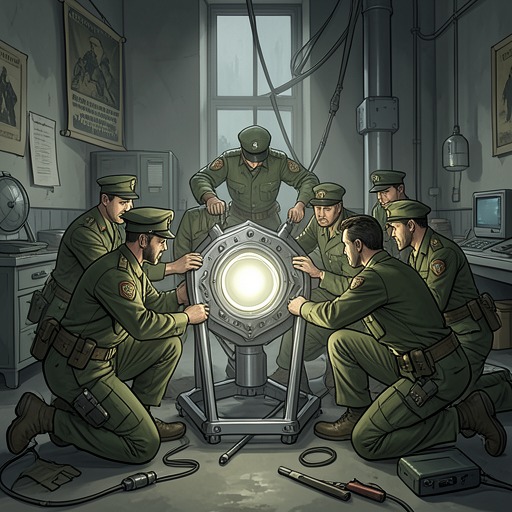
Sokol’s Squad Seizes the Drone Command Center
StrikeKenny Sokol’s squad’s assault on the drone command center turns a covert crossing through the Bridge into an open fight for control of the machinery directing the invasion. The team’s attempt to pass unnoticed ends at the bunker’s guarded entrance; after a firefight, Sokol breaches its sealed door and signals the pilots forward. The operation begins as a contest over access to the drones—and over the capacity to carry out the eradication of a population.
Strategic Stakes and Setting
The assault is part of the Sounders’ effort to stop the Retro invasion from the twenty-first-century side. Its stakes are made stark by the target: the aboveground bunker is the command-and-control center for the drone fleet, described as the twenty-first-century Air Force’s most valuable asset. The drones are not merely a military resource. Their operations are being directed from this building, and the eradication of an entire world’s population is being carried out from it.
The bunker’s design and security mark it as a critical stronghold. Alongside the dome, it is the only camp building built to withstand an attack, and it is the only building besides the dome identified as guarded. The two sentries outside are armed and alert, not low-level administrators but guards responsible for protecting the drone command center. Sokol’s team has studied diagrams of the building, but none of its members has seen it in person before approaching it.
The assault takes place against the clock. The preceding narration says there are thirty minutes until the boom; Sokol’s orders set 17:55 as the time through which his team must keep the Bridge’s doors open, unless worsening conditions require them to close early. The order makes the crossing itself part of the operation: the commandos must move against the bunker while another part of the team holds open their route back through the Bridge.
Crossing and Concealment
Kenny Sokol and his commandos emerge from the Bridge into the twenty-first century without warning the camp’s Retros of the violence they intend to bring. In the mostly empty dome, the guards on duty initially have no reason to anticipate an assault. Seeing the armed team appear out of the light, they straighten up—not to defend themselves, but to look as though they, too, deserve their uniforms.
The exchange is brief. One guard observes, “You’re early,” and Sokol replies, “You’re done.” He raises his Pulser and knocks the guard down; a commando quickly takes out the second. Two members of the team drag the bodies beside the open door, out of sight from outside. The disposal is as purposeful as the attack: the team is trying to preserve the appearance of normality while establishing a position at the threshold.
Sokol divides the force before leading the next movement. He names Thompson, Shaw, and Goodlad to accompany him; the rest are to remain at the Bridge and keep its doors open until 17:55, with permission to lock them down early if the situation becomes dangerous. The squad acknowledges the order quietly. Sokol warns that help may be on the way but should not be counted on, then wishes the team luck. The plan depends on separation and coordination: one group advances on the bunker while the others preserve the crossing and make their own judgment if the position becomes untenable.
The Bunker Assault
Sokol’s group walks quickly but casually toward the drone command center, trying to conceal the attack until surprise is no longer possible. The building is guarded because of what it controls, and its two armed sentries recognize the threat. One calls, “Halt right there!” Sokol answers by raising his Pulser and firing. At that moment, the camp is alerted: the covert approach has become an open assault.
The first shot misses. The guard fires back and drops Shaw, giving the exchange an immediate human cost. The sentries go prone to make themselves harder targets, but Sokol and the pilots fire on them. One guard is knocked out at once. The other retreats toward the bunker and hits a control switch, releasing a steel door that closes over the ordinary wooden one. The move seals the entrance, but it does not stop the attackers. A Pulser shot hits the guard, throwing him back against the wall; he is unconscious before he reaches the ground.
Sokol does not break stride. He pulls a black disk from his cargo pocket, places it on the sealed door, and spins away to take cover. The disk detonates with enough force to blow the door down. The sequence reverses the defenders’ brief gain: the steel barrier buys them a moment, then becomes the surface the Sounders breach. Shaw’s fall and the guards’ resistance show that reaching the command center is not a clean or uncontested step, even with surprise and preparation on the attackers’ side.
Entry and Wider Resistance
With the bunker door destroyed, Sokol tells the pilots, “You’re on.” The Sounders are inside. This is the operation’s decisive immediate result: the assaulting group has opened access to the command center, allowing the pilots to move in. The passage establishes the breach and entry, not the later outcome of the fight or the eventual fate of the drone fleet.
The episode sits within a camp where resistance takes more than one form. In a separate demonstration, hundreds of prisoners gather and chant “Water! Water! Water!” while fires and explosions draw the guards’ attention. The demonstration proves to be a diversion for prisoners boarding a bus; those in the courtyard are sacrificing their chance to escape to help a handful get away. Elsewhere, a prisoner named Scottie calls out a man whom Feit is about to inspect, exposing him before the line. And in a seemingly hopeless moment, a soldier places a hand over his heart, a silent gesture that surprises Tucker. These moments do not establish that the prisoners or the signaling soldier take part in Sokol’s bunker assault. They do, however, place the commandos’ organized strike within a broader pattern of danger, concealment, and resistance under Retro control.