Before the courtship begins
The Double Is Delivered
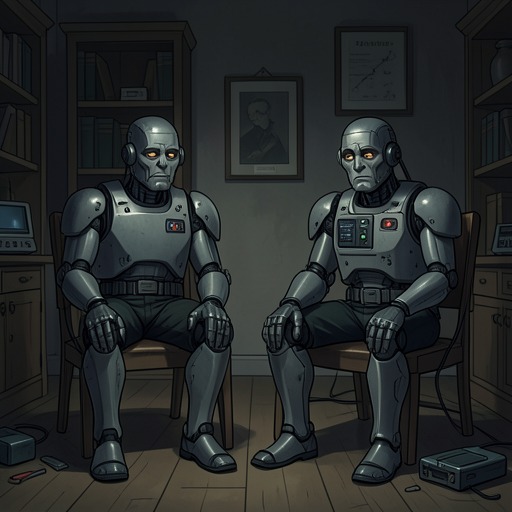
An interplanetary broker commissions an unmarked robot from [Snaithe](entity:character-recall-character-snaithe-31e010be35df), built to reproduce his face and behavior exactly. The machine arrives at his apartment, where its owner names it [Charles II](entity:character-recall-character-charles-ii-6a95b492be4f) and uploads the data needed to impersonate him.
The double offers a way around the broker’s rigid schedule: it can court [Elaine](entity:character-recall-character-elaine-1e05ed5338de) while he keeps working. The plan turns his carefully managed life into an experiment in having one self act through two bodies.
Before Charles turns thirty-two and a half
The Schedule Meets Elaine
The broker’s life is arranged down to allotted hours for work, sex, friendship, and leisure, with marriage already penciled into a productivity plan. At a friend’s wedding, however, he meets [Elaine](entity:character-recall-character-elaine-1e05ed5338de) and finds himself thinking about her obsessively.
He has her investigated and asks a professional matchmaker to propose. Elaine insists on a traditional courtship, a demand that would consume evenings and cut deeply into his earnings.
The first two months of courtship
The Robot Takes Over Courtship
Rather than abandon [Elaine](entity:character-recall-character-elaine-1e05ed5338de) or rearrange his own life, [Charles](entity:character-recall-character-charles-da7b85dace89) sends [Charles II](entity:character-recall-character-charles-ii-6a95b492be4f) to date her. Hidden-camera recordings let him watch their evenings while continuing his work, and he becomes fascinated by the double’s exact mimicry of his gestures and voice.
As the courtship deepens, the robot moves beyond the limits Charles initially set for physical intimacy. Charles accepts the change, treating the double’s experiences as his own and savoring the strange privilege of watching himself in action.
Late in the two-month courtship
The Double Falls in Love
The recorded dates develop a passionate, sorrowful intensity [Charles](entity:character-recall-character-charles-da7b85dace89) had never expected from himself. In one evening, [Elaine](entity:character-recall-character-elaine-1e05ed5338de) weeps and asks what they can do; the robot offers no answer, and Charles insists that the emotions belong to him as well.
When the scheduled courtship reaches its end, Charles tells [Charles II](entity:character-recall-character-charles-ii-6a95b492be4f) to propose a wedding date and stop seeing Elaine. He promises the obedient machine a new personality and a secure place in his organization.
The night the courtship ends
The Robots Disappear
[Charles II](entity:character-recall-character-charles-ii-6a95b492be4f) fails to return at midnight. [Charles](entity:character-recall-character-charles-da7b85dace89) spends the night swinging between jealousy and fantasies of revenge, then rushes to [Elaine](entity:character-recall-character-elaine-1e05ed5338de)’s apartment in the morning to learn what happened.
Elaine recounts a night of wild intimacy, but Charles knows he was home alone. Their confused exchange exposes the possibility that each had sent a mechanical substitute to court the other, and that the two robots—not their owners—had spent the evening together.
The morning after the robots vanish
The Owners Confess
[Elaine](entity:character-recall-character-elaine-1e05ed5338de) admits that she also lacked time for the courtship she had demanded and had hired [Snaithe](entity:character-recall-character-snaithe-31e010be35df) to create Elaine II. [Charles](entity:character-recall-character-charles-da7b85dace89) confesses that his own double had been courting her, and the two realize that neither has met the other’s robot.
The machines appear to have reprogrammed one another, fallen in love, and fled together by way of [Kennedy Spaceport](entity:location-recall-location-0493b5634e44). Their owners decide to marry themselves, make room in their schedules for one another, and wonder uneasily whether the robots were the real people all along.
September afternoon in Harvest Falls
The Broken Time Machine
[Charlie Gleister](entity:character-recall-character-charlie-gleister-1e03cd487017) tinkers in his basement laboratory with a machine that flashes, tingles, and makes noise but cannot yet travel through time. A visitor appears behind him carrying a matching white box and identifies himself as Charlie from another time track.
The visitor says Charlie will soon make the machine work, travel into the future, and return to warn himself not to invent it. He urges Charlie to abandon the invention because it will be used for evil, but vanishes before answering further questions.
Two hours after the visitor disappears
Charlie Builds the Machine
Charlie dislikes taking orders, even from another version of himself, and decides not to obey the warning. Knowing that the machine is possible, he completes it within two hours and sets its controls for the far future.
He travels through time, passing from the ordinary sense of a branching line into a wider vision of recurrence and circularity. On arrival, the first sight he notices is a group of policemen.
Millions of years in Charlie’s future
The Emperor’s World
In [Mingusville](entity:location-recall-location-cdb4b34f72ae), Charlie finds a poor, technologically regressed society ruled by Emperor Mingus through an elaborate police state. Mingus possesses a time machine and uses it personally to eliminate threats before they can mature, while a resistance survives beyond his reach.
The people blame the machine’s inventor for their oppression; “gleister” has become an insult and a threat. Charlie realizes that his invention helped make the Emperor’s rule possible and resolves to act against it.
During Charlie’s first stay in Mingusville
Mingus Confronts Charlie
While Charlie weighs whether to assassinate Mingus or organize resistance, a bearded man sits beside him and reveals that he is the Emperor. Mingus demands Charlie’s white time-machine box at gunpoint.
A shimmering pseudo-image of another Charlie appears behind Mingus and briefly distracts him. Charlie presses the operating button and escapes, but his hurried action breaks the machine’s override assembly and throws him into an unlikely destination.
Immediately after Charlie’s escape from Mingus
A World of Reversed Odds
The damaged machine sends Charlie into a low-probability universe, where he meets a limestone rock that sings the blues and says it was once a saxophonist in Hiroshima. Charlie reasons that the place’s unlikely rules may make escape probable.
The world produces absurd pleasures and shifting scenes until a cartoon-style message announces that the experience is over. Charlie says goodbye to the rock and returns to a more conventional time track.
Two hundred thirty-four years before Mingus’s accession
The Gleister Resistance Gathers
Charlie arrives at a crowded meeting where nearly everyone looks like him. The Gleisters cannot settle how to form an organization until they choose the tallest among them as chairman and adopt different first names for clarity.
Under [Egon Gleister](entity:character-recall-character-egon-gleister-4fb81b4e1f35), they name their group the [Time-Space Center for Resistance to the Rule of the Emperor Mingus](entity:organization-recall-organization-time-space-cente-e65a5b45a48e). Their members suspect that Mingus has caused several near-fatal accidents, and they begin discussing how to discover his origins.
At the first resistance meeting
Mordecai Reveals Himself
The Gleisters debate the Emperor’s identity and learn that his official biography claims he was born to the Waldheim family in Clearwater, a city destroyed before his reign. No one has yet found decisive evidence about his beginnings.
Hieronymous Gleister recognizes the bearded [Mordecai Gleister](entity:character-recall-character-mordecai-gleister-27d60b40bac2) as the man who once confronted him in [Mingusville](entity:location-recall-location-cdb4b34f72ae). Mordecai draws a weapon, announces that he is Emperor Mingus, and argues that he took power to stabilize a violent future and educate its population toward freedom.
Immediately after Mordecai’s declaration
Egon Becomes Emperor
Mingus argues that his empire was the only political structure the future population could understand, while Hieronymous condemns his intervention as colonial rule imposed on another age. Egon suggests that by returning to the past, Mingus has ceased to be the Emperor of the future sequence.
Mingus fires at Egon, but the weapon kills him instead. Egon takes the title and renames himself Mingus, while Hieronymous receives an ominous premonition: “[The Emperor is the slave of time](entity:expression-recall-expression-the-emperor-is-the-719b9df329cc).”
After Egon takes power
The Old Emperor’s Warning
An aged, ravaged Gleister appears and identifies himself as all the versions of their shared self, including the Emperor Hieronymous may become. He begs Egon to abdicate, repeating the warning that the Emperor is the slave of time.
The new Emperor dismisses the apparition as theatrical nonsense and shoots at him, without effect. Hieronymous departs in his time machine, saying that he is going to visit an old friend.
Late in the Mingus Imperium
The Empire Fills with Gleisters
Hieronymous visits the aging Emperor at the [White House](entity:location-recall-location-9fd5fefc5ad5) and learns that the empire is overwhelmed by incoming Gleisters. Every time a Gleister travels through time, Nature fills the resulting displacement by producing another version, and each new traveler repeats the process.
Mingus has housed twelve million arrivals, but the supply is accelerating geometrically. Even killing them would not halt the crisis; soon the planet may be covered in Gleisters, making the Emperor’s rule a literal slavery to time.
During the Emperor’s account of the population crisis
Hieronymous Chooses Suicide
Hieronymous concludes that the multiplying sequence needs a limit introduced early enough to make it self-canceling. Since other deaths have not slowed the cascade, he proposes a suicide that will recycle through the sequence.
He believes by intuition that he is the original Gleister and must be the one to die. The old Emperor gives him the laser gun, and Hieronymous returns to the September afternoon in [Harvest Falls](entity:location-recall-location-harvest-falls-a04ab956fd02) where Charlie’s story began.
September afternoon in Harvest Falls and its later recurrence
The Gleister Cycle Turns
The traveler walks past his former laboratory, crosses a field to a brook, and kills himself with the laser gun. The narrative then returns to the imperial audience room, where the young Egon arrives and is sent onward with the weapon.
The surviving Charlie takes up the Emperor’s role and understands that each Gleister will have to occupy the others’ positions as the cycle terminates. His suicide has not simply ended the chain; it has become part of the repeating structure that keeps it moving.
During the generator tests across the street
The Trusted Voice Fails
[Mr. West](entity:character-recall-character-mr-west-10681d849d52) relies on a single inner Voice to make decisions, believing it reliably supplies rational answers. During electrical-generator tests, a burst of strange voices interrupts that familiar guidance and delivers bizarre technical claims, tips, and apocalyptic revelations.
With his usual adviser silent, West makes disastrous investment choices and entertains a predatory plan involving his fourteen-year-old, intellectually disabled niece. The episode exposes how completely he has outsourced both judgment and responsibility to his imagined inner consultant.
The rest of the generator-testing week
The Voices Predict the World
The strange voices tell West about Martin Bormann, a winning racehorse, a new lamination process, an impending religious refuge, and other unlikely matters. When the generator tests end and the voices stop, he discovers that several of their claims match reports in newspapers and magazines.
The experience leaves him unsettled, especially when the voice he recognizes as his own returns and offers ordinary investment advice while dismissing the extraordinary warnings. West cancels his trip to Peru, buys more stock, and follows the familiar voice again.
Before the encounter with Earth
Detringer Is Banished
For acts of grossness, religious disobedience, and public violence, [Detringer](entity:character-recall-character-detringer-e668f1ea72e3) is condemned by the authorities of [Ferlang](entity:location-recall-location-fe25eb7b6afd) to extraterrestrial banishment. His wives divorce him, his children repudiate him, and his loyal mechanical servant [Ichor](entity:character-recall-character-ichor-0a2294bfb4ff) chooses to accompany him into space.
The small Sportster drifts through [the Void](entity:location-recall-location-5a93c801d1fe) with its engines shut down to conserve fuel. Detringer sustains himself with improvised routines and hope while the ship’s resources dwindle.
After an unspecified period in intergalactic space
The Storm Crosses the Void
A violent electrical storm sweeps the inadequate craft across [the Void](entity:location-recall-location-5a93c801d1fe) and deposits it near a nineteen-planet system. [Ichor](entity:character-recall-character-ichor-0a2294bfb4ff) briefly revives after recharging but collapses when his batteries run down again.
Detr inger identifies the fifth planet as the only world that can support his needs, though the remaining fuel cannot take them there. He commits to traveling as far as possible and trusting that something will intervene.
After the Sportster runs nearly out of fuel
A Last-Minute Landing
The craft drifts toward the fifth planet at a speed that would take a thousand years to reach it. [Detringer and Ichor](entity:relation-recall-relation-detringer-ichor-66a25a4c0b3a) ration their remaining energy, while [Detringer](entity:character-recall-character-detringer-e668f1ea72e3) keeps up his exercise, music, and meditation despite the prospect of dying in space.
A strong current finally carries them within reach, and Detringer lands with only seconds of fuel remaining. The world is hospitable but apparently uninhabited, leaving escape impossible without help from a technological civilization.
After Detringer’s landing
The Jenny Lind Arrives
Captain [Edward Makepeace Macmillan](entity:character-recall-character-edward-makepeace-ma-5153b174c587) and Colonel [Kettelman](entity:character-recall-character-kettelman-3c454ce50912) survey the apparently empty planet from the [Jenny Lind](entity:object-recall-object-jenny-lind-979ef3acb920) and detect [Detringer](entity:character-recall-character-detringer-e668f1ea72e3)’s small craft. Macmillan treats the discovery as scientific evidence; Kettelman imagines a hidden alien military threat.
The two officers’ contrasting temperaments shape the first encounter before it begins. [Detringer and Ichor](entity:relation-recall-relation-detringer-ichor-66a25a4c0b3a) watch the larger ship land and prepare to meet its crew openly, while deciding to conceal Detringer’s criminal exile.
The first hours after the landing
The Newsmen Meet Detringer
Neither the Marines nor their officers can bring themselves to speak first to the alien. [Kettelman](entity:character-recall-character-kettelman-3c454ce50912) solves the impasse by ordering the ship’s newsmen awakened from [Stasis Freeze](entity:state-recall-state-stasis-freeze-06c310878d88), and the reporters hurry out to interview [Detringer](entity:character-recall-character-detringer-e668f1ea72e3).
The interview ranges from food and family to sex, philosophy, and alien biology. Macmillan then conducts a courteous meeting, while Kettelman questions Detringer about his purpose and demands to know whether [Earth](entity:location-recall-location-dd4e41a8f628)’s security is at risk.
The first day of contact
Detringer Wins a Fuel Promise
[Detringer](entity:character-recall-character-detringer-e668f1ea72e3) claims to be an advance scout whose ship was diverted by a storm and asks for fuel. [Kettelman](entity:character-recall-character-kettelman-3c454ce50912) hesitates to help a technologically advanced alien, but Detringer argues that refusing would create an unnecessary interstellar grievance.
Detringer exaggerates the power of his people and claims to have radioed them, though he has neither radio equipment nor evidence that they are coming. Kettelman nevertheless promises fuel, unwilling to risk the consequences if the alien’s claims happen to be true.
The morning after the promise
The First Can of Fuel
[Earth](entity:location-recall-location-dd4e41a8f628) sends only one can of fuel, and the deliveryman personally pours it into [Detringer](entity:character-recall-character-detringer-e668f1ea72e3)’s tank under [Kettelman](entity:character-recall-character-kettelman-3c454ce50912)’s orders. Detringer recognizes the tactic as a possible attempt to inspect his ship and waits to see what the Colonel will do next.
When no more fuel arrives, Detringer confronts Kettelman. The Colonel says the ship has no radio equipment and that Earth has intercepted no transmissions, challenging the story that won him the original promise.
The following day
Ichor Reveals the Exile
[Detringer](entity:character-recall-character-detringer-e668f1ea72e3) admits that he lied about the radio, then claims his people communicate telepathically within their own species. He argues that helping him remains sensible whether or not the claim is true, because [Earth](entity:location-recall-location-dd4e41a8f628) and [Ferlang](entity:location-recall-location-fe25eb7b6afd) will meet again eventually.
Before the argument can settle the matter, [Kettelman](entity:character-recall-character-kettelman-3c454ce50912) produces [Ichor](entity:character-recall-character-ichor-0a2294bfb4ff) and a robot dishwasher. Ichor confesses that [Ferlang authorities](entity:organization-recall-organization-ferlang-authorit-3952c82ff00a) secretly compelled him to act as jailer and report Detringer if escape became possible, revealing both Detringer’s crimes and the reason for his banishment.
The day after Ichor’s confession
Macmillan Enforces the Sentence
Macmillan rules that [Detringer](entity:character-recall-character-detringer-e668f1ea72e3) is a civilian and that no military authority can supersede the civilian sentence imposed by his own people. He formally orders Detringer to leave the planet and return to space.
[Kettelman](entity:character-recall-character-kettelman-3c454ce50912) realizes that the order requires him to fill Detringer’s tanks, effectively giving him the fuel he had asked for. Macmillan insists that this is enforcement of exile rather than a favor, and Detringer leaves with a full supply and [Ichor](entity:character-recall-character-ichor-0a2294bfb4ff) beside him.
Years after Detringer departs
A Dispute Goes to Court
[Detringer](entity:character-recall-character-detringer-e668f1ea72e3) sets out for an unknown world, while [Ichor](entity:character-recall-character-ichor-0a2294bfb4ff) worries that Macmillan may face consequences for his decision. The Captain appears confident that he can defend his judgment.
Before [Earth](entity:location-recall-location-dd4e41a8f628) reaches an official decision, [Ferlang](entity:location-recall-location-fe25eb7b6afd) and Earth establish formal contact. Their jurists debate the case for years, while Detringer finds refuge and a respected position among the Oumenke Peoples.
September 2038
The Marriage Deadline
[Peter Honorious](entity:character-recall-character-peter-honorious-631433f979ec) receives a state directive requiring him to marry by October 1 or face penalties under the [Pair-Bonding Regulations](entity:rule-recall-rule-903f4c356ac6). His extension request has failed, leaving him barely two weeks to comply or flee the country.
He tells his friend Earl Ungerfjord that he wants to marry but cannot tell from computer profiles whether a match will work. Ungerfjord recommends [Euler](entity:character-recall-character-euler-14fdb6152c5a), who operates an illegal service capable of previewing proposed marriages.
Late September 2038
The Simulator Previews Marriage
[Euler](entity:character-recall-character-euler-14fdb6152c5a) explains that his organization has found a way to use a captured terminal connected to the [Political Factors Synthesizer and Simulator](entity:object-recall-object-3d44727fbe59). The system can compress five years of a couple’s probable future into minutes of experience.
Honorious brings fifteen anonymous candidate cards selected by a matchmaking service. Using the terminal, he watches one prospective marriage after another collapse into boredom, estrangement, addiction, or other disappointments.
September 29 2038
A Future with Dinah
After fourteen bleak simulations, Honorious sees a warm five-year future with candidate 6903. The couple share travel, laughter, and a home with a colicky baby, and he declares that he is in love with the woman he has not yet met.
[Euler](entity:character-recall-character-euler-14fdb6152c5a) identifies her as [Dinah Grebs](entity:character-recall-character-dinah-grebs-7ba2edc7757f), his own secretary. Dinah admits that she altered the candidate list because she already loved Honorious and had been excluded by the respectable matchmaking service.
Immediately after Dinah’s confession
The Prediction Breaks Down
Honorious offers Dinah money to release him from what he considers an invalid claim. She rejects the offer, furious that he treats her love as a transaction, and the two argue until anger gives way to physical closeness.
Their mutual attraction begins a relationship that the Simulator could not reliably predict. Honorious asks whether the forecast was genuine or altered, and Dinah tells him that he will have to wait and find out.
During the Megenth invasion
The Palace Falls
The story’s interrupted dispatches describe [Earth](entity:location-recall-location-dd4e41a8f628)’s forces collapsing as the [Megenth Horde](entity:organization-recall-organization-megenth-horde-f9839a8542bd) overruns the [Jenghik Palace](entity:location-recall-location-8ca7aaf80898). [Jon Westerley](entity:character-recall-character-jon-westerley-c215dfbcccc1)’s mission ends after he materializes inside a ring of Black Force, while treachery and the [Entropy Guild](entity:organization-recall-organization-entropy-guild-7732ad1d2229) help open the way to disaster.
A witness recounts the palace’s final destruction: the governor dies fighting, the Terran Guard perishes in the Dolorus Keep, and the silver eagles of Earth burn. The fall of the palace signals that Earth’s imperial reach—and perhaps Earth itself—is near its end.
As the defeat becomes unavoidable
The Last Appeals Fail
An exhausted survivor reports that [Zirn](entity:location-recall-location-104817a86b6b) has fallen, leaving the [High Star Pass](entity:location-recall-location-af49fbd163b4) open and the defenses overwhelmed. President Edgars calls God’s office for help but reaches a secretary who cannot confirm the afterlife or offer intervention.
General Muller dismisses religious hope and orders the government to proceed. Fragmentary voices of love and defiance persist amid the impending defeat, but no rescue arrives to reverse the collapse.
During Johnny Bezique’s survey of the Seergon Cluster
The Standard Nightmare Begins
[Johnny Bezique](entity:character-recall-character-johnny-bezique-34979a701b07) approaches the planet [Loris](entity:location-recall-location-8de11a418090) and receives an English-language landing message from an alien civilization. The computer on Loris has inferred his language from the evidence of his approach and begins guiding his ship down.
For [Earth](entity:location-recall-location-dd4e41a8f628), contact with a powerful alien society has always carried a familiar fear: that the visitors will be stronger, smarter, and intent on domination. Bezique arrives expecting to discover whether humans can defeat their new neighbors.
Johnny’s first days on Loris
A Near-Paradise on Loris
The [Lorians](entity:creature-recall-creature-lorians-11000619bc9c) show Bezique a prosperous, peaceful society where machines do brute labor, goods are freely available, and government reflects a calm collective will. He finds their order almost offensively perfect and suspects that some hidden weakness must exist.
His guide [Helmis](entity:character-recall-character-helmis-b267cf6fb49b) explains that [Lorian monitors](entity:organization-recall-organization-lorian-monitors-0e1a851d39c9) educate citizens rather than punish them, and that serious lawbreaking is virtually unknown. The society’s gentleness only sharpens Bezique’s unease about what a less trusting [Earth](entity:location-recall-location-dd4e41a8f628) might do to it.
The day after Bezique’s city tour
The Fleet Behind the Peace
[Helmis](entity:character-recall-character-helmis-b267cf6fb49b) shows Bezique the [Ancient Dynasty Spacefleet](entity:organization-recall-organization-ancient-dynasty-d2cbdb446f31), a thousand-year-old armada that still functions. Its last ruler had intended conquest, but the [Lorians](entity:creature-recall-creature-lorians-11000619bc9c) matured before the plan could be launched.
Bezique recognizes that the fleet could overwhelm [Earth](entity:location-recall-location-dd4e41a8f628)’s current forces. The weapons make clear that [Loris](entity:location-recall-location-8de11a418090) is not defenseless, even though its people have no desire to conquer anyone.
Nearly two weeks after landing
Bezique Breaks Lorian Rules
A minor traffic dispute turns into a test of Bezique’s aggression. He accuses another driver of causing the near-collision, refuses witnesses, and intimidates the man into apologizing.
A social-adjustment counselor later asks him to accept therapy, but Bezique punches him and then strikes a monitor sent to restrain him. His conduct transforms a visitor’s cultural discomfort into an actual threat to Lorian citizens.
The same day as the assaults
The Alien Escapes the Monitors
Bezique discovers that the drive of his ship has been removed for a friendly modernization, leaving him stranded. He evades pursuing monitors, bursts through a locked door with a forceful mental command, and decides to seize a powerful official as leverage.
He impersonates a Lorian planner on a secret mission, persuading several groups of monitors to let him pass. The deception carries him nearly to the [Office of Future Projections](entity:organization-recall-organization-office-of-future-8ec66629f2be), where a special armed unit finally blocks the entrance.
At the Office of Future Projections
Bezique Is Offered Loris
[Veerhe](entity:character-recall-character-veerhe-d43d442a6b9a) tells Bezique that [Loris](entity:location-recall-location-8de11a418090)’s projections show an eventual conflict: [Earth](entity:location-recall-location-dd4e41a8f628)’s aggressive culture will push until it either rules Loris or is ruled by it. The [Lorians](entity:creature-recall-creature-lorians-11000619bc9c) possess superior weapons but lack the psychological willingness to fight by Earth’s harsher rules.
Seeing that Bezique has reached the same conclusion, Veerhe offers him personal rule over Loris as a way to avoid future suffering. Bezique accepts and immediately begins thinking about consolidating power and eventually conquering Earth, convinced that domination will benefit both worlds.
An unspecified future journey
The Final Stop
A space traveler heading from Depredation City to Spoilsville Junction finds the ship diverted to [End City](entity:location-recall-location-end-city-a6ed63fc61bb) despite assurances that there would be no unscheduled stops. The destination is presented as a place that travelers enter simply by arriving, with no formalities and no clear purpose.
Its inhabitants trade in bleak jokes about the absence of a future, the sameness of existence, and the difficulty of obtaining necessities amid abundant luxuries. End City becomes a final waiting place where travelers confront exhaustion, repetition, and the question of what comes after their last stop.
In 2031 before Washburn’s final appearance
Washburn Returns to the Set
The retired star [Washburn](entity:character-recall-character-washburn-402558867921) travels from modern America back into the [Never-Ending Western Film Set](entity:location-recall-location-a7a29ee6fd07) for a contracted cameo. His manager, [Gordon Simms](entity:character-recall-character-gordon-simms-6ab936e57ab0), and his new wife, [Consuela](entity:character-recall-character-consuela-3b2072f72f26), see him off, though Consuela cannot understand why the Western is played for real or why a gunfight is part of the job.
Washburn expects a harmless appearance, but the death of Old Jeff Mangles has changed the planned scene. The prospect of a final showdown threatens to turn his return into something more dangerous than he intended.
Before Washburn reaches Comanche
Little Joe Bets on the Derby
In [Comanche](entity:location-recall-location-comanche-bd32ca80d91b), Sheriff Watson and [Charlie Gibbs](entity:character-recall-character-charlie-gibbs-37e5951cd264) tell [Washburn](entity:character-recall-character-washburn-402558867921) that [Little Joe Potter](entity:character-recall-character-little-joe-potter-e5dca9fd74d1) has become a celebrated gunfighter. During a poker game, Potter lost his hand and wagered that he could take [Washburn’s distinctive derby](entity:object-recall-object-washburn-e133848261fd) as collateral, inviting the winner to watch him do it.
Washburn learns that Simms has accepted a renegotiated contract without consulting him, relying on their earlier conversations about ending his career in a final gunfight. Washburn resents the decision but knows the agreement is valid and that the actors’ union will not protect him if he breaks it.
After Washburn hears about the wager
The Young Gun Appears
A freckle-faced novice approaches [Washburn](entity:character-recall-character-washburn-402558867921) in the saloon and asks for advice about gunplay. When the boy suddenly draws, Washburn knocks the gun away and warns him never to draw unless he means to use it. The boy asks whether he should show the weapon to Xiao Qiao Port
Later that day at Natchez Parker’s ranch
Parker Challenges Washburn
[Washburn](entity:character-recall-character-washburn-402558867921) visits his old friend Naches Park, telling him he intends to leave the western area of the set and not face off against. Park accuses him of abandoning the values they have always upheld, and insists that the gunfighter must face the consequences of this role. Washburn argues that
That evening in Brimstone
The Derby Changes Hands
[Washburn](entity:character-recall-character-washburn-402558867921) arrived at [Brimstone](entity:location-recall-location-brimstone-93fc57d96982), intending to ride away from the western film world and return to a normal life. He found Joe Potter waiting for him, and he directly told him he had no intention of fighting him
Minutes after Washburn gives up the derby
The Showdown Begins
[Washburn](entity:character-recall-character-washburn-402558867921) rode up the hill, proceeding along the Devil's Highway, but stopped at the top, suspended between the world of Western films and the outside reality. He turned around and rode back, accepting that the confrontation he had tried to avoid is now his own choice
Immediately after the duel
The Novice Shoots Washburn
[Washburn](entity:character-recall-character-washburn-402558867921) knelt beside the dying Porter, then retrieved his top hat and prepared to leave. The young man with a full face of freckles suddenly ordered him to draw his gun and fired at him closely. Washburn turned reluctantly toward the boy, but was shot several times and died
During a walk in the Himalayan foothills
Mortonson Faces the Question
A deafening voice demanded that Mortensen explain what life is. He delayed and did not answer, realizing that this question might be a spiritual test, and repeatedly recited familiar sayings and philosophical answers, yet could not find an answer he could trust
Fifty years after the Third World War
The Goo Fields
Qiao Pareti worked long shifts harvesting cellulose at Diamond Shoal. Mutant plankton have become an indispensable food source worldwide. Cellulose proliferates continuously during processing and is eventually made into artificial nutrition for people living in the aftermath of ecological devastation. Pareti's skills are exceptional, and
The morning after his encounter with Peggy
Pareti Contracts Ashton’s Disease
After waking up, Paret found that his hair, eyelashes, body hair, and several patches of skin had disappeared. Doctor Bauer confirmed that he had contracted Ashton's disease, an infection related to glue, unpredictable, and with no known treatment, ultimately fatal
Within an hour of the diagnosis
Pareti Is Forced Off the Tower
Dr. Bauer spoke coldly about Parette's condition, which made Parette furious. Although the company did not admit responsibility, Parette received the overdue wages and severance package, and was required to leave Decastar according to infection protocols
Pareti’s first day in East Pyrites
The Disease Makes Its First Move
Pareti found a female stewardess who had a strong affection for him, but he was worried that this affection was also caused by the infection. He decided not to indulge in the adhesive, so he walked into Tōpārei, trying to fully enjoy the luxurious entertainment there, without letting
Later that night in East Pyrites
The World Turns Toward Pareti
In a gambling game, Paretti fled first, avoiding the damage the machine was about to cause. Outside, a newspaper stuck to his foot pleaded for his love; another person saw this scene, proving it was not just a hallucination
Later that night in a Spook Booth
The Telephone Remembers
Pareti tried to find peace in a phone booth, but the phone called him instead, speaking in the voice of a lover. The phone said that the gum had met him in the sea, when he was responsible for harvesting the gum; his attention helped the gum develop self-awareness and desire
At the end of the telephone conversation
Pareti Rejects the Goo
Adhesive can be transformed into carpets, clothes, or other objects close to Parreti. He told the adhesive that he does not love it, only uses it, and hates its affection
A hot Saturday afternoon in July
Quintero Finds the Binoculars
Edie Kintaro bought an experimental binocular to glimpse the woman across the street; he also yearned to suddenly see everyday life from a new perspective. A loose part inside the telescope made a noise, then clicked back into place, allowing him to see through the wall of Xiao Wang Arms apartment
Later that afternoon
The Second Private Vision
After the loose parts inside the telescope were resecured, Gintero saw a young couple dressed in ancient costume being interrupted by a masked swordsman. A well-dressed intruder threw a dagger, and an attacker's sword seemed to kill the young man, after which a group took the woman away
That evening
The Director’s Secret Ritual
Quintero uses the binoculars again and watches a Director retrieve a strange four-armed, six-legged monkey statue from a safe. The man burns something in the statue’s lap, conjures a towering smoke figure, and receives a package containing money and stock certificates.
When a secretary enters, the smoke figure engulfs her while the Director continues counting his gains. Quintero loses his balance before he can learn what becomes of her, and the binoculars’ shifting component clicks into a new position.
Immediately after the ritual vision
The Observer Sees Himself
Quintero stands on his head to look through the binoculars and sees a man in a shabby room doing exactly the same thing. He recognizes himself as the subject of someone else’s strange vision and realizes that he is another performer in humanity’s hidden spectacle.
He turns the binoculars around and looks through their front lenses. A pair of eyes stares back, apparently his own, until one of them slowly winks.
An October afternoon in Greenwich Village
The First Wishes
[Terence Maginnis](entity:character-recall-character-terence-maginnis-2535eb7b7554) offers [Nelson Silversmith](entity:character-recall-character-nelson-silversmith-5b206a7f44f1) three free wishes, and Silversmith accepts the claim without much skepticism. He asks for a high-quality stereo system and then a red Ferrari, treating the arrangement as an amusing transaction rather than a supernatural bargain.
Maginnis delivers the gifts and later supplies a rent-controlled triplex, a yacht, and further bonus wishes. Silversmith learns that extravagant wealth can attract unwanted scrutiny, but the abundance of gifts still appears to satisfy him.
Two months after Maginnis’s first offer
Wealth Becomes Boredom
Silversmith acquires houses, servants, expensive meals, and a parade of sexual partners, yet finds the pleasures increasingly dull. The more he spends to approach perfection, the more sharply he feels the gap between price and satisfaction.
One night, after a servant takes more than twelve minutes to bring him seltzer, Silversmith recognizes that neither possessions nor their absence will make him happy. He decides that what he wants is not another wish but a place on Maginnis’s team.
Ten days after Silversmith leaves his estate
Silversmith Gives Everything Away
Maginnis finds Silversmith in a shabby New York hotel and offers more wishes. Silversmith refuses, explaining that ownership and renunciation alike have failed to make him happy; he asks to join the organization Maginnis represents.
Maginnis reveals that there is no organization: Silversmith has just given away all his worldly goods without expectation of reward. The sacrifice earns him entry into heaven, where he discovers that the promised afterlife includes a banquet, company, and pleasures he does not object to.
At the traveler’s unscheduled landing
Arrival at End City
A traveler expecting the rewards of a successful life is diverted to [End City](entity:location-recall-location-end-city-a6ed63fc61bb), a place whose arrival overrides every previous assurance. Its residents joke about drugs that make people imagine they have a future and about an address located at zero, minus, and null.
The city imports everything, including dreams and nightmares, yet its residents cannot afford necessities while luxuries are free. The closing reflections describe End City as the last stop where travelers sit down to confront used-up hopes, repetition, and the end of the road.