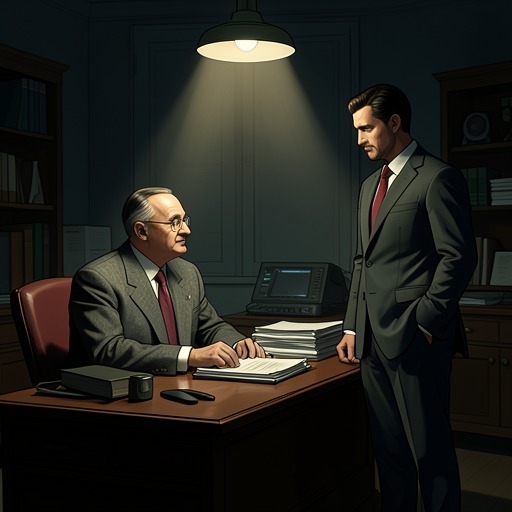
Federal Bureau of Investigation
TrumanThe Federal Bureau of Investigation enters the account of Harry S. Truman’s presidency at a moment when fear of Communist influence was becoming a force in national politics. Under J. Edgar Hoover, the Bureau publicly warned of the scale of the perceived danger, while its surveillance practices formed part of a less visible debate over executive authority and civil liberties. The account’s central tension is that Truman’s own concerns about Communists existed alongside his later association with a security policy whose limits had not been fully explained to him.
Public Warnings and the Red Scare
In the postwar atmosphere of shortages, political conflict, and mounting suspicion, fear of Communist influence was more than a campaign slogan. A Washington Post correspondent found hostility to Communism widespread in the places he visited. Republicans accused Truman of appeasing the Soviet Union abroad and allowing Communism to grow at home; members of Congress also warned of Communist infiltration in universities and even the Army. These accusations placed pressure on the administration to demonstrate vigilance, and gave the Bureau’s public interventions unusual political weight.
At a speech in San Francisco, J. Edgar Hoover warned that no less than a hundred thousand Communists were loose in the country. The warning gave a striking numerical scale to an anxiety that was already spreading through public debate. The account does not establish the methods or evidence behind Hoover’s figure, but emphasizes its place in an atmosphere of increasingly strident accusation. The President, meanwhile, was not simply a target of anti-Communist rhetoric: his private anxieties about Reds and fellow travelers were, the narrative observes, hardly different in spirit from the attacks directed at him.
Electronic Surveillance and Presidential Oversight
The Bureau’s institutional significance also appears through the question of electronic surveillance. That summer, under pressure from Attorney General Tom C. Clark, Truman secretly agreed to continue surveillance in cases involving national defense. The policy had been instituted under Franklin D. Roosevelt, and Truman’s approval therefore continued an existing practice rather than creating one from scratch. Yet the account makes clear that the inherited policy’s scope mattered: Roosevelt’s original 1940 authorization had been limited to aliens.
Clark did not tell Truman about that limitation. The omission makes the episode more than a general instance of wartime or postwar security policy. The President approved continuation of surveillance on the understanding conveyed to him, while a material boundary in the earlier authorization remained undisclosed. The resulting gap between the policy as presented and its original restriction exposes a problem of oversight: formal presidential approval did not ensure that the President had been given the full history of the power being continued.
The evidence identifies national defense as the stated condition for surveillance, but does not specify which cases were involved or what the Bureau did in them. It likewise does not describe the surveillance techniques, identify the people affected, or say how long the continued authorization remained in force. Those limits matter. The account supports a concrete conclusion about the continuation of an inherited authority and the information withheld from Truman, not a broader claim about every Bureau investigation or the full reach of its operations.
Security Anxiety and Political Pressure
The surveillance decision sits within a political climate in which suspicion could be expressed both as a matter of public alarm and as a matter of government policy. Hoover’s San Francisco warning was public and emphatic; Truman’s agreement to continued electronic surveillance was secret. Juxtaposed, the two episodes show different ways in which the perceived Communist danger shaped the administration: one through a public warning that intensified the national mood, the other through a presidential decision made within government.
The narrative also resists a simple contrast between a moderate President and an overzealous Bureau. Truman faced intense accusations that his administration was weak against Communism, but he himself shared anxieties about Communist influence. The Ottawa spy ring’s exposure, the account notes, could be cited as evidence that alarm was not wholly baseless. That context helps explain why surveillance could appear to the administration as a national-defense measure, even while the undisclosed restriction in Roosevelt’s original authorization raises a distinct question about how such authority was controlled.
Narrative Significance and Evidentiary Limits
The Bureau’s role here is therefore presented through two connected but different forms of power: Hoover’s capacity to shape public perception with a dramatic estimate, and the government’s capacity to authorize secret surveillance. The first made the danger legible to the public in stark numbers; the second translated concern into policy. The account does not equate the two, but places them in the same political setting, where warnings of infiltration and pressure for action could reinforce one another.
The episode also complicates Truman’s relationship to anti-Communism. He was subjected to claims that he was soft on the Soviet Union and permissive toward Communists at home, yet he privately feared Communist influence and approved a continuation of surveillance. At the same time, his decision was made without being told that Roosevelt’s original authorization applied only to aliens. The combination—not a simple story of either resistance or acquiescence—is what gives the Bureau’s brief appearance significance: it reveals how security policy could proceed through inherited authority, political pressure, and incomplete information, even as the public debate demanded certainty.