Republic of Korea Army
TrumanThe Republic of Korea Army was a principal South Korean force in the opening defense against the North Korean invasion. In the first months of the Korean War, it fought alongside American troops while facing a better-equipped opponent and a series of retreats. The book presents the army through those battlefield conditions: its shortages, the pressure on its units, and the effort to keep the advancing enemy from overrunning South Korea.
Role in the Early Defense
By July 6, American forces in the operation numbered about 10,000, while the Republic of Korea Army had about 25,000; North Korean forces were estimated at 90,000. Numbers alone did not capture the imbalance. American and South Korean forces were often outnumbered three to one, and sometimes ten to one or more, while lacking weapons capable of stopping Russian T-34 tanks. World War II bazookas proved ineffective against them.
The South Korean force had been deliberately kept under-equipped by American policy, which sought to avoid encouraging South Korea to attack the North. Once the invasion came, that restraint left the Republic of Korea Army and its American allies poorly prepared for the enemy’s tanks and concentrated attacks. The army’s early role was therefore not simply to fight alongside the United States, but to help hold ground under a substantial material and numerical disadvantage.
Retreat and Resistance
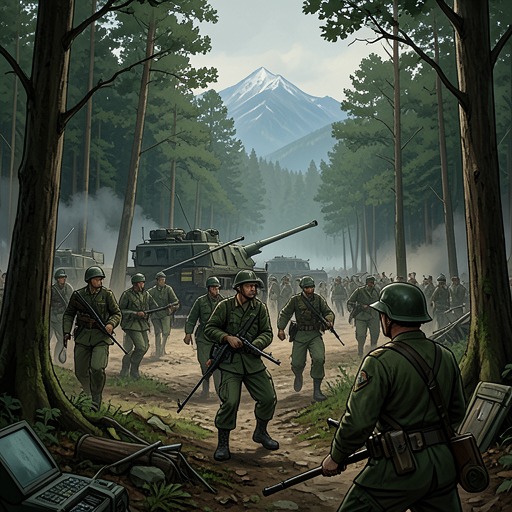
The Republic of Korea Army fell back with American forces as they tried to prevent a retreat from becoming a rout. Fighting took place in punishing summer conditions, and broken communications, mud-clogged roads, and large numbers of refugees added to the disorder. The account describes allied troops repeatedly fighting and withdrawing as the front moved south.
After seventeen days of savage fighting, American and South Korean forces had retreated seventy miles through the steep passes of the Sobaek Mountains to a defensive line on high ground behind the Naktong River. The withdrawal was a grave setback, but the forces had delayed the North Korean advance long enough for men and supplies to arrive through the port of Pusan. Their resistance helped prevent South Korea from being overrun at once.
Retreat Under the Chinese Offensive
The Republic of Korea Army faced another retreat after Chinese forces entered the war. Press accounts described South Korean soldiers withdrawing through Seoul as United Nations forces pulled back; Seoul was again in flames, and President Rhee and his government fled to Pusan. The wider Eighth Army had retreated nearly 300 miles since the Chinese offensive began on November 28, and the withdrawal continued in severe winter cold.
Across these episodes, the army’s history in the book is bound to the changing fortunes of the defense: an early struggle against a force with overwhelming advantages in equipment and numbers, a costly withdrawal that bought time, and a renewed retreat after Chinese intervention. The account emphasizes the pressure on South Korean soldiers without treating retreat as the whole measure of their role; in the summer campaign, their resistance, alongside that of American units, helped hold back the advance.