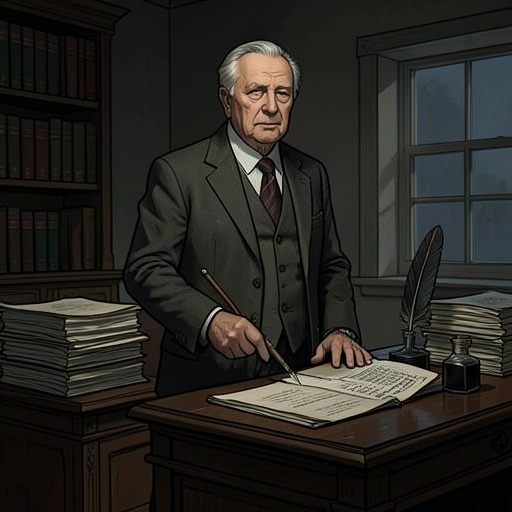
National Bank of Commerce of Kansas City
TrumanThe National Bank of Commerce of Kansas City was Harry S. Truman’s employer from 1903 to 1905, giving him his first sustained office job and making him the principal breadwinner in his family. Hired as a clerk in the vault, he handled checks and handwritten records in a basement workplace known to its clerks as “the zoo.” His supervisors repeatedly praised his performance, while the experience also exposed him to work he found dull and to a vice-president he came to dislike.
Application and Appointment
On Friday, April 24, 1903, Truman walked up Walnut Street in Kansas City to apply for work at the bank. He arrived in a dark suit and high, starched collar, dressed, the account observes, like a candidate for a bank clerk’s position. The two-page application asked about his ability with figures, debts, smoking, drinking, gambling, and other habits. Truman described his mathematical ability as fair and answered no to questions about debts and intoxicating spirits.
One question asked whether he had ever played the races or speculated. The surviving application shows that he began to write an answer, stopped, and replaced it with the same dash mark he used for repeated answers. The account suggests that a memory of Claude may have come to mind, but leaves the reason for his hesitation uncertain. The moment is notable less as proof of what he thought than as an early trace in his own handwriting of a considered answer that did not disclose everything. On questions about recreation and routine, he named theaters and reading, and said that he spent his evenings and Sundays at home.
A letter from Dr. Twyman described Truman as a “model young man.” William T. Kemper, a friend of John Truman and a director of the bank, may also have helped; the account presents that possibility without establishing it. The bank hired Truman as a vault clerk at $20 a month, about what his father earned as a night watchman. He remained there for two years.
Work in the Vault
Truman worked downstairs from the bank’s cavernous main lobby, among the Corinthian columns and brass spittoons above. The clerks’ nickname for the below-street-level vault was “the zoo.” His duties included clearing checks drawn on country banks and keeping the notations in longhand. At times, he handled as much as a million dollars’ worth of checks in a day.
The task called for exactness and close attention, but, in the account’s description, little initiative or imagination. It was not work Truman particularly cared for. He nevertheless continued to do it carefully, and his pay rose steadily. By the time he was earning $40 a month, he had become his family’s number one breadwinner. The increase marked a material change in his household role: his earnings had grown from a starting wage comparable to his father’s night-watchman pay to a larger share of family support.
The bank’s vault also defined the limits of his daily world there. He worked at a repetitive desk task, recording transactions by hand, rather than in a role that offered much scope for independent judgment. Yet the routine gave supervisors repeated opportunities to observe the qualities they valued in him: accuracy, attentiveness, regular attendance, and effort.
Supervisors’ Assessments
Truman’s immediate superior, A. D. Flintom, reported that the young clerk was exceptionally bright and maintained the vault’s work better than it had been kept before. Flintom described him as willing, diligent, and eager to please. He noted that Truman watched the work closely enough to catch errors that a careless clerk might miss, and commended his appearance, habits, and character.
Flintom’s later assessment again emphasized reliability and ambition. He described Truman as accurate, always at his post, and consistently up to date with his work; he also judged his character and habits excellent. Writing to vice-president Charles H. Moore, Flintom said that he knew of no better young man in the bank. His praise was not indiscriminate: he found Truman’s brother Vivian Truman pleasant in appearance but possessed of little ability, and explicitly contrasted the two brothers. That comparison makes the reports more than routine commendation; Flintom was distinguishing Truman’s performance from that of another employee in the same family.
Workplace and Early Significance
Truman’s relationship with the bank’s senior management was not uniformly positive. He later recalled that vice-president Charles H. Moore seemed happiest when calling an inoffensive clerk before him in the grand lobby to berate him as dumb and inefficient. The recollection identifies Moore as the first person Truman actually disliked. It also contrasts the supervisor’s recorded praise of Truman with the humiliating treatment he remembered being meted out to clerks more generally. Despite his dislike of Moore and his indifference to the work itself, Truman continued to do his best and received successive raises.
The bank episode thus combines a narrow, highly observed job with an important change in Truman’s material circumstances. Its records depict a clerk whose watchfulness and dependable attendance made him stand out; the narrative also preserves his hesitation on the application, his boredom with the routine, and his resentment of Moore’s treatment of subordinates. The two years at the National Bank of Commerce of Kansas City ended in 1905, but the account gives the employment a clear place in his early adult life: it was a first public test of his work, and the income made him the family’s leading earner.