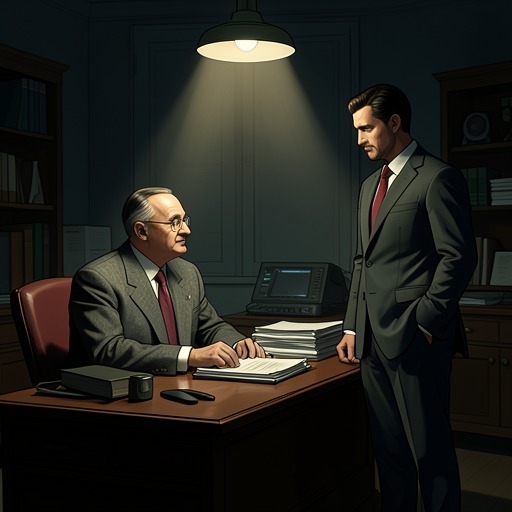
HUAC
TrumanHUAC was a congressional committee whose hearings and investigations became part of the postwar national debate over communism and alleged disloyalty. The account shows it as a setting for contested testimony and politically consequential inquiries, while distinguishing the committee’s work from the separate legal proceedings that resulted in Alger Hiss’s conviction.
Hearings and the Hollywood Ten
During the anti-Communist scare of 1950, three screenwriters associated with the Hollywood Ten had refused to tell HUAC whether they were Communists. A federal judge denied their pleas for acquittal, placing the committee’s questioning within a broader climate in which accusations and demands for political disclosure carried serious public consequences. The account presents this episode as one part of the period’s mounting pressure around suspected communism, not as a finding by the committee that the screenwriters were guilty of a crime.
The Hiss Inquiry and Richard Nixon
HUAC also provided the setting for Richard Nixon’s role in the case against Alger Hiss. Nixon, described as the committee’s only lawyer, played a leading part in the case. Hiss’s second trial ended in a perjury conviction for lying about passing secret documents; the account identifies that conviction as the outcome of a trial, rather than a verdict issued by HUAC.
After the conviction, Nixon used a radio appearance to accuse the administration of deliberately concealing the alleged Hiss conspiracy. The controversy thus extended beyond the committee’s proceedings: HUAC was connected to an inquiry that became a larger political dispute about the handling of the case and the credibility of the government’s response.
Place in the Anti-Communist Climate
The episodes associated with HUAC sit amid a wider atmosphere of suspicion. On the day the president returned to Missouri in June 1950, newspaper coverage included the Hollywood Ten proceedings and the arrest of David Greenglass, who was charged with involvement in the Klaus Fuchs spy ring at Los Alamos Laboratory. These events were distinct, but their appearance together in the account conveys how committee hearings, criminal cases, and espionage allegations occupied the same charged public landscape.
The evidence portrays HUAC through particular investigations rather than a full account of its organization or procedures. Its significance here lies in the way its hearings brought questions of political allegiance into public view and became entangled with consequential legal cases and partisan accusations.