United Nations Command
TrumanThe United Nations Command is presented as the authority holding North Korean prisoners during the Korean War and as part of the institutional framework within which military commanders were expected to act. The account’s clearest focus is the Command’s custody of prisoners and the dispute over whether they could be sent home against their wishes.
Role in the Korean War
At the armistice talks at Panmunjom, the fate of 132,000 North Korean soldiers held by the United Nations Command became a central sticking point. The original understanding had called for an immediate exchange of all prisoners when hostilities ended. The United States later opposed that arrangement because nearly half of the prisoners—about 62,000—did not want to be repatriated.
Prisoners and the Armistice
Harry S. Truman insisted that the prisoners be allowed to choose whether to return home. He argued that an armistice should not be secured by handing people over to possible slaughter or enslavement, and refused to yield on the issue. The Command’s custody of the prisoners thus placed it at the center of a consequential question in the negotiations: whether ending the fighting required an unconditional exchange, or whether individual choice would shape repatriation.
Authority and Limits
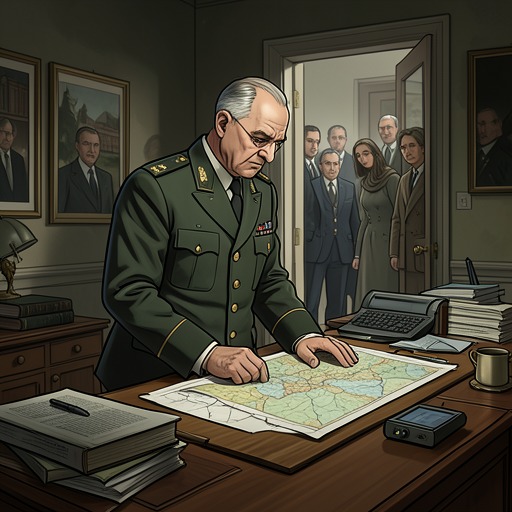
The account also situates the United Nations Command within a system of political and military authority. It describes a military commander of the United Nations issuing a foreign-policy statement in defiance of presidential orders and of United Nations policy. This episode underscores the distinction between command in the field and authority to declare policy; the account does not, however, specify the Command’s internal organization or explain how its forces were constituted.
Significance in the Account
The United Nations Command is not described through its administrative structure or a full history of its operations. Instead, its significance emerges through two linked issues: custody of prisoners and the authority governing military action. The prisoner dispute shows how the Command’s wartime role extended into the terms of a possible peace, while the episode of a commander defying policy reveals the limits placed on military initiative.