North Atlantic Treaty Organization
TrumanThe North Atlantic Treaty Organization is presented as a defining part of Harry S. Truman’s postwar record: both an achievement he later singled out with pride and a commitment whose military requirements shaped decisions at home. The account does not describe the organization’s founding, membership, or internal structure. Instead, it shows how the alliance belonged to a wider American effort to resist the expansion of Soviet influence, and how its defense needs connected international policy to production, labor, and presidential responsibility.
Place in postwar strategy
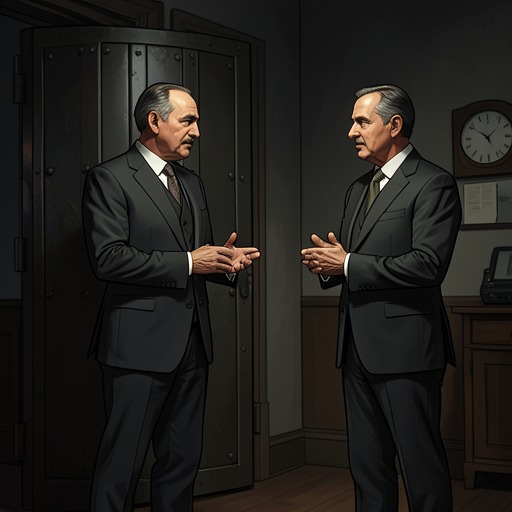
The alliance appears against a background of growing concern about Soviet power. In discussions after Franklin D. Roosevelt’s death, Averell Harriman warned Truman that Soviet control in Poland and Romania could bring secret police and restrictions on free speech. Harriman argued that American policy needed reconsideration, while still maintaining that workable relations with the Soviet Union were possible through concessions on both sides. Truman acknowledged that complete cooperation from Joseph Stalin was unrealistic, but expected the United States to press for agreed commitments. These exchanges establish the strategic atmosphere in which the administration pursued a more durable postwar role; they do not, by themselves, supply a detailed account of the alliance’s creation.
By 1947, the administration’s concerns extended beyond any single aid measure. As Truman and his advisers considered assistance to Greece and Turkey, the President convened congressional leaders to hear George C. Marshall’s assessment of the danger that Soviet domination might spread across Europe, the Middle East, and Asia. The account stresses the urgency of securing domestic support for action. The North Atlantic Treaty Organization belongs to this broader policy landscape: a commitment to European security that required American political backing as well as diplomatic resolve.
Political backing and presidential responsibility
The narrative repeatedly connects foreign commitments to the institutions and constituencies that had to sustain them. Truman’s discussion of Poland with Soviet officials, for example, linked the conduct of international affairs to the prospect of Senate approval for American participation in the United Nations. This is not a direct account of negotiations over the North Atlantic Treaty Organization, but it clarifies a recurring constraint in Truman’s foreign policy: external commitments could not be separated from congressional judgment and domestic political consent.
That connection matters to the alliance’s place in the book. Truman later named the North Atlantic Treaty Organization among the accomplishments he most valued, alongside aid to Greece and Turkey, the Marshall Plan, Point Four, and the Berlin Airlift. His recollections present these policies as parts of a larger record, rather than as isolated initiatives. He also regarded Korea as the supreme test of his presidency and believed that American military strength and national prestige had been restored. Together, those assessments show how the alliance fitted into the broader security policy Truman claimed as a legacy, even though the account gives no detailed institutional history of the organization itself.
Defense production and the European buildup
The alliance’s most concrete appearance in the account comes during the steel dispute. United Steel Workers sought a wage increase after having had no raise since 1950. Truman referred the dispute to the Wage Stabilization Board, which recommended an increase of 26 cents an hour. The union accepted the recommendation, but management rejected it unless it could also raise steel prices. As negotiations stalled and the strike deadline approached, Truman judged the proposed wage settlement fair and saw a stoppage as a threat to national security.
The stakes extended beyond domestic industry. Truman feared that a steel strike would impair the supply of munitions for the war in Korea and the buildup of North Atlantic Treaty Organization forces in Europe. Secretary of Defense Robert Lovett warned that even a short interruption would increase the risks of stretching the armaments program, since the armed services depended on full use of American industrial capacity. In this account, the alliance is therefore not merely a diplomatic name on a list of achievements: its European defense buildup depended on materials produced through a contested labor and industrial system.
Truman declined to use the Taft-Hartley Act to delay a strike for eighty days. He considered further delay unlikely to settle a dispute whose facts were already clear, and unfair to workers who had stayed on the job for nearly three months without a change in pay. His position reveals a tension within the policy context of the North Atlantic Treaty Organization: the administration sought to maintain military readiness, but Truman also weighed the fairness of the proposed settlement and the consequences of imposing a legal delay on labor.
Assessment and significance
The book’s treatment of the North Atlantic Treaty Organization is concise but consequential. The alliance figures among the policies Truman recalled as achievements, while its defense buildup supplies a concrete reason why a domestic labor dispute became a question of international security. This pairing links retrospective political evaluation to the practical demands of sustaining military power.
The organization also helps define the scale of Truman’s postwar responsibilities. His administration’s security commitments required cooperation across diplomatic, congressional, military, and industrial arenas; no single decision or institution stood apart from those pressures. The evidence does not provide the alliance’s formal arrangements or trace its development in detail. It instead locates the North Atlantic Treaty Organization within Truman’s larger account of postwar leadership: a European commitment he counted as a success, and a continuing demand on the country’s capacity to support its allies.