Darryl Louise Chastain and Ralph Wayvone: Recruitment and Exploitation
VinelandRalph Wayvone’s relationship with Darryl Louise Chastain begins as a recruitment built around a shared target and becomes a contest over who can claim the other’s choices. He offers her a professional place in his organization by promising access to Brock Vond, the object of her years-long revenge fantasy. Yet Ralph’s dossier, his surveillance, and his later decision that Darryl Louise already owes him reveal the coercive structure beneath the pitch: he treats her history and her talent as assets he can acquire, while she struggles to keep her purpose from becoming his instrument.
Recruitment Through a Shared Enemy
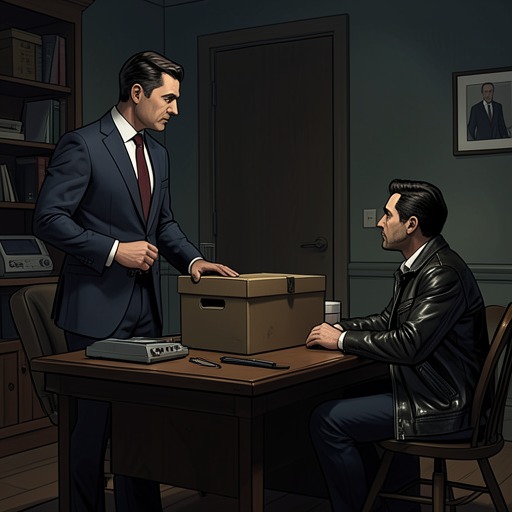
Ralph approaches Darryl Louise in a Eugene café, where she has been staring at a plate of four rubbery shrimp covered in tomato sauce. His tailored suit has already caught her attention when he sits opposite her, opens an armored briefcase, and produces an FBI file: an 18-by-24 studio photograph of Brock Vond, attached to federal-stamped pages. He presents the paperwork as legitimate and the proposal as mutually desirable. Darryl Louise’s desire to kill Brock, he argues, can serve both her purpose and his.
His timing is precise. Brock, Ralph says, has moved from his campaign against the Left to the War on Drugs and has become more powerful still. People close to Ralph are worried, but he insists that he is not turning to Darryl Louise because his side lacks other means. He claims she is motivated, and that her story is already in a computer. The appeal therefore rests on two kinds of knowledge: Ralph’s account of Brock’s political reach and his possession of Darryl Louise’s personal history. Her recollection of an armored white car outside Inoshiro Sensei’s home shows that the offer touches an old, intimate grievance, not merely a current political calculation.
Ralph also knows what he wants from her body and training. He has heard of the Vibrating Palm, the light touch said to cause a person’s death a year later, when the practitioner is far away. Darryl Louise names the technique and explains that it requires years of martial-arts discipline and, in her account, has profound moral weight; it is not a casual means of settling a personal dislike. As she explains its seriousness, she recognizes that she is trying to persuade herself as well as Ralph. His easy reassurance does not resolve the ethical danger she sees in the proposal.
A Dossier Built Over Years
Ralph’s claim to know Darryl Louise is not simply a bluff based on the file. He remembers seeing her compete years earlier, after hearing reports of an extraordinary performance at a regional elimination tournament. He travelled beyond the Mojave to watch her in a damp concrete arena, then followed her from contest to contest across the American South and West. The circuit—remote motels, weapons, hard-edged company, and long drives—became the setting in which he watched her career from a distance.
He thought of himself not as a helpless spectator but as a shrewd, energetic manager. The years of attention yielded a dossier that, he believed, would eventually be useful; the recruitment is the moment that expectation pays off. When Darryl Louise says that she was once the best, Ralph responds as someone who remembers her directly, not merely as someone repeating what others have told him. That distinction makes his interest personal in its duration, but not necessarily reciprocal: his accumulated knowledge gives him a considerable advantage over the woman he is trying to hire.
The Offer’s Terms and Its Pressure
Darryl Louise understands that Ralph is not asking for an ordinary favor. She challenges his reliance on a technique that can be morally serious and technically demanding, and questions why he has approached her rather than relying on guns, knives, or car bombs. Ralph answers by emphasizing the method’s distinctive promise: the practitioner can be far away when the delayed death occurs. His salesmanship converts her discipline into a form of professional utility, while her explanation tries to keep that discipline attached to its ethical limits.
Later, Ralph courts her in a more theatrical register, dancing with her as a storm rages and invoking the image of a black belt dancing with an older gentleman. The scene briefly gives Darryl Louise room to think clearly about her fugitive life. She is struck by the fact that Ralph has pursued her, and even publicly bought her for the price of a fully equipped Lamborghini; the offer of a chance to kill Brock adds to its force. Ralph then describes an unusually permissive employment arrangement: the best contracts, a veto over every mission, no weekly quotas, and accounting reviews only every three months. The terms promise autonomy, but they do not erase the imbalance established by his surveillance and knowledge of her past.
Flight, Debt, and the Unfinished Recruitment
Darryl Louise does not give Ralph the answer he wants. She promises to tell him her decision at dinner the following evening, then escapes instead. Near Drain, Oregon, she loses Ralph’s pursuers beside a late-model Oldsmobile with steam coming from its hood. She changes cars again before reaching Los Angeles, retrieves papers deposited at a Wilshire bank, buys a 1966 Plymouth Fury with cash, and changes her appearance with a wig. Her flight is not just refusal of a job: by adopting another identity, she acts against Ralph’s ability to hold her in place through the history he has collected.
Ralph’s pursuit nevertheless leaves a sense of obligation that he can exploit. After Darryl Louise’s bungled attempt to kill Brock at the Imperial Hotel, Ralph watches her departure through the hotel’s spy cameras. He considers having her captured again, then decides against it. His reasoning is revealing: he believes they can find her whenever they choose and that she will recognize how much she owes them. The decision spares her immediate recapture, but it also recasts her escape as a debt rather than a clean break. He watches her go with admiration and expresses hope that she succeeded, while continuing to imagine that, if she did not kill Brock, someone else will.
Their connection therefore never settles into a straightforward employer-and-operative arrangement. Ralph offers Darryl Louise choice within a contract, but also treats her talent, vendetta, and vulnerability as resources he has earned a claim upon. She is drawn by the prospect of confronting Brock and resists the capture of her agency; her flight and Ralph’s refusal to pursue her at the hotel leave that tension unresolved. The relationship turns recruitment into a form of pursuit, and makes the language of professional freedom coexist with the pressure of surveillance and presumed debt.