Takeshi Fumimota and Minoru: Longtime Work Partners
VinelandTakeshi Fumimota and Minoru are longtime work partners whose relationship combines specialized technical work with the shorthand of people who have faced danger together. Their cooperation is not presented as a formal alliance with clearly stated terms; it emerges through remembered missions, wary exchanges about evidence, and Minoru’s ability to pull Takeshi into an urgent investigation. The work keeps bringing them back to the same questions: what happened, who benefits, and whether a seemingly isolated incident belongs to a larger design.
Professional Familiarity and Shared Work
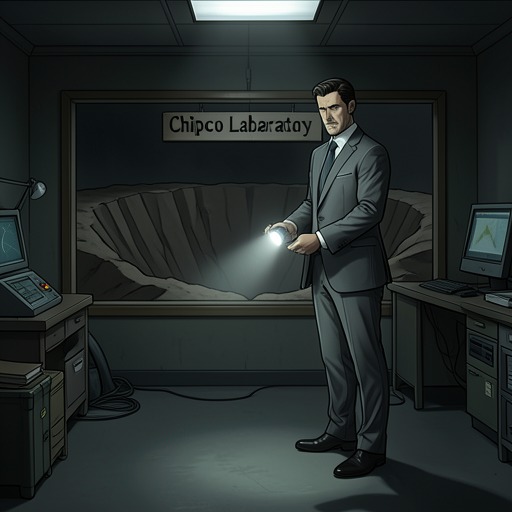
At the bottom of a deep crater, Takeshi recognizes Minoru among technicians arguing nearby. Minoru is an experienced bomb-disposal specialist, portrayed as an unlikely combination of limited general judgment and extraordinary perception: an idiot savant with X-ray vision. The description makes his value to the work distinctive. His expertise is not abstract; Takeshi finds him fixed on something cupped in his hands, while the other technicians dispute what they are seeing.
Their opening exchange is brief and familiar. Takeshi remarks on the day’s strange events, and Minoru invites him to look. The object’s precise nature is not established in this conversation, but the exchange shows the practical basis of their partnership: Minoru attends closely to technical evidence, and Takeshi comes to him to interpret an anomaly. The surrounding confusion does not need to be settled before they can recognize that the evidence merits attention.
When Minoru says he has never been down in a hole like this and dislikes it, Takeshi calls after him with an invitation to get a drink. The offer turns a hazardous work scene into an occasion for their habitual sociability. Minoru accepts the invitation on the helicopter taking them out, asking whether Takeshi really means it and whether they might get Singapore Slings. Their teasing ease sits beside the risk of the operation rather than replacing it.
The Himalayas as a Shared Reference
Once airborne, Minoru recalls that they had not flown together since their trip to Lhasa. His mischievous reminder signals a memory both men already know, and Takeshi answers as someone who expected Minoru to bring it up. They return to the Himalayan episode on the train, where its details become a framework for interpreting the case at hand: an attack on inanimate objects, a Czech-made detonator and explosive, Semtex, and what they call a fictitious motive.
Takeshi asks whether the current affair might be self-sabotage. Minoru counters with the question of who drew up the insurance policy. The answer is Professor Wawazume, as in the Himalayan incident. This recurrence does not prove that the incidents have the same cause, but it gives their comparison a concrete point of contact: the same professor is associated with the insurance arrangements in both cases. Their joint recollection makes an apparently technical detail newly significant.
The men exchange a look as tired veterans, likened to jungle natives collecting spent brass after a firefight for a small payment per ton. The image places their work below the level of the powers that shape it. They suspect that Chipco is deeply involved in a much larger struggle and allow that Professor Wawazume might be receiving a bribe, but neither possibility is confirmed. Their partnership means sharing suspicions and recognizing patterns; it does not grant them certainty or control over the forces behind the cases.
The memory also carries the texture of an earlier dangerous mission. Takeshi recalls the sudden storm in the Himalayas; Minoru remembers losing their way in the whiteout while searching for a pass and feeling time run out. After their laughter, Minoru recalls his first nuclear mission, and Takeshi remembers that Minoru was called the Kid. Their shared past therefore includes both peril and the capacity to laugh at what they endured. The recollections deepen their rapport without making the earlier episode fully legible: their trip through memory ends with no answer to the present case.
From Familiarity to Urgency
At Tokyo, the partnership changes pace. Minoru makes a phone call, becomes visibly unsettled, calls again, and returns to Takeshi with the warning that there is someone they must see immediately and that it may already be too late. He grabs Takeshi by the tie and pulls him toward a taxi despite his protests. The physical insistence is a sharp contrast with their earlier joking, and marks Minoru’s alarm as serious enough to override Takeshi’s reluctance.
Minoru directs the taxi to the Hilton International in Shinjuku, where an international symposium has brought together judges, American district attorneys, Interpol officials, and other well-connected travelers. He knows people on the list who might tell him about the case and could even obtain a facsimile of the sale contract bearing the buyer’s address. His connections and investigative initiative complement Takeshi’s willingness to accompany him: Minoru opens the route toward information, while Takeshi is drawn along as his partner.
The scene is set in 1978, amid bloody factional conflict within the yakuza, when public places cannot be assumed safe. That danger gives Minoru’s urgency added weight, but the passage does not establish exactly whom they need to reach or what the contract will disclose. At the hotel, Minoru’s contacts are occupied with scheduled evening engagements. The two men drink while waiting; a messenger eventually calls Minoru away, and he disappears. Takeshi is left behind, unable at first to find his way back from the restroom and ending up in a small room overlooking the street.
A Partnership Without Easy Answers
The sequence establishes the relationship through recurrence rather than a formal declaration. Minoru and Takeshi share an earlier mission, recognize the possible return of its pattern, and use their distinct knowledge to pursue the current case. Their exchanges move from technical scrutiny to playful drinking plans, from remembered danger to uneasy suspicion, and finally to an urgent attempt to find new information.
Yet working together does not make them omniscient. Their comparisons raise the possibility of insurance fraud, corporate involvement, or a wider conflict, while leaving those suspicions unverified. Nor does the narrative resolve Minoru’s disappearance at the hotel within this episode. The partnership’s defining feature is therefore not a clean solution but persistence: even when the evidence is evasive, the past incomplete, and Minoru suddenly out of reach, Takeshi remains caught up in the investigation they began together.