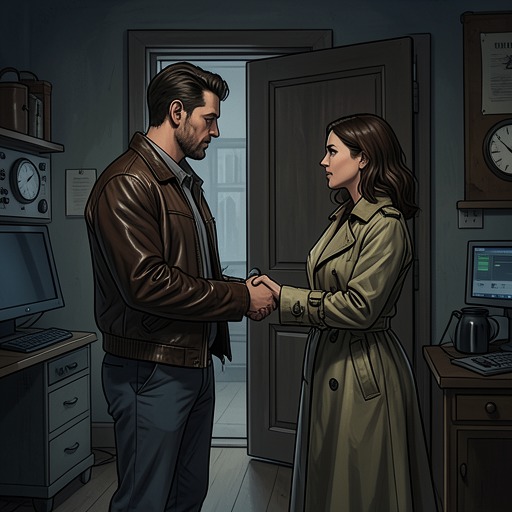
Takeshi Fumimota and Darryl Louise (DL): Atonement, Partnership, and Growing Intimacy
VinelandTakeshi Fumimota and Darryl Louise (DL) are joined by an injury that cannot be settled with an apology: DL once killed him, and after his resurrection she is ordered to remain at his side as the living cost of that act. Their enforced companionship becomes a working partnership in karmic repair, but its terms preserve the tension between obligation and desire. The relationship moves from an unresolved collision in Tokyo to shared labor among the Thanatoids of Shade Creek, where restitution becomes both a practical service and an intimate, continuing debt.
Collision, Recognition, and the Debt
The history between Takeshi Fumimota and DL begins with their collision in Tokyo and DL’s subsequent escape. When Takeshi encounters her again at the retreat, he recognizes that he has never stopped desiring her. Yet the recognition does not bring understanding: he cannot make sense of the specific sexual motives he imagines in her, then or now. DL, watching him approach with a mixture of amusement and disgust, responds with disbelief at his behavior. Attraction is already present, but it arrives entangled with the bewilderment and mistrust left by their first encounter.
Their reunion is interrupted by Sister Rochelle, who judges both of them culpable in the circumstances that have brought them together. She assigns DL to become Takeshi Fumimota’s devoted attendant and to repair the karmic wrong through work. The order makes their relationship more than a private reconciliation: DL’s service is imposed as penance, and Takeshi is its beneficiary. When DL asks how long the punishment will last, Sister Rochelle sets the term at one year and one day, linking it to the amount of life DL’s careless touch had left him. The duration gives their connection a defined measure, but not an easy resolution; for that period, companionship is simultaneously sentence, repayment, and the condition of their continued contact.
The Terms of Companionship
Sister Rochelle’s ruling also sets a boundary: DL stipulates that there will be no sex. Takeshi complains, but the restriction remains part of the arrangement. After leaving the retreat, the two travel downhill together in a rented Firebird, moving from the mountain retreat and muddy tracks toward paved roads and the interstate. It is the first time since that night in Tokyo that they have been alone together. DL identifies the arrangement as restitution to the victim and tells Takeshi that he must give her orders. He cannot think of anything to demand, pointing back to the no-sex clause as the immediate limit on what he might ask of her.
The terms are not merely formal. DL later explains that Takeshi’s resurrection was not free: Sister Rochelle and a team specializing in Eastern medicine brought him back after he was dead, and DL is the bill he must keep beside him, day after day. She presents herself as the person who first killed him and now remains bound to him by ties he cannot seem to comprehend. The image turns an abstract karmic balance into an ongoing obligation measured in daily presence. Takeshi, meanwhile, responds with flirtatious attention that DL notices; she jokes that moments like this make a girl want to forget her vows as a kunoichi. The restraint does not extinguish desire. It gives desire a form that must negotiate with the debt.
From Restitution to Shared Work
A stop at Shade Creek, made outside their original plans, gives the relationship a shared purpose beyond the assigned penance. Years later, Takeshi Fumimota and DL tell Prairie that the detour began their karmic-repair business. The town’s Thanatoids offered a large and seemingly inexhaustible body of clients, although many could pay little because heirs and assignees were greedy. The work soon widened beyond the case involving the trampled laboratory. They became involved in complicated disputes over dispossession and betrayal, including land and inland-water rights, intimidation, landlords, lawyers, and property speculation. Their partnership thus develops through practical attention to other people’s unresolved injuries, not simply through the private account between them.
DL initially resists the idea that karmic correction can become a profession. She insists that they are not in Tokyo and that nobody in this setting will pay for it. Her objection establishes a difference between the world in which the practice might seem viable and the local circumstances they actually face. The work nevertheless takes shape: they rent a meeting room at the Woodbine Motel for Saturdays and Sundays, while weekday meetings take place in a back room at the Zero Inn, open to anyone who wants to contribute testimony. The structure makes their service accessible even where payment is uncertain. What begins as a sentence imposed on DL becomes a continuing enterprise in which both of them hear accounts of injury and help those caught in tangled claims.
Intimacy, Uncertainty, and the Unfinished Bond
Takeshi Fumimota struggles to understand why DL continues to accompany him. He entertains the hope that she invented the account of killing him and that her behavior is an eccentric form of flirtation, but recognizes that this is wishful thinking. He cannot fully believe either in his own death or in the explanation that would make her conduct intelligible: if she killed him, why stay with him; if she did not, why subject him to so many trials? The questions do not produce a clear answer. Instead, the difficulties of their connection carry him toward an almost irrational joy, so intense that he imagines it might itself amount to losing his mind.
He begins to suspect that DL’s real mission may be to make his life into a koan, an insoluble Zen puzzle that might send him into blissful transcendence. This is not a settled account of her motives, but a description of his experience of their relationship: every apparent explanation opens onto another uncertainty. He does not ask her directly, expecting evasive answers accompanied by a smile and averted eyes. Her secrecy seems more childlike than sinister. Much later, DL confesses that she misses the retreat: its mountain ridge near the clouds, its high dark walls, and the company of the other women who returned there to rest after hardship. That recollection connects her continuing attachment to a life and community beyond Takeshi Fumimota, even as the two remain joined by their shared work and the unresolved terms of their intimacy. The evidence leaves their bond in motion: desire persists, the vow imposes limits, and neither the original debt nor its emotional meaning is simply erased.