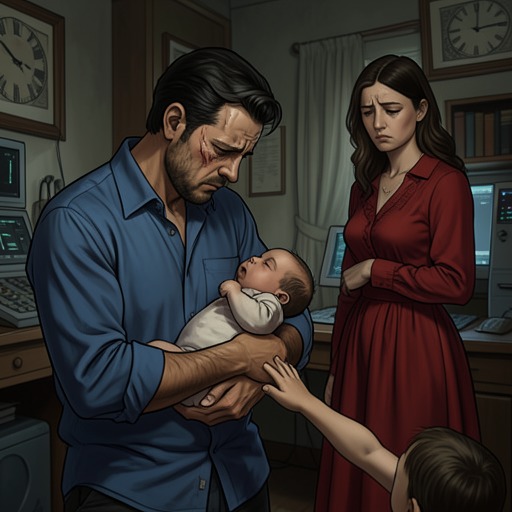
Zoyd Wheeler and Prairie Wheeler: Father-Daughter Bond
VinelandZoyd Wheeler and Prairie Wheeler’s father-daughter bond joins everyday familiarity to a separation neither can simply undo. Their exchanges over television, clothes, food, and money give the relationship a teasing domestic texture, while Prairie’s determination to find her mother, Frenesi Gates, exposes its deeper limit: Zoyd loves his daughter, but he cannot make the family whole by keeping her beside him.
Identity and Everyday Contact
In the summer of 1984, father and daughter share a household in which they often miss one another’s schedules. Zoyd wakes late and finds a note from Prairie on the kitchen table, beside an empty box of Count Chocula. She explains that her shift has changed again, that she is going with Thapsia, and that a local television station has called urgently for her father. The note closes affectionately, even as its practical details show how their connection often works: through messages, errands, and the routines of a shared home rather than uninterrupted conversation.
Their domestic life is not presented as serene. Prairie waits to watch a television program before Zoyd can take his turn, then admires the conspicuous cotton-print dress he has worn for his public performance and asks to have it when he no longer needs it, perhaps to cover her futon. The oddity of the request makes their affection legible through familiarity: she can tease him about his clothes and imagine their next use, while he treats her request as part of the household’s casual negotiation over possessions.
Teasing, Money, and Mutual Defensiveness
The ease between them also allows their jokes to stray into sensitive territory. When Prairie needs something new, Zoyd objects that they have to economize and do not have enough money even for food. She hears the remark as an accusation about her weight and answers by pointing to the cakes, pastries, candied fruit, and sweetened drink kept around the house. Zoyd denies that he meant to call her fat; Prairie adds that Big I has recently made comments of that kind. The exchange reveals how quickly a discussion of scarce money can become entangled with judgments about her body, and how readily Prairie pushes back rather than accepting her father’s explanation at face value.
Their humor can likewise be deliberately sharp. Zoyd jokes about whether Prairie is involved with lumberjacks; she protests his implication. Later, as she prepares to leave, she tells him to abstain from smoking, and he replies with a crude joke about her thighs. These parting barbs do not erase the tenderness in their relationship, but they show that tenderness is not expressed as solemn reassurance. Their familiar banter lets each answer the other in kind, even when the subject beneath the joke is worry, money, or the changes Prairie is undergoing.
A Love That Cannot Settle the Search
The bond reaches its emotional center when Prairie faces the loss of their home and the prospect of going on the road. She throws herself into Zoyd’s arms, though she does not cry. He asks her to stay the night with him and suggests that Isaiah Due Quattro can collect her in the morning. Prairie acknowledges that Hector Zuñiga was telling the truth: she is willing to go with him in search of Frenesi Gates. She tells her father that she loves him, but that something in her life remains incomplete.
Zoyd answers by insisting that he and Frenesi Gates will never get back together. His response distinguishes two matters that Prairie’s hope holds close: the search for her mother and the restoration of her parents’ marriage. He can tell her that reconciliation is impossible as he sees it, but cannot persuade her to stop seeking Frenesi. Prairie asks him to imagine himself in her position and consider whether he would do otherwise. The question makes her departure more than an argument about where she will sleep: it is a choice rooted in a family absence her father cannot repair for her.
Zoyd is deeply affected by Prairie’s directness. Her clear gaze makes him feel fraudulent and lost, and he asks whether she truly thinks he is crazy. Prairie quickly denies it and explains that she understands the feeling he has expressed: for her, there is only her mother. Zoyd wants to embrace her, but remembers that Prairie has repeatedly described herself as a possible bait in his emotional life, drawing him toward prison. He restrains the embrace, tries instead to reassure her with a familiar nickname and a pat on the shoulder, and lies awake above her while she falls asleep. His hesitation is not indifference; it is care complicated by his awareness that even affection can feel coercive to her.
Departure and the Shape of Their Attachment
The next morning, the bus carrying Billy Barf and the Vomitones descends the sandy driveway. Isaiah Due Quattro is at the wheel; blurred faces watch from behind tinted windows, and the bus is decorated with imagery of nuclear, cybernetic death and a steering wheel made from miniature iron skulls. Zoyd does not know what Prairie will encounter and feels powerless as she leaves. The departure gives physical form to the incompleteness she has named: he cannot accompany her into the search simply by loving her or asking her to stay.
Father and daughter have agreed to keep in touch through Sasha Gates, Zoyd’s former mother-in-law, who lives in Los Angeles. That arrangement preserves a link without pretending that Prairie’s journey has been settled or that the family’s separations have vanished. Their farewell returns to teasing: Prairie warns Zoyd about smoking, and he answers with another insolent joke. The humor leaves them on recognizable terms, but the bus carries Prairie away all the same. The relationship’s defining tension is therefore not a lack of affection; it is the difference between the home Zoyd wants to hold together and the unfinished family history Prairie feels compelled to pursue.