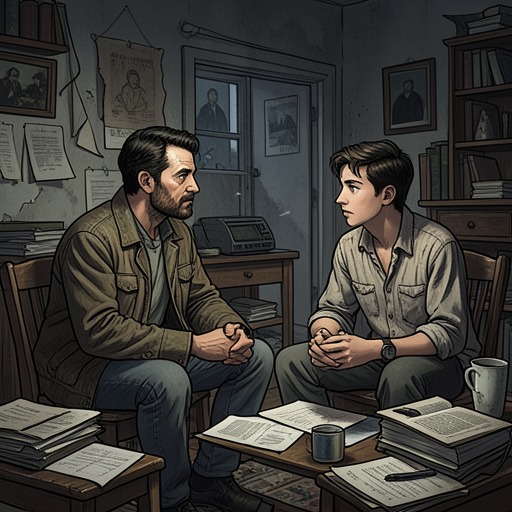
Zoyd Wheeler and Van Meter: Longstanding Friendship
VinelandZoyd Wheeler and Van Meter’s friendship joins everyday practical loyalty to a deliberately irreverent way of remembering. Van Meter makes room for Zoyd in a crowded, quarrelsome life, while their familiar teasing lets them revisit painful events without pretending the past was harmless.
A Friendship in the Cucumber Lounge’s Orbit
Van Meter belongs to the everyday geography around the Cucumber Lounge: he has lived for some time in a bungalow there, and when Zoyd arrives amid reporters, television crews, and state and county police vehicles, he ultimately parks in the space reserved for Van Meter. The gesture is small but telling. In the unsettled scene around the lounge, Van Meter’s space offers a familiar point of reference, and Van Meter himself is close enough to appear at the corner and greet Zoyd.
The greeting carries the recognizable shape of their companionship. Van Meter wears an expression of wounded righteousness, asks whether Zoyd is ready, and wants to know what took him up to the Log Jam. His question is not a formal inquiry but the easy scrutiny of someone who expects to hear the story. When Zoyd asks why so many people have gathered, Van Meter says that an old friend of his has turned up. The exchange places their personal familiarity against the conspicuous police and media presence: even amid a public spectacle, Van Meter approaches Zoyd through their shared history and immediate conversation.
Shared Disorder and Familiar Teasing
Van Meter’s home life is itself a comic emblem of disorder. His self-described commune contains current and former wives, friends of former wives, children whose parents are both present and absent, and people who have arrived from the night. Zoyd had hoped Van Meter’s move there might bring him a measure of serenity, but the crowded household has chosen continual argument instead. Its quarrels become ritualized, loud enough to inspire their own newspaper, the Blind-Side Gazette, and to be mistaken by passing truck drivers for a malfunctioning radio or restless ghosts.
This setting gives their friendship a texture of shared disorder rather than tranquil refuge. Zoyd can park in Van Meter’s space, and Van Meter can meet him with a question, but neither man’s surroundings promise calm. Their closeness is expressed less through declarations than through the ease of entering one another’s untidy worlds. Even Van Meter’s interest in Zoyd’s movements—asking about the Log Jam—belongs to a continuing exchange in which personal trouble is available for inspection and comment.
Recalling the Years of Trouble
The two men’s friendship has long included pretending to laugh at each other’s misfortunes. That habit comes into focus after Zoyd narrowly misses Hector Zuñiga: he had skipped the Lost Nugget and gone instead to the Steam Donkey, where Van Meter eventually joined him. Sitting beside Zoyd and slowly getting drunk on beer, Van Meter began to recall the old days. Their reunion is thus not simply a response to the commotion at the Cucumber Lounge; it reopens a shared past in which Zoyd’s relationship with Frenesi Gates and his repeated encounters with Hector remain available for retelling.
As Zoyd explains that Frenesi had been an educated filmmaker from Berkeley while he worked intermittently as a plumber, Van Meter asks whether Zoyd feels guilty about the work she later took up. Zoyd distinguishes guilt over that from regret that he failed to see what was happening and believed they could evade their pursuers. Van Meter’s response is to laugh at how tangled the two of them had become, then point out the painful irony: Zoyd had been so preoccupied with Hector that he did not realize another federal agent was involved with his wife until after she had left him. The joke draws its force from the delay in Zoyd’s understanding, not from any suggestion that the loss was trivial.
Affection Without Consolation
Zoyd answers Van Meter with mock gratitude for his support, then recalls that, at the time, he was relieved to have Hector off his back and believed he had narrowly escaped a trap. In retrospect, he recognizes that he had treated the end of that crisis as if it were the end of life’s difficulties. He had left with Prairie and imagined that, whatever else had ended, his love for his daughter would continue to burn like a small night-light. Frenesi was gone; Prairie remained. Hector, he thought, would no longer disturb his surroundings.
That recollection gives the friendship an important emotional limit as well as its humor. Van Meter does not offer a consoling correction to Zoyd’s past; his teasing exposes how much Zoyd failed to foresee, while Zoyd can accept the teasing because it comes from an old companion. Zoyd’s later judgment of himself is harsher than Van Meter’s laughter: he sees that he had mistaken a dramatic episode for a final resolution, though he and Prairie still had years of life ahead of them. The friendship therefore serves as a setting in which remembered failures can be spoken aloud, laughed over, and still recognized as consequential.