Frenesi Gates and Prairie Wheeler: Mother-Daughter Bond
VinelandFrenesi Gates and Prairie Wheeler: Mother-Daughter Bond is a relationship shaped by separation rather than shared daily life. Prairie’s memory of her mother is anchored in a childhood parting; Frenesi’s knowledge of her daughter becomes a succession of imagined scenes and recurring memories. Years later, Prairie uses photographs, documents, and film footage to approach a mother whose past she did not witness. Their bond thus persists through absence, but the surviving images can bring them close only in fragments.
Separation and the remembered parting
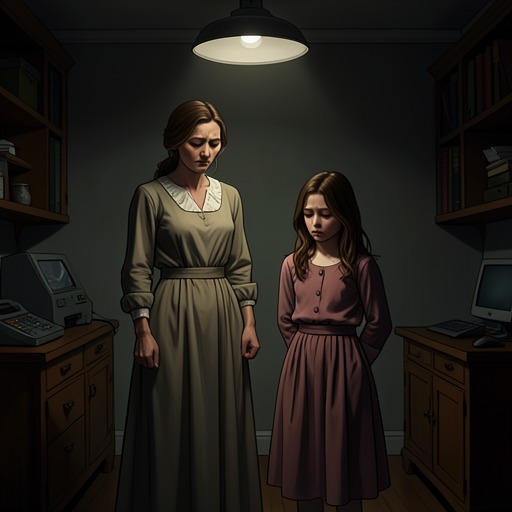
Frenesi has not seen Prairie since Prairie was a little girl. In Frenesi’s recollection of their last encounter, Prairie smiles at her, toothless and trusting, convinced that her mother will return that evening as usual. Zoyd Wheeler holds the child as she tries to wriggle free and reach Frenesi. The remembered gesture gives the separation its emotional shape: Prairie is not yet old enough to understand what is happening, while Frenesi carries the image of her daughter reaching for her long afterward.
The scene returns to Frenesi in the middle of an ordinary life with Flash. She sits at a kitchen table with coffee in an old apartment in a pale, damp Sun Belt town, while sunlight filters through leaves. The domestic setting does not quiet the past. Her thoughts return to Prairie as a recurring tune, and the remembered child remains vivid even though Frenesi no longer knows the person she has become. The contrast between the calm kitchen and the force of the memory makes absence an active part of Frenesi’s present, not a closed episode.
Imagining the daughter she cannot know
Because Frenesi has no direct knowledge of Prairie’s adolescence, she pictures it. She imagines Prairie as a young woman living in a California coastal bungalow, dressed in revealing clothes and held by an unspecified young man. The scene is not evidence about Prairie’s actual life; it is Frenesi’s attempt to supply the details that separation has denied her. She wonders whether she would recognize her daughter if they passed one another in the street.
That imagined stranger becomes a focus for Frenesi’s attention in the world around her. She watches girls at Southplex, one of the four large department stores framing the town, studying how they move and speak and what interests them. She searches for points of resemblance between these young women and the daughter she cannot see. The habitual observation is both intimate and indirect: Frenesi gathers everyday details without being able to ask Prairie about her life or verify her guesses.
Frenesi finds the subject difficult to discuss with Flash. His own children are absent from him too, but his attention does not remain with the loss in the way hers does. The two share a household, yet the conversation about Prairie cannot become a shared account of her. Frenesi’s continuing attachment is therefore marked by a tension between vivid concern and the lack of ordinary contact through which a parent might know a growing child.
Prairie’s search through records and images
For Prairie, the separation becomes a search into who her mother was. Frenesi’s dossier gathers materials accumulated over many years and from different sources: official papers bearing stamps and file numbers, FBI memoranda, old underground newspaper clippings, radio interviews with Frenesi, and material concerning 24fps, the film collective with which Frenesi and DL had worked. To Prairie, the dossier resembles an eccentric relative’s scrapbook. Its mixture of bureaucratic records and remnants of a vanished movement offers no single, complete account, but gives her routes into a history she did not experience.
The documents make Frenesi available to Prairie as both a person and a trace. Prairie can call up personal and published photographs of her mother at demonstrations, under arrest, and beside recognizable figures from the movement. One image shows Frenesi looking toward a riot police officer near a wire fence, her fingertips apparently touching the barrel of an assault rifle. Prairie encounters a young woman in miniskirts or bell-bottom trousers and has to reconcile that unfamiliar political figure with the mother she never got to know. The photographs establish visible facts about Frenesi’s past while leaving the private relationship between mother and daughter largely unrecorded.
A photograph of Frenesi walking with DL offers a different kind of evidence. They appear to be crossing a university campus in a quiet interval, their long shadows falling across the grass. Frenesi is turned toward her companion with a restrained smile while DL speaks. Prairie reads the image’s ease and unguardedness as a glimpse of a life beyond political performance. She addresses the photographed women in her thoughts, urging the moment to continue, but the still image cannot answer her or disclose what came before and after it.
Film as a mediated meeting
Prairie also watches the 24fps footage, reel after reel, and sees the violence of the period: strikes against strikebreakers, police along a field, raids on a Texas commune, arrests and assaults, children thrown about, animals killed, and fields of marijuana burning. The material makes her mother’s political era more than a collection of familiar images from television. It asks Prairie to look at what the footage records, including scenes of coercion and force, rather than treating the past as distant spectacle.
As Prairie watches, she recognizes that Frenesi is often behind the camera. She imagines that by emptying her mind she can absorb her mother and share her eyes: the tired, frightened, or nauseated tremor of the frame, the choice of what to film, and the decision to move closer. The camera becomes a limited means of contact. Prairie cannot meet the mother who made the images, but she can attend to the perspective embodied in them. She experiences this access as a kind of visit to someone dead, though Frenesi is not presented as literally dead; the metaphor registers how thoroughly Prairie’s knowledge depends on mediation.
That closeness remains incomplete. In the footage, Prairie and the women watching with her identify Brock Vond crossing a courthouse lobby, and Prairie asks for the film to be stopped on a frame. The archival image brings her mother’s political history into focus, including the presence of a man tied to it, but it does not restore the missing years between mother and daughter. The relationship’s enduring significance lies in that unresolved gap: Prairie’s search can recover images and contexts, while Frenesi’s longing can imagine a daughter’s life, yet neither form of knowing substitutes for the ordinary shared time their separation has taken away.