Oil imperialism
1919Oil imperialism in the book is not confined to the ownership of wells or a single diplomatic decision. It appears as a contest over resources and routes, conducted through the remaking of borders, corporate lobbying, publicity, and finance. The recurring image of oil as a winning card makes visible a harder logic beneath the language of peace: control of strategic supplies can shape which settlements seem possible and whose interests are treated as paramount.
Oil as the Trump Card
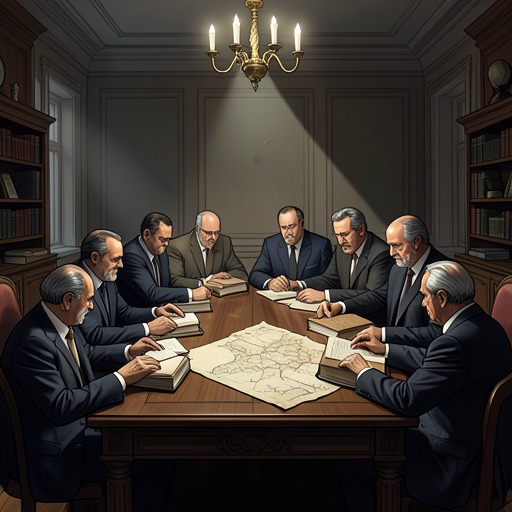
A compressed passage about the postwar settlement places the Rhineland, Danzig, the Polish corridor, the Ruhr, the Saar, mandates, the League of Nations, and freedom of the seas in a long inventory of disputed terms. The list moves from principles such as self-determination to territories and strategic arrangements, then abruptly gives oil the decisive hand. Its image of cards being dealt makes the negotiations feel less like the orderly application of universal principles than a contest in which claims are ranked by leverage. The contrast is pointed: national rights and international institutions occupy the table, but control of a resource can outweigh them.
That image establishes a framework for the more explicit discussion of Baku and the Near East. Oil is not merely another item in a catalog of postwar concerns; it is the material stake that gives the diplomatic map its pressure. The text does not present a settled account of who ultimately controls each field or territory. Instead, it shows the competing claims, predictions, and political arguments through which control is pursued, and leaves the reader alert to the difference between public principles and strategic interests.
Paris and the Contest for Supplies
At an opera in Paris, Eveline Hutchins hears Edgar Robbins turn a conversation toward Baku and oil. He argues that Britain is securing future supplies while American representatives wrangle under Woodrow Wilson, and fears that Baku will be added to British control. His speech brings the issue into a crowded social setting rather than a formal negotiating chamber: geopolitical rivalry circulates through an evening out, amid opera, conversation, and the movement of officials and journalists. The contrast makes the struggle feel both remote in scale and close at hand in the talk of people around the peace conference.
A man introduced as Mr. Rasmussen then gives the argument a more technical and urgent voice. He is an engineer with Standard Oil, and says that Baku cannot be held without substantial reinforcements, which, in his account, only the United States can provide. After the opera, at the Café de la Paix, he expands his case to include Persia, Mesopotamia, Mosul, and Mohommarah. He describes Anglo-Persian and other interests as gaining ground in the Near East, while Armenia is being discussed as a possible mandate despite the devastation and hunger he associates with Turkish rule. His account joins oil competition to the machinery of mandates: decisions about territories and populations become entangled with the struggle to secure supply.
The discussion also exposes the instability of the arguments being made. Mr. Rasmussen invokes self-determination to dispute Russian claims to Baku, describing its population as mainly Turkish and Armenian, yet admits that he would prefer the Bolsheviks to Britain if the alternative were British control. He predicts that Lenin and Trotsky have split and that monarchy will return in Russia within three months. The narrative supplies these statements as his confident claims, not as confirmed outcomes. His certainty, and the repeated orders for champagne, make the political briefing persuasive in manner while leaving its predictions visibly precarious.
Publicity, Democracy, and Business Power
J. Ward Moorehouse turns the resource dispute into a case for political communication. In conversation with Eveline Hutchins, he argues that public opinion can be mobilized against British control and that American interests risk losing primacy in world oil production. The language of self-determination enters his argument, but so does the demand that France, rather than Britain, should hold Baku. He presents the question as one of national interest and public persuasion, even as the proposed remedy remains another power’s control of the same resource.
Later, over champagne, Moorehouse describes himself as having abandoned Mexican business affairs to serve his country in Paris. He complains that Wilson is insulated by advisers, that American corporations fail to spend enough on publicity, and that the French and English press could be influenced with proper resources. He portrays American democracy and business methods as welcome to people abroad, then argues that the benefits of peace can be secured only if the United States dominates it. The contradiction is central: democratic language is used to justify a campaign for economic and political predominance. The passage does not simply identify Moorehouse as a spokesman for oil interests; it shows how publicity can translate corporate competition into a story of national service, public consent, and democratic leadership.
Eveline’s response gives that performance another dimension. She is captivated by Moorehouse’s attentiveness and by his account of sacrifice, political exclusion, and public purpose; she fills his glass and listens as he turns personal troubles and business interests into a sweeping appeal. His charm and his self-presentation are part of the episode’s evidence about how influence works. The oil dispute is carried not only by the language of reserves and mandates, but by a persuasive speaker who frames commercial ambition as the defense of democracy and asks his audience to see publicity as a public good.
Finance and the Material Network
The book places the oil contest within a larger structure of corporate and financial power. Its account of the Morgan interests lists control across New York, Paris, and London, including banks, trust companies, insurance companies, railroads, street railway companies, an express company, and the International Mercantile Marine. That inventory emphasizes the breadth of an interconnected business network rather than a single company or commodity. The subsequent reference to interlocking directorates describes how that power is linked across institutions.
The figures attached to wartime borrowing sharpen the connection between finance and international policy. By 1917, the Allies had borrowed $1.9 billion through the House of Morgan; by the end of the Peace Conference, the phrase J. P. Morgan suggests is associated with the compulsion of $74 billion in power. The book places these numbers beside the public claim that the United States went overseas for democracy and the flag. It does not state that Morgan finance alone determined the oil settlement. Instead, the juxtaposition shows why the peace conference cannot be read as a contest of principles detached from the institutions capable of financing war, moving goods, and exerting influence across borders.
Shipping supplies a physical counterpart to those financial and diplomatic networks. The narrative describes lines of camouflaged freighters hugging the coast, with lifepreservers on deck and boats swung out, while transports, colliers, and hospital ships travel back from Italy and Saloniki. French and British battleships and destroyers patrol nearby and inspect ship papers. In the same coastal passage, a large Standard Oil tanker is found burning outside Genoa’s breakwater, its fire spreading over the water and lighting the harbor and town. The scene does not explain the fire as an act of oil politics; its significance lies in the visible vulnerability and scale of the infrastructure through which fuel and other commodities move. Oil power depends on material systems at sea as well as on arguments made in conference rooms.
Monopoly, Trade, and Unequal Exposure
A Caribbean episode aboard the Callao offers a related, though distinct, picture of corporate power. The ship waits outside Roseau in Dominica while limes are prepared for loading. An older island resident tells Joe Williams and another quartermaster that the United Fruit Company is a monopoly: if growers refuse its prices, he says, their limes can be left to rot on the wharf. The commodity here is fruit, not oil, and the passage does not equate the two trades. It does, however, make concrete a commercial pattern also relevant to the book’s resource politics: a company able to control prices and access to transport can expose producers to loss while retaining leverage over the flow of goods.
The episode also sets the local speaker’s complaint against the sailors’ limited understanding of the island and their casual assumptions about its people. The company’s power is explained to them by someone who lives with its effects, while they arrive as mobile employees of the shipping system and initially treat the port chiefly as an inconvenience. That difference in position matters. Across the book’s treatment of oil, mandates, and commerce, resource control is discussed by politicians, engineers, financiers, and publicists; the Roseau scene briefly shifts attention to the people on the commodity-producing side of a company monopoly. Together, these strands make oil imperialism legible as more than a contest between national flags: it belongs to a wider world of corporate leverage, strategic transport, and unequal power over resources.