American patriotism and 100 percent Americanism
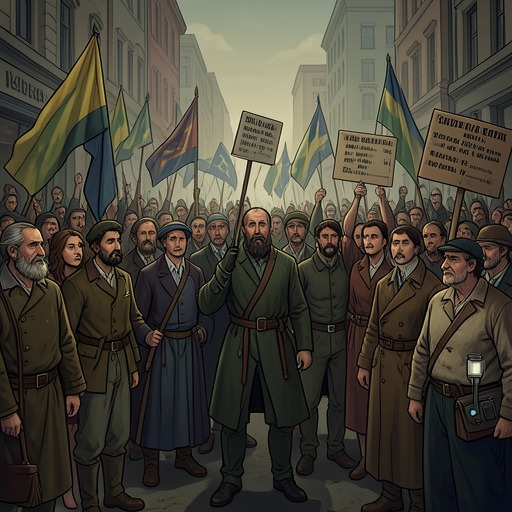
1919American patriotism and 100 percent Americanism are presented as contested political claims rather than an uncomplicated expression of shared loyalty. The novel places flags, bond drives, military parades, and public appeals to national unity alongside the suppression of antiwar speech and labor organizing. For Ben Compton and the workers around him, the central conflict is whether loyalty means compliance with wartime institutions or solidarity with people resisting them. The narrative repeatedly shows patriotic language being used to define dissent as suspect, even as it depicts that language being challenged by evidence of profiteering and repression.
Patriotism as a Test of Loyalty
During the war, a representative seeking subscriptions to a Liberty Bond approaches Ben at work and invokes the perfect record of his department. The appeal quickly shifts from collective achievement to personal suspicion: the representative suggests that refusal could make Ben appear pro-German or pacifist, then questions whether he has fulfilled the draft-registration requirement. Ben does not accept the demand to prove his loyalty through a purchase. He explains that he opposes a capitalist war and will not help support it. The exchange makes patriotism an informal test enforced through workplace pressure and public accusation, not merely a private feeling.
Ben’s refusal has immediate consequences. Later that evening a police officer examines his registration card and finds it valid, but by the end of the week Ben has been fired without an explanation. Ben fears that his comments could expose him to prosecution under the Espionage Act, and he and Helen Mauer leave their room and travel to New York City. The sequence links patriotic pressure to practical risks: even when Ben has complied with the formal registration requirement, his opposition to the war can cost him his job and make him fear arrest.
Wartime Dissent and the State
After the news arrives that the Bolsheviks have taken power in Petrograd, Ben and Helen become involved in organizing a meeting at Empire Casino to send greetings to the Russian workers’ government. The gathering takes place under close observation. Federal agents sit in the audience with a stenographer, police restrict entry, and soldiers and sailors enter the gallery. Ben’s speech condemns a war that, in his view, benefits bankers and munitions makers while workers are sent to fight. He also argues that the workers will learn from the war and eventually use the knowledge and force being imposed on them. His words prompt an intervention: the meeting is broken up, Ben and other speakers are arrested, and men of conscription age must show their registration cards before leaving.
The proceedings reveal a sharp difference between formal rights and their practical limits. Ben has his card, but his political speech remains grounds for surveillance and arrest. When an official offers to quash the charges if Ben will report for military training, Ben says he will continue opposing the war if released. He is freed on bail, with a promise not to agitate before trial, and the Steins do not tell him who supplied the money. Patriotism here is backed by both legal pressure and conditional leniency: Ben can leave detention, but only under terms designed to restrain his political activity.
Public Celebration and Private Opposition
On the day Ben goes to Morris Stein’s office carrying his suitcase, New York City is decorated with flags and crowded with office workers watching a military procession. A band plays a popular song about keeping the home fires burning, and the crowd’s excitement surrounds Ben as he prepares to go to jail. He reminds himself that the same public he sees celebrating has accepted the imprisonment of antiwar figures, the killing of labor organizers, and the violence against workers in Everett. The juxtaposition does not make the celebrants individually responsible for every act; it shows how an atmosphere of national celebration can coexist with—and obscure—the punishment of those who reject the war.
The parade’s effect is not uniform. In Stein’s office, Ben meets Stevens Warner, who has served a year in prison for refusing to register. Warner dismisses the procession as no reason for soldiers to forget the hardships of military life. Stein, by contrast, watches the spectacle and admits that it makes him feel he may have missed something. Their contrasting responses keep patriotism from becoming a simple division between believers and opponents: the public display can stir doubt even in someone who has supported prisoners, while a former prisoner sees through its promise of uncomplicated national unity.
Labor, National Symbols, and Repression
The novel extends its criticism beyond wartime dissent to the struggle over labor. At a New Jersey textile strike, Ben speaks after mounted police keep workers from entering a meeting hall they have hired. The crowd includes men, women, and children, and the attempt to hold an overflow meeting is met with police intervention. On a later visit to the picket line, Ben’s companion witnesses police breaking up the line and a striker being assaulted; she responds by striking a police officer and is taken away in a police wagon. These scenes associate patriotic authority with the defense of employers’ control, while the workers’ appeals to collective rights are treated as a threat to order.
The lumber passages make the economic contradiction explicit. During the war, the price of lumber rises from sixteen dollars to 116 dollars per thousand feet, and the government pays as much as twelve hundred dollars per thousand for spruce in some cases. Timber owners and mill interests are described as patriots who have won the war, yet they organize against radicals and help make it worthwhile for former soldiers to raid Industrial Workers of the World halls, assault organizers, and burn literature. The narrative places patriotic self-description beside wartime profit and anti-union action, showing how national service can be claimed by the same interests that resist workers’ demands.
At Centralia, members of the American Legion and a group associated with the Chamber of Commerce wreck an Industrial Workers of the World hall, assault those inside, detain some, and destroy union materials. The workers hire another hall, and the union continues to grow. Later, a mob takes Wesley Everest from jail and kills him; an official account then represents his death as a self-inflicted escape attempt. The contrast between the violence and its public explanation exposes the power to define which actions count as patriotic defense and which people can be cast as enemies. Against that power, the recurring image of Paul Bunyan joining the lumber workers’ union turns a national folk figure toward industrial democracy: the forests, wages, working hours, housing, and food become questions of who the country is meant to serve.