Labor movement
1919The labor movement in the novel is both an organized campaign for workers’ rights and a way of seeing how economic power enters ordinary life. Its demands take shape in mills, construction camps, ships, harvest fields, and logging camps: fair pay, control over working time, safer and more decent conditions, and the freedom to assemble. The narrative follows the movement through individual commitments and collective action, while showing how employers and public authorities try to contain it through dismissal, surveillance, and repression.
Work and the conditions of labor
The movement’s material basis is visible in the contrast between workers’ labor and the conditions under which they perform it. Joe Williams’s seafaring work involves a long passage on the steamer Argyle, where he chips rust, paints steel plates and the ship’s stack, and endures poor food, cramped sleeping quarters, and a rough voyage. The details establish a world in which a worker’s body and time are spent maintaining a vessel, while the regulations provide little more than a daily ration of lime juice. Later, the draft sweeps up men in New York City who lack registration cards, including Joe, a merchant seaman who says he has not had time to register and is exempt. His case makes visible how a worker’s occupational status can be disregarded or questioned by state procedure.
The labor movement also appears in Ben Compton’s changing understanding of work. Traveling with Bram Hicks, he moves from precarious employment into exceptionally demanding seasonal labor: long days in Saskatchewan harvesting wheat, followed by a job in a fruit cannery on the Columbia River. The harvest’s work rhythm—hours in the sun and dust, followed by exhausted sleep—becomes a practical education in labor rather than an abstraction. At the cannery, Bram is injured while working machinery, and the company denies him compensation, citing his notice and his status as a non-Canadian. The episode exposes how workers can bear the cost of hazardous employment while employers use technical grounds to avoid responsibility.
Organizing, solidarity, and public speech
In New Jersey, Webb Cruthers takes his companion to see a textile workers’ strike. The mills are surrounded by police and special deputies, while strike headquarters is crowded with workers, handbills, newspapers, and people trying to organize publicity. The meeting cannot be held in the mill town because the mills control the available space; strikers and supporters must travel to a neighboring town, where mounted police turn people away from the hall. The blocked meeting becomes a test of whether a crowd can claim a public voice when the employer’s local power reaches beyond the factory gates.
Ben Compton answers that exclusion by speaking from a lamppost to the people gathered outside. His address frames the denied meeting as an insult to workers, and his arrest is followed by Webb’s attempt to rally the dispersing crowd. Later, Webb invites his companion onto the picket line. In the early morning, workers sing and call out to passing strikebreakers as police move against the line. When a fallen striker is attacked, she tries to help and is arrested. The scene shifts labor politics from the platform to direct participation: solidarity is no longer only a principle discussed by others but a choice made amid confusion and risk.
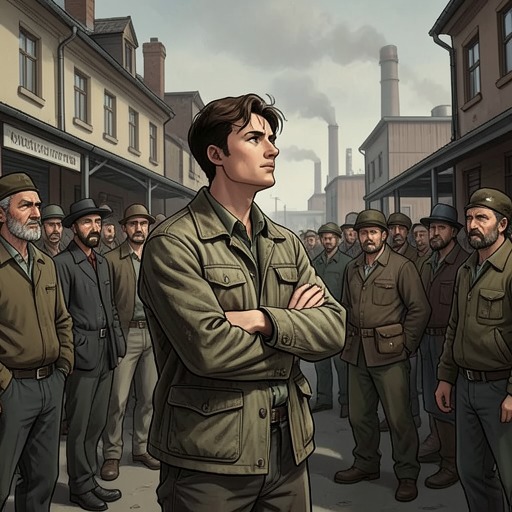
Ben’s own organizing develops through repeated encounters with workplace discipline. At a construction camp, Nick Gigli tells him that the bosses have been shorting the men on their hours and that a strike is planned. Ben decides to join it. When the foreman sends him on an errand the next morning, Ben refuses on the ground that he is on strike and is fired. The employer’s response combines economic authority with an ethnic insult, trying to separate Ben from the workers with whom he has chosen to stand. Ben rejects that division and identifies himself with his class. The scene makes solidarity an action with an immediate cost: he loses his job and leaves to find Nick and the other men.
Repression and the costs of organizing
The novel repeatedly shows collective action meeting organized opposition. During the textile strike, police arrest Ben and later break up the picket line. After he and Bram are released from jail, the strike has ended and the mills are running again; the streets and meeting hall look ordinary. That return to normality does not erase what the participants have learned, but it demonstrates how quickly a visible campaign can be forced out of public view.
The movement’s repression is more openly coordinated in Everett, Washington. After reading about the free-speech struggle in Solidarity, Ben and Bram travel west to help. At the dock, deputies arrest the arriving Industrial Workers of the World members and use physical intimidation to control them. The workers are taken away from the town and threatened with a gauntlet. The episode links the fight for free speech to labor organizing: preventing workers from meeting and speaking is part of preventing them from acting together. Bram and Ben have already encountered the precariousness of itinerant work; in Everett, that vulnerability meets the coercive power of local authorities and anti-union forces.
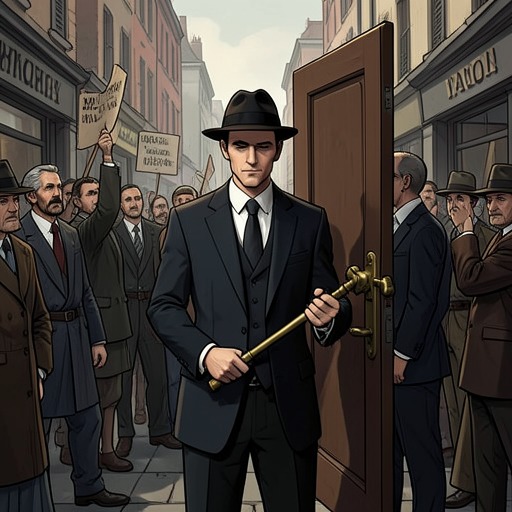
Ben later speaks at a meeting at the Empire Casino called to send greetings to Russia’s workers’ and peasants’ government. Federal agents monitor the gathering, police close the doors, and soldiers and sailors enter the hall. Ben argues that war benefits bankers and munitions makers rather than workers, and he is arrested with other speakers. When officials offer to quash the charges if he reports for military training, he says he will continue opposing the war. He is released on substantial bail, on the assurance that he will not agitate until trial. The terms of his release make clear that surveillance and restrictions on speech can continue beyond the moment of arrest; his commitment persists, but the authorities limit his ability to act publicly.
A movement across occupations and regions
The labor movement is not confined to a single trade or locality. Ben and Bram travel by improvised means from Buffalo toward Duluth, find work harvesting grain, and then move to the Columbia River. From there, reports of the struggle in Everett draw them farther west. Their movement follows employment opportunities and organizing news together: workers are mobile because work is insecure, and that mobility can also carry political knowledge from one workplace to another. Bram’s experience as a sailor and boilermaker, and Ben’s successive jobs, place their organizing within a broader world of casual and industrial labor.
The novel’s account of timber workers makes the movement’s demands especially concrete. Lumberjacks, loggers, shingleweavers, and sawmill workers are described as a subordinated workforce within a timber empire. Organizers call for forests to belong to the public, wages to be paid in money rather than company scrip, clean bunkhouses, decent food, dry clothing, and an eight-hour day. The demands encompass ownership and political power as well as the immediate conditions of work. The employers’ response is to organize against the Industrial Workers of the World, sponsor the Legion of Loyal Loggers, and enlist former soldiers in attacks on union halls and organizers.
In Centralia, Washington, on Memorial Day in 1918, members of the American Legion, led by a group from the Chamber of Commerce, wreck the local union hall, beat and detain people there, remove others from the county, and burn the organization’s papers. The union hires another hall and continues to grow. That recurrence gives the labor movement one of its central patterns in the novel: repression can destroy a meeting place and interrupt an organization, but it does not automatically extinguish the impulse to organize.
Meaning and narrative role
The movement joins disputes over wages and working conditions to broader arguments about democracy, class, and political speech. Ben discovers that he can hold an audience when he speaks, and even in court he turns his sentencing into an occasion to address the workers present. His development shows political conviction forming through work, solidarity, arrest, and public speaking rather than through theory alone. Nick Gigli’s varied work history and Bram Hicks’s itinerant employment likewise make organizing inseparable from the instability of working-class life.
The narrative also sets the language of patriotic service against the labor conditions it leaves intact. A YMCA slogan urges that soldiers be kept fit to go home, while the accompanying account of casual labor describes repetitive handling of scrap, inadequate protection, and workers identified by ethnic labels rather than individual names. In the logging passages, timber owners claim patriotic authority after wartime profits have risen sharply, even as organizers demand basic workplace protections. These contrasts expose a conflict over who benefits from national sacrifice and who has the power to define democracy. The labor movement’s significance lies not in a single successful strike but in its persistent effort to turn shared exposure to exploitation into collective speech and action.