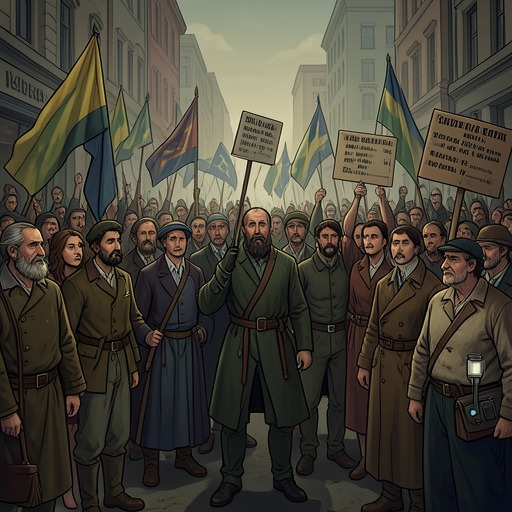
The Red Scare and repression of radicals
1919The Red Scare and repression of radicals is presented not as a single campaign but as a pattern of state power reaching from wartime policing into postwar labor conflict and anti-radical surveillance. Joe Williams is seized as a suspected foreigner; organizers and strikers meet police force and arrest; Ben Compton is detained for his politics; and Woodrow Wilson’s language of democratic peace stands beside the imprisonment and persecution of dissenters. Across these episodes, paperwork, police authority, public hostility, and patriotic rhetoric narrow the space in which opposition can act.
Wartime Suspicion and Administrative Power
Joe Williams’s detention shows how suspicion can attach to an ordinary worker before authorities establish what he has done. After the Argyle reaches the wharf, an English policeman takes him from his bunk without allowing him to wash or say goodbye to the crew. A crowd jeers as he is driven away. At the police station, officials inspect the photographs, stamps, and newspaper clippings from his cigarbox, question him in German despite his inability to understand it, and subject him to an invasive search. His worn clothes and seaman’s belongings do not protect him from treatment as a dangerous stranger. The inspector invokes the Defence of the Realm Act and threatens a period of detention, making emergency legislation the official framework for coercion.
The episode’s force lies partly in the mismatch between the evidence and the response. Joe has come ashore from a ship; the authorities nevertheless read his papers and possessions as grounds for suspicion, while his attempts to answer are repeatedly treated as evasion. His arrest suspends the ordinary expectations of a working sailor: he is taken away before being paid off, and the crew remains behind. The scene makes the machinery of repression tangible through routine commands, confiscated belongings, and official control over where a person may go, rather than through a formal explanation of guilt.
A related form of administrative suspicion appears in New York City during the draft. Joe has returned from sea and has not registered, although he says that his work as a merchant seaman exempts him. A police officer arrests him at the Wall Street subway exit and sends him with a crowd of men to the Custom House. On the sidewalks, clerks and other onlookers call the group slackers, while women hiss and boo. The men are kept in crowded basement rooms through a hot August day, prevented from telephoning, and allowed to use the single toilet only under guard. Joe is eventually told that he may go once his license arrives, but is also ordered to register. The episode links compulsory documentation to public shaming: a claim of exemption does not settle the matter until an official accepts the proper paper.
Labor Organizing Under Police Pressure
The New Jersey textile strike extends the same pattern from individual detention to collective action. Webb Cruthers and Anne Elizabeth Trent visit the mills and find police outside, armed special deputies inside the gates, and a strike headquarters crowded with organizers and handbills. The mills’ control of the town is reflected in the organizers’ inability to hire a hall there; the meeting must be held in a neighboring town instead. Even there, mounted police bar the entrance, declaring the hall full while thousands of strikers and their families remain outside in sleet.
Ben Compton addresses the crowd from a lamppost, describing the exclusion as an insult to workers. Police drag him away, and the crowd begins to disperse under pressure from mounted officers. Webb then takes up the protest, arguing that the strikers have a right to the hall they rented. The sequence shows how an attempt to assemble and speak is constrained at several stages: the employer’s hold over the town restricts access to a venue, the meeting is displaced, and police authority closes the alternative space. Organizers’ efforts to sustain a public gathering are met not with a debate over their claims but with physical removal and the threat of arrest.
The repression reaches Anne Elizabeth Trent on the picket line. She joins the early-morning procession with Webb, amid strikers singing Solidarity Forever and others calling out against strikebreakers. When police break up the line, she intervenes to help a fallen young woman and is arrested. Her charges include rioting, felonious assault, obstructing an officer, and inciting to sedition. In the crowded women’s section of the county jail, fellow strikers compare arrests and discuss the strike; the detention thus becomes another place where the movement’s members meet and affirm their cause. Anne is released on bail, and the organizers turn her arrest into publicity and propose that she join a delegation to Washington, D.C., to petition the president and picket the White House. Her experience illustrates both the immediate cost of participation and the way arrest can be repurposed as public evidence of the conflict.
Antiwar Politics and the Federal Response
The book places the suppression of radicals within the larger wartime bargain between patriotic mobilization and political conformity. Its newsreel-like account lists the war’s material and social consequences, then states that anyone who objects to making the world safe for cost-plus democracy goes to jail with an imprisoned antiwar socialist. The line punctures the promise that the war is simply a defense of democracy: dissent against the war’s profiteering arrangements is treated as a punishable threat. Later, Woodrow Wilson is described as exerting the power of the government under his control, with opponents dismissed as either crooks or reds and no pardon granted to the jailed socialist.
That contradiction becomes visible during Wilson’s western speaking tour. In Seattle, workers associated with the Industrial Workers of the World line the route in silence. Their leaders are in jail or have been lynched, and the workers do not join the applause and patriotic cheers heard elsewhere. They watch Wilson pass in his car, haggard and physically strained. The silent line is a political response in its own right: the president’s public appeal to justice and peace meets the presence of people who have experienced the state’s and the public’s violence against labor organizers. In Pueblo, Wilson continues to speak of truth, justice, liberty, and peace, while the surrounding narrative has already shown how limited those promises are for dissenters.
A more direct federal confrontation follows at the Empire Casino in the Bronx. The meeting is called to send greetings to Russia’s workers’ government, but federal agents sit in the front row with a stenographer, police close the doors, and officers break up the crowd outside. Soldiers and sailors enter the gallery and help drive the audience from its seats. Ben Compton speaks against a war he describes as benefiting bankers and munitions makers, and says that workers will learn from the violence directed at them. Police arrest him and others; men of conscription age must show their registration cards before leaving. The meeting’s political purpose is therefore surrounded by surveillance, disruption, and enforcement of military obligations.
Ben’s detention continues the pattern behind the public arrests. He is held for three days in a disused federal office and questioned repeatedly by detectives; threats and intimidation accompany the interrogations. When he is offered release in exchange for promising to report for military training, he refuses to abandon his opposition to capitalist war. He is eventually released on substantial bail after Morris Stein gives assurances that Ben will not agitate before trial, although the Steins do not tell him who provided the money. The result is not simple freedom: bail removes him from the cell but leaves his political activity constrained and his case unresolved.
Public Language, Fear, and the Limits of Peace
The newsreel passages broaden the pattern beyond individual arrests. A report about police discovering pamphlets in Yiddish, Russian, and English alongside Industrial Workers of the World membership cards gives ordinary organizing materials the atmosphere of a security threat. Headlines about the League of Nations and peace negotiations appear beside the question of how to deal with Bolsheviks and the blunt answer, Shoot them. The juxtaposition compresses the book’s central irony: public language celebrates international peace while circulating calls for violence against political opponents.
Taken together, the episodes show repression operating through more than imprisonment alone. Authorities search possessions, demand registration papers, close meeting halls, monitor speeches, break up crowds, and attach criminal charges to protest. Onlookers can reinforce that power through insults and patriotic suspicion, while organizers respond with picket lines, meetings, petitions, and public witness. The resulting tension is not resolved by the end of these scenes. Instead, the novel sets ideals of democracy and peace against the treatment of people who challenge the war, the draft, or the power of employers, making the Red Scare a recurring test of what those ideals mean in practice.