Newsreels
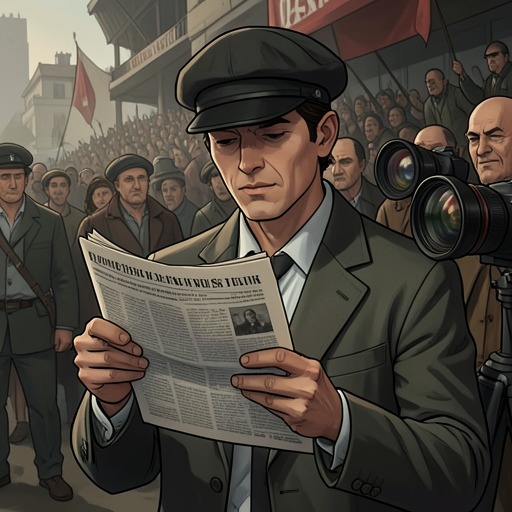
1919Newsreels are recurring documentary collages in U.S.A., interrupting the characters’ stories with fragments of the public language of their time. Their force lies not in offering a continuous account of events but in making headlines, songs, and commercial slogans collide: history arrives in bursts, vivid and incomplete, while the people living through it remain caught in its larger circumstances.
Form and Placement
Each Newsreel assembles materials drawn from newspapers and popular culture: actual headlines, pieces of news stories, advertising slogans, and song lyrics. They enter the book as interruptions rather than as a separate, continuous chronicle. The effect is a rapid succession of scraps, compared in the novel’s critical framing to fireworks that momentarily illuminate the American landscape. The fragments are not simply background information; their abruptness makes the public world press into the private narratives.
The novel’s broader structure gives these inserts a distinctive role. Its many fictional lives move forward without a single governing hero or conventional plot, under the prevailing pressure of history. Newsreels flash that pressure into view in public, widely circulating language. Where the characters’ experiences unfold unevenly and individually, the collage presents history as a crowded field of headlines, appeals, and popular phrases.
War in Headlines and Song
The numbered sequences show how quickly the material can change tone. Newsreel XX begins with a song fragment about infantrymen and the dirt behind their ears, bringing the ordinary, physical presence of soldiers into the collage. Newsreel XXI shifts to a brief, recognizable farewell to Broadway and greeting to France, compressing departure for war into the language of a popular song.
Newsreel XXII places a forecast of renewed railroad prosperity beside a headline reporting a thirty-year prison sentence for Eugene V. Debs. The proximity matters: commercial optimism and political punishment occupy the same clipped public space, without a narrator smoothing their contradiction into a single argument. Their juxtaposition lets the reader register a society in which promises of renewal coexist with the repression of dissent.
Collage, Contradiction, and Public Voice
The fragments derive meaning partly from their differences. A song can make war sound familiar or even buoyant; a headline can abruptly return the reader to imprisonment, casualties, or institutional power. Because these materials retain the brisk, impersonal surface of public communication, their arrangement exposes tensions that any one item might leave unspoken. Newsreels do not explain away the gap between patriotic feeling, commercial confidence, and the costs of war. They place these idioms next to one another and leave their friction visible.
This method also distinguishes the inserts from the novel’s minute biographies and its fictional life narratives. Biographies establish historical figures as fixed markers, while the fictional narratives follow ordinary people through change and uncertainty. Newsreels instead offer a discontinuous collective register: the many voices and ready-made phrases through which the country speaks, advertises, sings, and reports events. Their collage form makes public language itself part of the book’s subject.
Relation to The Camera Eye
Newsreels share a topographical function with The Camera Eye, but the two modes direct attention differently. The Newsreels gather externally circulating material, while The Camera Eye records a nameless individual life of sensations. In one passage, remembered images of blood, damaged bodies, and ambulance work at Récicourt make war bodily and immediate; elsewhere, a first-person passage moves through a city during a general strike, registering closed transport, red flags, placards, and police agents. These subjective impressions do not turn the Newsreels into personal testimony. Instead, the contrast places public fragments beside an individual consciousness implicated in the history those fragments evoke.
Together, the modes widen the book’s field of vision without resolving it into a single authoritative account. Newsreels make the public landscape flare up in fragments; The Camera Eye makes experience intimate and partial. Their difference is a structural tension: the reader encounters both the large-scale language through which a nation represents itself and the limited, embodied perceptions through which history is lived.