Propaganda and manipulation of public opinion
1919Propaganda and manipulation of public opinion are shown not as a single campaign but as a contest over who may define the war, democracy, and the public good. Red Cross publicity turns danger and sacrifice into a carefully directed appeal; J. Ward Moorehouse links that appeal to American influence and commercial interests; and labor organizers face force when they try to circulate a rival account. Against these polished arguments, the novel sets the material realities of shipping, strikes, and financial power, making persuasion inseparable from the question of who benefits and who gets heard.
Publicity as an Organized Wartime Task
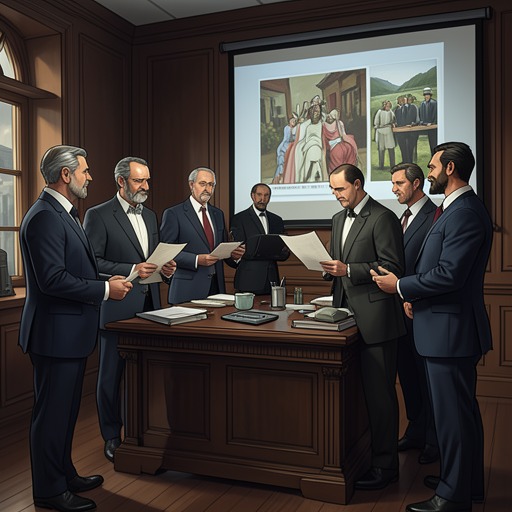
That winter, as Paris filled with Americans in uniform, staff cars, and Red Cross supplies, J. Ward Moorehouse arrived from Washington to lead Red Cross publicity. His reputation preceded him: the office had heard he was a celebrated New York publicity expert, and his arrival stirred anxious speculation about what would change. At a meeting with the publicity department, he presented the work as having two linked purposes: encourage donations from people at home and inform the public about Red Cross operations. In his view, people did not sufficiently understand the workers’ contribution and might instead heed critics he characterized as pro-German, disguised as pacifists, or merely intent on complaint. Publicity, he argued, had to make civilians in the United States and the Allied countries feel the workers’ sacrifice as keenly as the sacrifice of soldiers in the trenches.
He made that principle theatrical. While he described the workers as being under fire and ready for supreme sacrifice, Major Wood’s swivel chair squeaked. Several listeners started and looked toward the window as if a shell might be coming in. J. Ward Moorehouse seized the moment as an example of the desired effect: publicity should produce a catch in the throat, steady the nerves, and strengthen the resolve to continue. The scene shows persuasion being engineered through emotion, not simply through information. Eveline Hutchins felt stirred despite herself, while Eleanor Stoddard remained difficult for her to read; the same speech could command attention without securing uniform assent.
J. Ward Moorehouse: Public Mission and Personal Appeal
In July, after returning from the United States with a firsthand account of Château-Thierry, J. Ward Moorehouse predicted that the war would end within a year. That evening he invited Eveline Hutchins to dinner at the Café de la Paix, explaining that Eleanor had asked him to cheer her up. His account of the future cast the United States as a benefactor that would help heal war-scarred Europe during a new era of expansion. The language joined humanitarian purpose to national opportunity. He presented the vision with such conviction that Eveline found herself liking him, even though she also sensed that he could sound as if he were rehearsing a speech.
Later, during a long conversation after dinner, his public case became more explicitly political and personal. He complained that the president was insulated from advice, that Britain was securing control of important resources, and that American leaders failed to grasp the power of modern publicity. He said that, with adequate resources, he could influence the French press within weeks and believed something could also be done in England. He portrayed public opinion as ready to welcome American democracy and business methods, and argued that securing the benefits of peace required American dominance. These were J. Ward Moorehouse’s claims, not a neutral account of the peace negotiations; the scene makes their confidence and self-interest part of what the reader must assess.
His disclosure of private troubles further complicates the performance. He described his wife Gertrude’s illness, the possibility that her family might take control of her affairs, and the risk that the Staple family could withdraw money invested in his business. He also said he had abandoned his Mexican affairs when his government needed him. His appeal to Eveline mingled national duty, business difficulty, wounded professional pride, and personal longing; he ended by wishing he were free to fall in love with her. The scene does not reduce his political convictions to a sham, but it places them beside the financial and emotional interests through which he experiences public service. Persuasion here is intimate as well as institutional: a vision of national purpose is delivered across a dinner table and entangled with a bid for understanding.
Oil, Trade, and the Interests Behind Public Claims
The novel places such rhetoric beside arguments about control of resources. At an opera gathering, Edgar Robbins talked about Baku and oil, claiming that Britain was securing future supplies while the Americans debated under Woodrow Wilson. At supper afterward, Mr. Rasmussen, an engineer with Standard Oil, described competition in Baku, Mohommarah, and Mosul, and the rivalry between American companies, Anglo-Persian, and Royal Dutch. He argued that the British were moving toward a settlement that would leave the United States behind. J. Ward Moorehouse agreed that American interests and public opinion mattered, while Eveline’s question about the Russians exposed a further tension: arguments about self-determination appeared within a discussion focused on which power would control oil. The speakers’ confident predictions and strategic framing reveal how readily the language of national interest can absorb a dispute over resources.
A separate encounter at Roseau gives that economic contest a more immediate setting. While the Callao waited for limes to be crated, an older island resident described United Fruit Company as a monopoly: if growers rejected its prices, he said, their limes could be left to rot on the wharf. His charge, delivered to Joe Williams and another quartermaster over rum with the ship lit beyond them, offers a counter-account to the company’s power from the position of those dependent on its market. The men work aboard the vessel but have little part in setting the terms of trade. The passage also places this criticism inside a scene shaped by the sailors’ racist descriptions of the island and its people. Their talk narrows what they notice even as the old man’s account points toward the larger commercial arrangement around them.
The financial passages widen the same contrast from trade to credit. The account of J. P. Morgan’s reach lists control across banks, trust companies, insurance companies, railroads, street railways, an express company, and the International Mercantile Marine. It then sets the language of democratic war aims against the scale of financial influence: by 1917, the Allies had borrowed $1.9 billion through the House of Morgan, while by the end of the Peace Conference the phrase J. P. Morgan suggests carried force over a stated $74 billion. The juxtaposition makes the phrase sound less like casual advice than a measure of concentrated power. Public claims about democracy and peace coexist with financial networks capable of shaping the conditions under which those claims are pursued.
Labor Speech, Counterpublicity, and Coercion
The struggle over public opinion also unfolds in the textile strike that Webb Cruthers and Anne Elizabeth Trent visit in New Jersey. At strike headquarters they encounter handbills being distributed, stacks of clippings, and workers gathered around a publicity office. The setting makes communication part of the organizing effort: materials must be produced and carried into a community where the mills dominate the town. When the meeting hall is declared full despite the crowd outside, Ben Compton speaks from a lamppost, calling the exclusion an insult to the working class. As police drag him away, the crowd begins to retreat under pressure. Webb then climbs onto a hydrant and protests that the workers had hired the hall and had a right to use it. Their speeches contest the official appearance of orderly procedure with the crowd’s experience of being shut out.
The next morning, Anne Elizabeth Trent joins the picket line. Strikers sing Solidarity Forever and jeer at strikebreakers as police break up the line. When a young woman falls, a policeman kicks her in the face; Anne Elizabeth Trent strikes back and is clubbed and taken to a police wagon. The violence is not simply a counterargument to labor speech: it changes who can speak, and at what cost. The injured woman’s face and the darkness of the wagon remain with Anne Elizabeth Trent as the concrete consequence of a public order defended by force.
The later political meeting at the Empire Casino makes the mechanisms of surveillance still more explicit. Federal agents sit in the front row with a stenographer, police close the doors after the first couple of hundred people arrive, and officers break up the gathering outside. Soldiers and sailors enter the gallery and watch the speakers; when the meeting begins, the chairman identifies the agents and the uniformed listeners as part of the audience. Ben Compton’s speech against capitalist war is cut short as people are hustled from their seats and speakers are arrested. Men of conscription age must show their registration cards before leaving. The scene presents the attempt to send greetings to the workers of Russia as both a public act and a monitored offense.
After his arrest, Ben Compton is offered the quashing of charges if he agrees to report for military training. He refuses to promise silence about capitalist war, but is released on bail on the condition that he do no agitating until trial. The condition turns the state’s response from interruption into a restriction on future speech. Taken together, the strike and meeting show that publicity is not only the organized presentation of a message: it is also access to halls, handbills, crowds, and the ability to speak without being beaten, arrested, or silenced by bail conditions.
The Novel’s Critique of Persuasion
Across these episodes, public language repeatedly presents institutional purposes as common interests: Red Cross publicity joins morale to sacrifice, Moorehouse’s peace vision joins humanitarian aid to American expansion, and oil arguments cast corporate competition as national necessity. The novel does not treat every speaker as equally informed or every counterclaim as automatically reliable. Instead, it places polished advocacy beside exposed interests, financial figures, interrupted meetings, and workers’ bodily vulnerability. The resulting contrast makes the management of opinion visible as a struggle over both meaning and power: who can shape a story for the public, whose account is dismissed as disloyal, and whose voice is met with coercion rather than an answer.