Labor movements and industrial conflict
1919Labor movements and industrial conflict in the novel are not abstractions: they take shape in cold picket lines, crowded meeting halls, dangerous jobs, and disputes over pay and authority. Across the experiences of Anne Elizabeth Trent, Ben Compton, Joe Williams, and others, collective action offers workers a way to challenge exploitation, while employers and public authorities use hiring, policing, detention, and legal pressure to contain it.
Work and the Conditions of Solidarity
The novel places labor politics against the ordinary demands and constraints of work. Joe Williams’s seafaring experience, for example, includes twenty-five days aboard the steamer Argyle, where he handles cargo, chips rust, paints steel plates and the ship’s stack, and works amid poor food and crowded, pest-ridden quarters. The daily limejuice ration, supplied under maritime regulations, is a small sign of formal oversight within a job otherwise marked by harsh conditions. This account does not depict Joe organizing a union, but it makes visible the material life of a worker whose livelihood depends on ships, cargo, and employers’ demands.
Work also brings people into contact with state power. Back in New York City, Joe is caught in a roundup of men questioned about draft registration. He explains that he is a merchant seaman and claims exemption, but the police hold him until his license arrives and tell him that he must register. The episode places a worker’s account of his occupation and exemption against an enforcement system that treats men on the street as potential draft evaders. Employment does not insulate him from official scrutiny; instead, his status must be established to authorities.
The Textile Strike and Public Protest
Anne Elizabeth Trent encounters industrial conflict with Webb Cruthers during a textile strike in New Jersey. The town’s mills dominate local life: the meeting must be held in a neighboring town because, where the mills are located, the company controls access to a hall. At strike headquarters, handbills are being distributed and publicity work is underway among crowded offices and stairways. The organization is built from practical tasks as well as speeches: workers and supporters circulate information, visit strikers’ homes, and prepare for a public meeting.
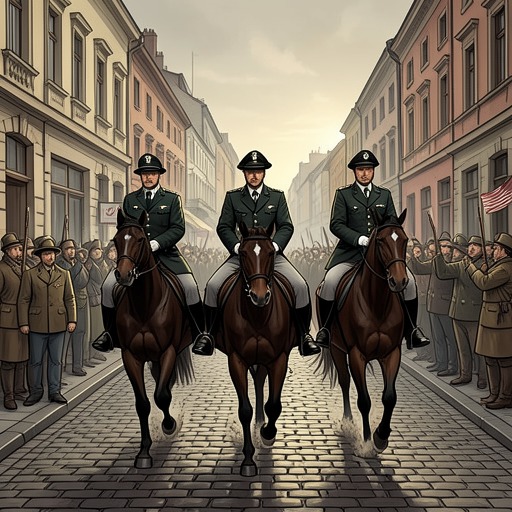
That meeting is blocked despite the strikers’ expectation that they have permission to use the hall. Mounted police turn people away, leaving a crowd of thousands in sleet outside. Ben Compton tries to address them from a lamppost, presenting the closure as an insult to workers; police drag him away as the crowd begins to disperse. Webb then protests the exclusion and invokes the strikers’ right to use the hall. His intervention is brief: he and Anne Elizabeth run from the approaching police, and later he hides his face on the train rather than acknowledge her in public. The episode shows both the possibility and the risk of speaking in a crowd. Solidarity is visible in the gathering, but the meeting itself is denied a place to take shape.
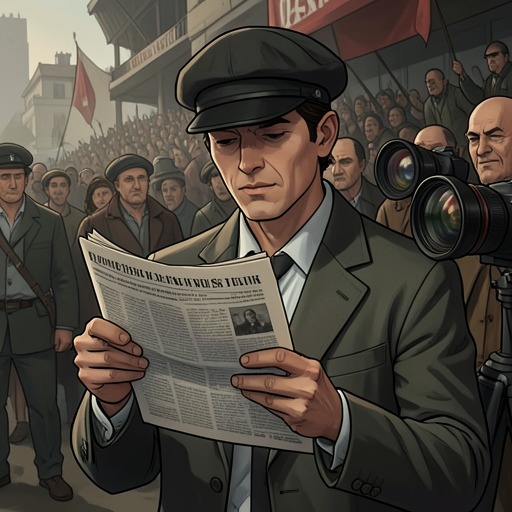
Anne Elizabeth’s later return to the picket line turns sympathy into direct participation. In the early morning, strikers arrive in inadequate coats; some sing “Solidarity Forever,” while others jeer at people crossing the line. When a young woman falls and is attacked by police, Anne Elizabeth intervenes. She is struck, taken away in a police wagon, and charged with rioting, assault, obstructing an officer, and sedition. In jail, she finds other women discussing their arrests and the strike, and begins to see how her actions have made her a public figure. A newspaper presents her as a woman who assaulted a police officer; Ben Compton congratulates her, and Sylvia Dalhart asks her to join a delegation intended to petition Woodrow Wilson and picket the White House if the delegation is refused a hearing. The strike has made her both a participant and a potential representative of the cause.
Workplace Discipline and Class Allegiance
Ben Compton’s experience on a construction job makes the conflict over work especially direct. Nick Gigli tells him that the bosses have been cheating the men over their time and that workers intend to strike. Ben says he will join them. When the employer, Volle, orders him to perform a task the next morning, Ben refuses because he is on strike; Volle fires him and threatens him with further retaliation. The dispute is not only about the immediate order. It tests whether Ben will identify with the workers who have little power on the job or accept the employer’s authority as final. Ben answers by affirming his American identity and his allegiance to his class, and then goes to join Nick and the other laborers.
The employer’s response makes the limits on collective action explicit. Company representatives appear with revolvers and warn that men who do not return to work will be dismissed and may face vagrancy laws. Economic pressure and the threat of state punishment reinforce one another: the workers may refuse the job, but the company can withhold employment, while public law can make leaving work precarious. Ben’s choice to walk out therefore carries consequences beyond losing his position; it commits him to a larger struggle whose risks are controlled by others.
Organizing, Repression, and Political Opposition
The Industrial Workers of the World provides a network for workers and organizers moving between jobs and regions. After seasonal work and employment in a fruit cannery, Ben and Bram Hicks read about a free-speech fight in Everett and decide to go there to help. In Seattle, the organization’s headquarters is crowded with young people arriving from the United States and Canada. When a group travels to Everett to hold a meeting, armed deputies arrest those stepping off the boat. Ben and Bram are among the detained workers. Their intended act is public speech; the response is coordinated policing that prevents the meeting before it can begin.
The novel also links labor organizing to opposition to war. At a meeting at the Empire Casino in the Bronx, Federal agents record the proceedings, police restrict entry, and uniformed soldiers and sailors appear in the gallery. Ben speaks against a war he presents as serving bankers and munitions makers rather than workers. Authorities arrest him, and men of conscription age are required to show registration cards before leaving. In custody, he refuses to promise that he will stop opposing the war. He is released on fifteen thousand dollars bail after Morris Stein assures the authorities that Ben will not agitate until trial. The restriction does not resolve his political commitment; it places that commitment under legal supervision.
The Wider Economy of Labor
The timber industry broadens the novel’s account from particular strikes to an economic system. Lumberjacks, loggers, shingleweavers, and sawmill workers are presented as the labor force beneath a powerful timber industry. Organizers call for forests to belong to the public, payment in money rather than company scrip, dry clothing and clean bunkhouses, adequate food, and an eight-hour day. In the novel’s adaptation of the Paul Bunyan figure, a worker who has returned from making Europe safe for democracy joins a lumber local to help improve conditions at home. The contrast is pointed: wartime democratic language accompanies continued struggle over workers’ basic terms of life.
The profits sharpen that contrast. The price of lumber is said to have risen from sixteen dollars per thousand feet to one hundred and sixteen during the war, with the government in some cases paying as much as twelve hundred dollars per thousand for spruce. Timber owners and mill operators are described as patriots even as they set out to remove labor organizers from logging camps. The movement’s demands are thus set against an industry that benefits from wartime purchasing and invokes patriotism while resisting workplace change.
The novel also briefly places unpaid household and caregiving work beside these public disputes. When Dr. Hutchins and his wife are unwell, Eveline Hutchins takes responsibility for their care and for meals, housekeeping, and laundry. This is not presented as a strike or a labor organization, but it shows how work and obligation extend beyond the jobs contested in the streets and camps. Taken together, the episodes portray industrial conflict as a struggle over more than wages: it concerns time, safety, the right to gather and speak, the power to refuse, and who bears the costs of maintaining both workplaces and households.