The Unknown Soldier and the John Doe motif
1919The Unknown Soldier and the John Doe motif make anonymity the center of a national act of remembrance. An unidentified member of the American Expeditionary Forces is brought home for burial at Arlington National Cemetery, but the name John Doe expands beyond the single coffin: it gathers many possible lives into one figure, while exposing the gap between official commemoration and the irrecoverable individuality of the dead.
The unidentified body and its designation
A congressional resolution authorizes the Secretary of War to bring to the United States the body of an American member of the American Expeditionary Forces who lost his life during the war and whose identity has not been established. The chosen body is to be buried in the Memorial Amphitheater at Arlington National Cemetery. The language defines the soldier through service, nationality, death, and the absence of a recoverable identity. It makes the lack of a name not an obstacle to commemoration but its formal premise.
The narrative places that decision among numerous pine boxes holding the remains of people whose identities are also unknown. There are more possible dead than can be selected for this singular burial, and the question of how one John Doe is chosen from among them remains open. The text does not supply a procedure that resolves the question. Instead, the selection carries the unease of an individual distinction made among bodies that cannot be distinguished by name. John Doe is at once the one who receives the national honor and one among many who could have received it.
A life made plural
The John Doe figure is then given a birth and a childhood, but not a single stable biography. His imagined birth is rendered as a human beginning shared by a woman and a man; his upbringing ranges across Brooklyn, Memphis, Cleveland, Alexandria, and other places. The catalogue moves between city neighborhoods, a country-club setting, a shack, a tenement, and an exclusive suburb. Rather than establishing one verifiable hometown or class identity, it makes the anonymous soldier belong to many American settings at once.
His possible achievements and occupations refuse to settle into one social type. The portrait can make him a child celebrated in a baby parade, a schoolyard champion, or a quarterback; it can also make him a busboy, a bellhop, an office boy, a telephone lineman, a longshoreman, a lumberjack, or a plumber’s helper. Other jobs include driving a truck, repairing a Ford, and selling books while asking for help to work his way through college. These details give anonymity a social breadth: John Doe is not merely a symbol detached from ordinary life, but a figure assembled from the different places, ambitions, and kinds of work from which a soldier might have come.
That plurality complicates the state’s effort to claim the dead as a single national representative. The body cannot testify to which of these lives was its own. Instead, the catalogue of possible biographies makes the reader confront how much remains unknown even when a public ritual assigns the dead a common identity. The motif honors an individual soldier while resisting the idea that one anonymous body can stand neatly for every difference among the living and the dead.
Service, identification, and loss
The motif’s anonymity is connected to the practical objects and routines of military life. Soldiers receive identification tags stamped with serial numbers, drill, hike, learn the manual of arms, eat army food, and perform guard duty overseas. The account places these routines beside the danger of the front: shrapnel, bullets, machine guns, mud, and gas masks. Military systems attempt to identify and organize their members, yet the John Doe figure remains an exception to that system’s promise of legibility.
A soldier recalls losing his identification tag while swimming in the Marne. The specific circumstance sharpens the larger problem: an object meant to secure a soldier’s identity can be lost, leaving the body harder to connect with a name. The narrative does not establish that this soldier is the one selected for Arlington, and the detail should not be treated as a solution to the selection question. Rather, the lost tag shows how easily the material link between a person and an official record may fail amid the disordered experiences of war.
The public burial and its symbols
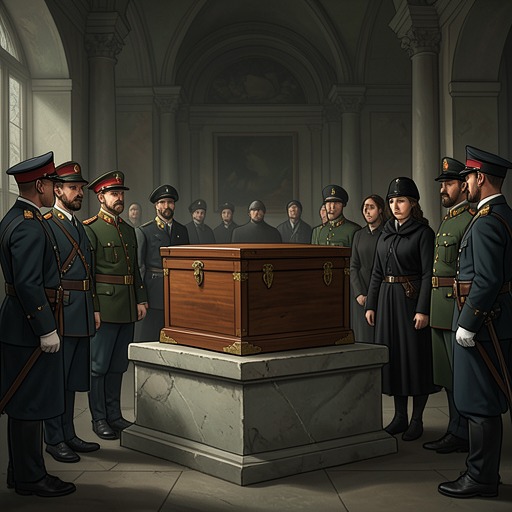
The selected body is placed in a pine coffin, carried home aboard a battleship, and buried in a sarcophagus in the Memorial Amphitheater at Arlington National Cemetery. The ceremony drapes the American flag over the coffin and includes the sounding of taps, prayer, and volleys. President Harding speaks of the tribute as impersonal, a description that accords with the ceremony’s central paradox: the nation gives solemn honor to a soldier whose personal identity it cannot name.
The recognition is made visible through a collection of decorations pinned where the body’s chest would be. These include the Congressional Medal, the Distinguished Service Cross, the French Medaille Militaire, the Belgian Croix de Guerre, an Italian gold medal, and military honors from Romania, Czechoslovakia, and Poland. The body is also associated with a wreath and a gift of wampum presented by an Arizona delegation. Such objects gather honors and national affiliations around remains that cannot be matched to a known biography. Their abundance contrasts with the absence of the most personal identifying fact: the soldier’s name.
The observance is described as too meaningful and tragic for applause. Silence, tears, songs, prayer, muffled drums, and soft music take the place of a celebratory response. Diplomats, military officers, politicians, soldiers, sailors, and bereaved women attend. Woodrow Wilson brings poppies. These details show the ceremony making a public community around a body that cannot be returned to a known family or hometown, while the quiet register keeps commemoration from becoming simple triumph.
Anonymity against the treatment of veterans
The episode sits beside a different account of a returned soldier, Wesley Everest. After discharge from the army, Everest goes back to logging, the work he had done before service; he had been a sharpshooter and won a medal for his marksmanship. Later, a mob removes him from jail and kills him. The contrast is not that the two men share a known identity or fate: the Arlington soldier remains unidentified, while Everest is named. Rather, their juxtaposition sets official reverence for an unknown veteran against the lethal violence inflicted on a particular veteran after he returns to civilian life.
Together, the anonymous soldier and the named logger expose two sharply different public treatments of military service. The Arlington ceremony converts an unknown dead man into an honored national emblem; Everest’s death shows that a veteran’s service does not protect him from violence. The John Doe motif therefore holds commemoration and erasure in tension. Its national ritual gives the unidentified body a place, honors, and a collective audience, while the many possible lives attached to John Doe keep that symbolic unity from fully replacing the singular histories that war leaves unrecovered.