Newsreel collage
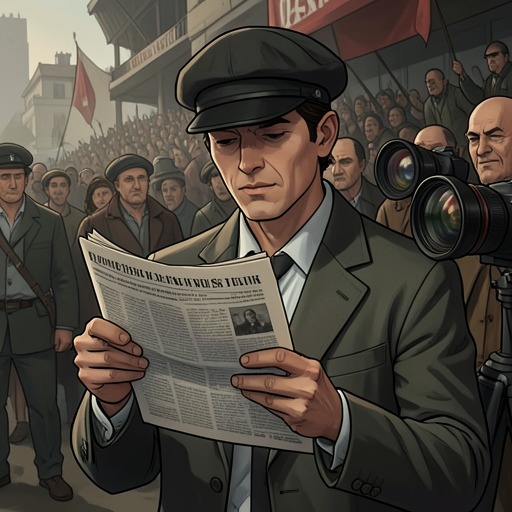
1919Newsreel collage is the novel’s recurring montage of contemporary headlines, news fragments, advertising slogans, and popular song lyrics. By interrupting the characters’ separate narratives with public language in rapid, sometimes jarring succession, it makes history felt as a stream of competing messages rather than a settled account. The fragments do not resolve into a single plot; their collisions expose the institutions and conflicts pressing on ordinary lives.
Form and Placement
The Newsreels interrupt the movement of the characters’ lives with material drawn from the public world. The novel’s formal design sets those collages alongside continuous character narratives, brief biographies of prominent figures, and the inward passages of The Camera Eye. Each mode offers a different scale of attention: the fictional lives move through circumstances, the biographies mark historical figures as landmarks, and the Newsreels flash fragments of the contemporary landscape into view. Their abruptness is part of their effect. A headline, a dispatch, a slogan, and a song lyric can arrive in quick succession without being reconciled into a narrator’s explanation.
That structure matters in a book whose many ordinary characters are shaped by institutions and caught in history, yet do not share a single heroic plot. The Newsreels place public events and popular language beside the characters’ individual trajectories, allowing the reader to register a historical pressure that no one character can encompass. The montage therefore does more than supply period detail: its discontinuities are a way of organizing the novel’s account of a society experienced through fragments.
Contradictory Public Messages
Newsreel XLI places an account of British Colonial Office telegrams beside a report on Count von Brochdorf-Ranzau’s physical weakness and the headline PRIVATES HOLD UP CABMAN. The dispatch explains that early-arriving press messages may be buried at the bottom of baskets while later ones, piled on top, are handled first; it adds that this should not be taken as an insult. The mundane explanation of how messages are sorted sits beside diplomatic and street-level news, making the circulation of information itself visible. What reaches the public is not simply what happened: it also depends on procedures, delay, and selection.
Other fragments in the same sequence turn abruptly toward social anxiety and wartime uncertainty. A notice declares that evening gowns are demoralizing the youth of the land; another reports that soldiers overseas fear losing gold, followed by a headline calling conscription a puzzle. Their proximity does not offer a common argument or authoritative verdict. Instead, the juxtaposition lets cultural policing, material concern, and the machinery of conscription occupy the same news field. The ordinary and the consequential are pressed together, without a transition that would make the contrast comfortable.
War, Labor, and Institutional Power
Newsreel XLII puts a report of a gala day in Seattle beside news of crowds, guardsmen, machine guns, and an order to fire after the guardsmen’s inaction supposedly endangered them. The same collage carries a statement from the president of Harvard University urging students to serve as strikebreakers. His appeal invokes public service, order, and the laws of the Commonwealth. Set against the report of armed force and the pressure of a labor conflict, the university’s formal language becomes part of the political scene rather than a detached explanation of it. Institutional authority speaks in the same space where force is being reported.
The collage’s arrangement makes the relationship between labor conflict and official power visible without turning it into a continuous scene. A headline about electricity being cut off and another about armies fighting for Kyiv broaden the field again, abruptly shifting from a local dispute to other public crises. Such changes in scale are characteristic of the form: the reader moves among civic order, industrial conflict, and international struggle without the assurance that one will be given priority or explained by the next.
Newsreel XLIII carries a report of radicals whose placards are taken away and whose clothing is torn and eyes blackened by service and ex-service men. The treatment is presented as a brief public report, not as an extended account from the demonstrators’ point of view. Nearby fragments include reports of deaths from wood alcohol and the possible interruption of trains in France. That juxtaposition is not a claim that the events are equivalent; it shows how political violence enters a crowded stream of news alongside other crises. The collage registers the presence of repression while withholding the kind of sustained narrative that might make any one fragment feel safely resolved.
The Public Voice and the Camera Eye
The Newsreels’ materials include more than news reporting. Advertisements, slogans, and popular lyrics bring the persuasive and emotional languages of everyday life into the collage. Their inclusion keeps the public record from seeming purely factual: the reader encounters not only reports about events but also the phrases through which institutions and popular culture address, reassure, admonish, or mobilize the public. In one late passage, the slogan KEEP THE BOYS FIT TO GO HOME appears amid a first-person account of repetitive labor loading scrap iron. The contrast between an uplifting promise and exhausting work belongs to The Camera Eye, not to a Newsreel, but it clarifies the distinctness of the two modes: both interrupt the surrounding narrative, while one foregrounds subjective sensation and the other assembles circulating public language.
The Camera Eye’s passages are marked as an individual consciousness at work; the Newsreels instead collect fragments that have already entered public circulation. The contrast prevents the collage from being mistaken for an impartial overview. Its materials are selected and placed, and their meaning emerges through adjacency as much as through any fragment alone. The result is a form of historical attention that can show a crowd, a policy, a slogan, and a report in collision, while refusing the comfort of a single voice that would explain them all.
Narrative and Political Significance
The Newsreels give the novel a second, discontinuous rhythm beside the characters’ unfolding lives. Rather than building toward a unified resolution, the collage repeatedly interrupts and reorients attention. Its newspaper fragments can be bureaucratic, sensational, or violent; its slogans and lyrics can sit beside them without smoothing their differences. The reader must make connections across the cuts, and those connections reveal the reach of public institutions into daily experience.
This form suits a novel in which history advances through many lives rather than through one central hero. The collages make the surrounding world palpable not as a stable backdrop but as a noisy arrangement of claims, reports, and commands. In their quick shifts—from the handling of telegrams to conscription, from strikebreaking to street violence—the Newsreels create meaning through contrast. Their fragmentation is not an escape from history: it is the means by which the novel presents a society whose events and messages exceed any single character’s ability to gather them into a complete account.