Antiwar pacifism
1919Antiwar pacifism is presented as a political conviction tested by war, rather than as a position safely held apart from public life. Fanya Stein gives it an organized, explicitly peaceful form through her work for women’s peace organizations and her delegation’s attempt to reach Woodrow Wilson. Ben Compton turns opposition into a more precarious practice: he registers as a conscientious objector, refuses to support the war, and continues to speak even as protest brings dismissal, arrest, and bail conditions. His revolutionary rhetoric complicates the meaning of his refusal, making the distinction between resisting a war and rejecting violence itself central to the concept’s portrayal.
Peace Work and the Declaration of War
Fanya Stein’s pacifism is expressed through practical support for organized peace work. She reads Tolstoy and Kropotkin with Ben and sends money to women’s peace organizations. Her conviction that Wilson would keep the United States out of the European war gives way abruptly when he declares war. Fanya responds with a hysterical crying fit; the political reversal is registered not as an abstract change of policy but as a collapse of the hope on which her activism had rested.
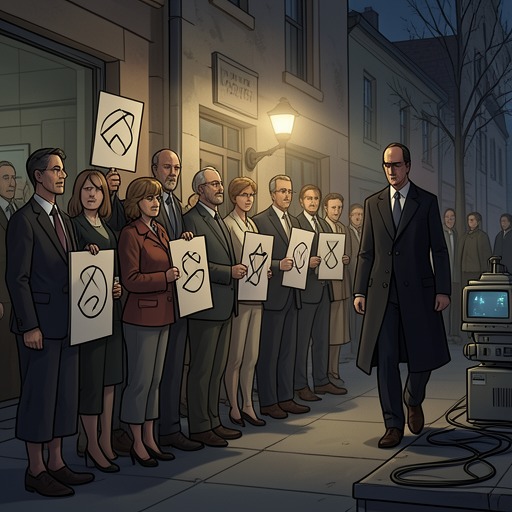
The day before the declaration, Fanya had returned from Washington, where she had gone with a women’s peace delegation to try to see the President. Detectives drove the delegates from the White House lawn, and several girls were arrested. The scene places peaceful petition directly against state control of access and public space: the delegation seeks a hearing, but the response it encounters is expulsion and detention. After the declaration, Fanya tells Ben that capitalists want war and predicts that its consequences may produce revolution. Her analysis links pacifism to opposition to economic power, but her immediate response remains grief at the failure of peace.
Ben leaves Fanya’s apartment to go to the socialist newspaper, and, as he departs, finds himself making a spitting noise like his father. He tells himself he will never go there again. The gesture marks a break in the intimate exchange: Fanya has asked him to stay, while Ben returns to political work. His antiwar commitment is therefore not simply a shared feeling with Fanya; it becomes a separate course of action, one that increasingly exposes him to institutional punishment.
Conscientious Objection Under Pressure
On Morris Stein’s advice, Ben registers for the draft and writes conscientious objector on his registration card. The act places his refusal inside the very process that could compel him to serve: he complies with registration while identifying his opposition on the card. Soon afterward, he and Morris disagree about what can be done. Morris advises bowing before the storm; Ben insists that he will agitate against the war until he is jailed. The disagreement costs him his position in Morris’s office and ends his law studies. His objection is not a private exemption from political conflict but a commitment he intends to make publicly, despite its immediate consequences.
The pressures extend beyond the state. Ben cannot return to work at a drugstore because its owner fears a police raid if a radical is employed there. His brother, who earns good money in a munitions factory, urges him to give up his opposition and take a job; even Gladys calls his effort futile. In Passaic, Ben finds shipping work at a mill whose workforce is depleted by the draft and whose employees are working overtime. Around him, wartime employment and consumer purchases offer a material inducement to accept the new order. The novel sets that apparent return to ordinary prosperity against the disappearance of radical institutions and the suspension of a newspaper, showing the social costs of maintaining dissent as well as its financial ones.
Ben’s refusal becomes visible when a warworker seeks to sign up everyone in the shipping department for a Liberty Bond. Pressed to preserve the department’s perfect record and warned that refusal could make him look pro-German or pacifist, Ben says that he does not believe in capitalist war and will not help support it. The exchange turns a bond drive into a test of loyalty: resistance is framed as a blemish on a collective record, then as evidence of suspect allegiance. A police officer checks Ben’s registration card that evening and reluctantly accepts it as valid, but by week’s end Ben has been fired without explanation. His card protects him from one immediate accusation; it does not protect his livelihood.
From Flight to Public Protest
Fear of prosecution under the Espionage Act drives Ben and Helen Mauer from Passaic to New York. Ben believes that his remarks against capitalist war could bring charges, and he refuses to spend another night in their room. They have about a hundred dollars between them and rent a room on East 8th Street under the name Mr. and Mrs. Gold. The move initially looks like retreat, but news from Petrograd changes Ben’s decision. After reading that the Maximalists have taken power under the slogan All Power to the Soviets, he tells Helen that he will face jail rather than flee to Mexico. Her support matters to his resolve: he acknowledges that he might have acted cowardly without her, and insists that a person cannot stand alone.
The couple then helps arrange a meeting at the Empire Casino to send greetings to the new workers’ and peasants’ government. Surveillance and obstruction shape the event from the outset. Federal agents sit in the front row with a stenographer; police close the doors after the first few hundred people enter, while officers break up the crowd outside. Soldiers and sailors enter the gallery and watch the speakers. The meeting’s purpose is a public expression of solidarity, but its setting makes clear that even the gesture is being monitored and contained.
When Ben speaks, he says that the government agents in the audience prevent him from saying everything he wants to say. He argues that capitalist governments drive people into a war that benefits bankers and munitions makers, and predicts that workers will learn to use the guns with which profiteers are instructing them. Police interrupt the meeting, arrest Ben and others, and require men of conscription age to show their registration cards before leaving. Ben’s speech makes the limits of his pacifism explicit: he opposes the existing war, but his vision of revolutionary resistance includes the possibility of armed force. The narrative does not equate conscientious objection with a settled rejection of every form of violence. Instead, it shows antiwar politics crossing into a more radical argument about who controls force and for what ends.
Repression, Compromise, and the Unresolved Refusal
Ben is held for three days without food or water in a disused office in the Federal building on Park Row. Detectives question him in rotating groups, at times cajoling or threatening him; one group brings rubber hose, though they do not beat him. After he confronts them, they bring him water and stale ham sandwiches. The interrogation turns his speech into a bodily ordeal, making the enforcement of wartime loyalty concrete rather than merely legal. Later, an elderly official questions him in a well-appointed office, and Morris Stein arrives as his lawyer.
Morris tells Ben that the charges can be quashed if he promises to report for military training, since his draft number has been called. Ben answers that, if released, he will continue opposing capitalist war until he is arrested again. The offer makes the state’s desired settlement plain: release in exchange for compliance and silence. Ben will not promise to abandon his position. He is instead released on fifteen thousand dollars bail, with Morris assuring the authorities that he will do no agitating until trial; the Steins do not tell Ben who supplied the bail. The result is neither acquittal nor a definitive victory for his protest. His freedom is conditional, and his public activity is restrained by the terms that secure it.
Afterward, the Steins give Ben a room, feed him, and try to restore him with wine and milk. He sleeps, reads, and withdraws from discussion of his case, telling Morris that he no longer cares what is done and that he might as well be in jail. Helen calls, but he does not ask her to visit. The account leaves him in this suspended state rather than resolving the trial or his long-term objection. Across Fanya’s peace work, Ben’s registration and refusal, and the authorities’ repeated attempts to discipline speech and action, antiwar pacifism emerges as both an ethical stance and a conflict over who may define loyalty. Its force is visible in the persistence of dissent; its limits appear in the surveillance, lost work, detention, and enforced silence that follow.