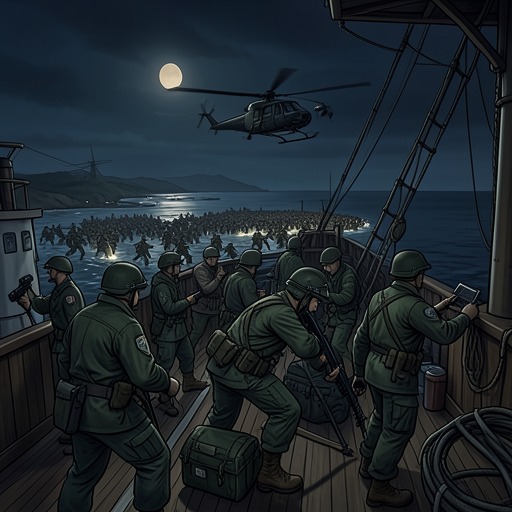
Boychenko's Forces Retreat toward Kerch
AfterburnBoychenko's Forces Retreat toward Kerch follows the rebels’ evacuation of the palace with a movement that Dmitriev recognizes as a withdrawal toward home. The estimated 1,500 fighters, mostly from the 4th Spetsnaz Fleet Brigade, take the coast road northeast to Kerch; their route gives practical meaning to Boychenko’s promise that they would be allowed to go home. The episode marks a change in the immediate stakes: the question is no longer only who holds the palace, but where the departing force is headed and whether its departure fulfills that promise.
The Palace Evacuation and the Road North
The report reaches Dmitriev after the helicopters have left. He is told that the rebel forces have evacuated the palace as well and appear to be retreating up the coast road. The sequence matters: the palace’s evacuation follows the helicopters’ departure, while the rebels’ movement is presented as a separate development that Dmitriev must interpret. The report estimates that about 1,500 fighters are on the road, most of them from the 4th Spetsnaz Fleet Brigade.
Dmitriev responds as if the news has struck him physically, then gets up to study the map. The map distinguishes the routes of his own forces from those of the rebels and marks the American fleet’s movements in broad blue strokes. This is not simply a report of a unit changing position. Dmitriev is trying to read the retreat against the geography and military situation around it, with the coast road becoming the clue that makes the rebels’ destination legible.
Kerch as Destination
Dmitriev follows the coast road northeast toward Feodosiya and then traces its direction to Kerch. At that point, the strait separating Crimea from the Taman Peninsula and Russia proper is only five kilometers wide. The route therefore points beyond a local retreat: Kerch offers a way toward the mainland and makes the scale of the movement clear to him.
His repeated identification of the coast road as the key detail turns uncertainty into recognition. He concludes that the fighters are going to Kerch and, in his understanding, going home as Boychenko promised them. Kulagin answers that they have won. The exchange gives the movement its immediate political and military meaning, but it also makes clear that this is Dmitriev’s interpretation of the rebels’ destination and of what their departure signifies.
Cover and the Wider Operational Strain
The retreat unfolds under continuing American air cover. A report says carrier aircraft are providing protection for the rebels, while Dmitriev’s aircraft have not been able to get close enough to attack. Their movement is therefore not described as an unopposed march: the account places it within a contested air situation in which the American presence limits Dmitriev’s options.
The wider campaign also shows how dependent the American carrier group is on replenishment. Although Jefferson is nuclear-powered and does not need fuel for its own propulsion, its aircraft consume aviation fuel and other expendables. A modern carrier requires at-sea replenishment every two to three weeks, and the group’s usable supplies can shrink to two to four days under continuous maneuvering and round-the-clock flight operations. If the Bosporus Strait closes, Jefferson and its escorts risk being trapped in the Black Sea with little ability to continue operating. These constraints do not explain the rebels’ decision to retreat, but they frame the wider contest: control of the air and movement on land take place alongside a struggle to sustain the forces involved.
Departure and Its Consequences
Later resupply efforts underscore that vulnerability in concrete terms. At a subsequent stage, fuel tested for Jefferson is judged suitable, but nearly three million gallons—about 9,000 tons—of aviation fuel still have to be pumped aboard. Flight-deck operations are suspended during the loading. The scale of the task contrasts with the five-kilometer stretch of water that defines the rebels’ apparent route toward Kerch: one movement is measured in a narrow passage home, the other in the enormous quantity of fuel needed to keep a carrier group functioning.
The retreat’s ending is consequently more than a change of position on Dmitriev’s map. The evacuated palace, the estimated 1,500 fighters on the coast road, the air cover that prevents an attack, and the destination at Kerch converge on Boychenko’s promise of return. Dmitriev reads the withdrawal as proof that the rebels are going home; the scene presents that recognition as a consequential turn in the campaign, while leaving the wider question of military control and resupply unresolved.